Response Ready helps families prepare for sudden cardiac arrest by offering FDA-approved AEDs from all six manufacturers at competitive prices. An affordable AED for home use starts at around $1,400 and gives you the power to act in those critical minutes before paramedics arrive. This guide compares the top models for 2026 and walks you through choosing the right one for your household.
Key Takeaways
- Home AEDs start at $1,411 in 2026. The HeartSine Samaritan PAD 350P is the most budget-friendly FDA-approved option, while value packages from multiple brands range from $1,461 to $2,367.
- Every FDA-approved AED is designed for untrained users. Voice prompts, visual guides, and automatic heart rhythm analysis mean anyone in your household can operate the device effectively during an emergency.
- Long-term costs matter as much as the purchase price. Factor in replacement pads ($50 to $230) and batteries ($100 to $310) every 2 to 5 years. Value packages bundle these accessories and save you money over time.
Get certified in CPR
Adult & Pediatric First Aid/CPR/AED — Blended Learning
Self-paced online + in-person skills check. 2-year certification.
CPR, AED & First Aid Certification
Instructor-led on-site. Practice on real manikins and AED trainers.
What Is an Affordable AED for Home Use?
An affordable AED (automated external defibrillator) for home use is a portable, FDA-approved device that analyzes heart rhythm and delivers an electric shock to restore normal heartbeat during sudden cardiac arrest. Home AED models cost between $1,411 and $2,400, weigh 2 to 7 pounds, and are designed so anyone in a household can operate them with zero medical training. These devices use voice prompts and visual guides to walk users through each step, and they will only deliver a shock when the heart rhythm requires it.
What Makes a Home AED a Smart Investment?
Sudden cardiac arrest strikes more than 350,000 Americans outside of hospitals each year. Survival rates drop roughly 10% for every minute without defibrillation. When you live more than a few minutes from the nearest fire station or hospital, a home AED closes that gap.
An AED for home use is not the same as a professional hospital defibrillator. Home models are lightweight (typically 2 to 5 pounds), fully automatic or semi-automatic, and built for people with zero medical training. They analyze heart rhythm and deliver a shock only when medically necessary, so you cannot accidentally harm someone.
The real question is not whether you need one. It is which model gives you the best combination of reliability, ease of use, and total ownership value for your budget. For a complete breakdown of AED pricing across all brands, see our AED cost guide for 2026.
Who Should Buy a Home AED?
A home AED is a smart purchase for several groups of people. Consider buying one if any of the following apply to your household:
- Families with a history of heart disease. If anyone in your home has been diagnosed with a heart condition, coronary artery disease, or has had a previous cardiac event, having an AED within reach can be the difference between life and death.
- Households with older adults. The risk of sudden cardiac arrest increases significantly after age 45. Homes with aging parents, grandparents, or elderly relatives benefit from immediate defibrillation access.
- People who live in rural or remote areas. When EMS response times exceed 8 to 10 minutes, a home AED fills the gap. Every minute without defibrillation reduces survival odds by roughly 10%.
- Active families and home gym users. Strenuous exercise can trigger cardiac events even in seemingly healthy individuals. Having an AED near your home gym or workout area adds a layer of protection.
- Hosts of frequent gatherings. If you regularly entertain guests, host events, or run a home-based business with visitors, an AED protects everyone on your property.
If you are unsure which AED fits your situation, check our guide to the best AEDs for home use for a broader comparison.
What Is the Cheapest FDA-Approved AED for Home Use?
The lowest advertised price is only one part of choosing an affordable AED for home use. In 2026, budget-friendly FDA-approved models generally start near $1,411 before optional carrying cases, replacement pads, batteries, wall cabinets, and training. A lower upfront price can be a strong fit when the device is simple to operate, has clear voice prompts, and comes from a manufacturer with reliable replacement supplies.
For most households, the best value is the AED that balances purchase price, warranty length, pad and battery replacement cost, and confidence during a real emergency. HeartSine, Philips, Defibtech, and ZOLL all offer home-friendly options, but the right choice depends on who may use the device, where it will be stored, and whether children may need pediatric capability.
Best Affordable AEDs for Home Use in 2026
Response Ready carries AEDs from all six FDA-approved manufacturers. Here are the four most popular models for home buyers, ranked by starting price. All prices reflect current 2026 retail pricing on responseready.com.
| Model | Starting Price | Value Package | Weight | Key Feature | Best For |
|---|---|---|---|---|---|
| HeartSine Samaritan PAD 350P | $1,411 | $1,461 | 2.4 lbs | IP56 dust/water resistance | Budget-conscious buyers |
| Defibtech Lifeline AED | $1,478 | $1,539 | 2.8 lbs | Simple 2-button operation | First-time AED owners |
| Philips HeartStart OnSite | $1,529 | $1,579 | 3.3 lbs | No prescription required (OTC) | Easiest purchase process |
| ZOLL AED Plus | $2,082 | $2,142 | 6.7 lbs | Real-time CPR feedback | Families wanting CPR coaching |
HeartSine Samaritan PAD 350P
The HeartSine Samaritan PAD 350P is the most budget-friendly FDA-approved AED on the market at $1,411. It weighs just 2.4 pounds, uses a combined pad-battery cartridge (called a Pad-Pak) that simplifies maintenance, and carries an IP56 rating for dust and water resistance. The Pad-Pak design means you replace pads and battery in a single swap every four years, keeping long-term costs predictable.
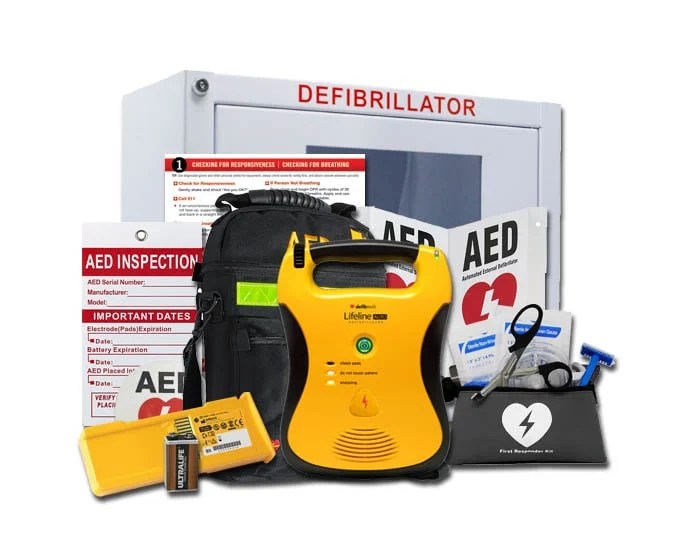
Defibtech Lifeline AED
The Defibtech Lifeline AED is a strong choice for first-time buyers at $1,478. Its two-button interface keeps operation simple under stress. The device runs automatic self-checks daily to confirm readiness, and its status indicator light gives you a quick visual check without opening the case. Battery life runs up to seven years, which is among the longest in this price range.
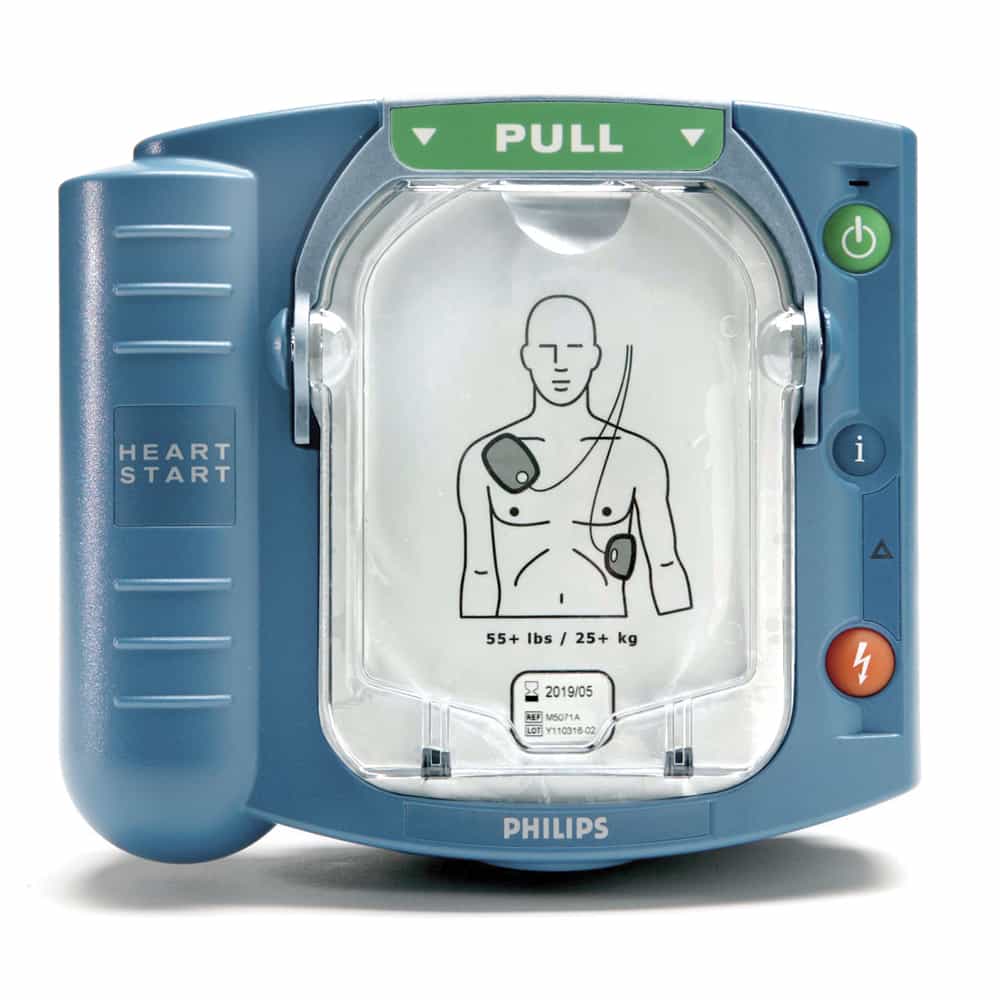
Philips HeartStart OnSite
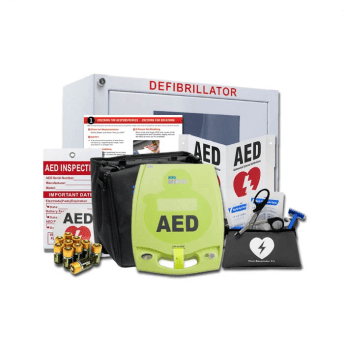
The Philips HeartStart OnSite is the only AED with FDA approval for over-the-counter sale, meaning you can purchase it without a physician’s prescription. At $1,529, it sits in the mid-range for home AEDs. Calm, step-by-step voice instructions guide you through pad placement and CPR. The OnSite Value Package at $1,579 includes a carry case, extra pads, and a first responder kit.
ZOLL AED Plus
The ZOLL AED Plus stands out with real-time CPR feedback that monitors compression depth and rate, coaching you to deliver effective chest compressions. At $2,082 it is the priciest option on this list, but the CPR coaching feature can genuinely improve survival outcomes. Real-time CPR feedback is something emergency medicine professionals consider essential.
Need help choosing the right AED for your home? Response Ready can compare models, explain replacement costs, and help you build a complete home emergency setup.
How to Choose the Right AED for Your Home
Picking between these models comes down to four factors: your budget, who will use it, where you will store it, and how much ongoing maintenance you want to manage.
- Budget under $1,500: The HeartSine 350P or Defibtech Lifeline are your best options. Both deliver reliable performance at the lowest total cost.
- Simplest buying process: The Philips OnSite requires no prescription, so you can order and receive it without any paperwork.
- CPR coaching matters to you: The ZOLL AED Plus provides real-time feedback on your chest compressions, which studies show improves CPR quality.
- Harsh storage conditions: If your AED will live in a garage, boat, or RV, the HeartSine’s IP56 rating gives it the best protection against dust and moisture.
Every AED on this list comes from an authorized manufacturer, includes a warranty, and ships with the pads and battery needed to be rescue-ready out of the box. Response Ready also offers free shipping on orders over $99 and a 30-day money-back guarantee.

RECOMMENDED
HeartSine Samaritan 350P AED Package
Compact, fully-automatic AED designed for first-time responders. Pads, battery, carry case and wall sign included.
How Much Does a Home AED Cost? Price Breakdown for 2026
The cost of an AED for home use depends on the brand, model, and whether you choose a standalone unit or a value package. Here is a quick breakdown of what to expect in 2026:
- Budget-friendly AEDs ($1,400 to $1,550): The HeartSine 350P and Defibtech Lifeline fall in this range. These models deliver reliable performance at the lowest purchase price.
- Mid-range AEDs ($1,550 to $2,100): The Philips OnSite and Physio-Control LIFEPAK CR2 offer additional features like OTC availability or pediatric capability at a moderate step up in price.
- Premium AEDs ($2,100 to $2,400): The ZOLL AED Plus and ZOLL AED 3 include advanced features like real-time CPR coaching and WiFi connectivity for remote monitoring.
- Refurbished AEDs ($800 to $1,200): Professionally refurbished AEDs offer a lower upfront cost while still meeting safety and performance standards.
Looking for the best price on a specific brand? Browse our guide on where to buy an AED for home use to find the right deal.
How Long Do Home AED Pads and Batteries Last?
Most AED pads and batteries have expiration dates, even when the device has never been used. Pads commonly last two to four years, while batteries vary by model and standby conditions. These replacement cycles matter because a home AED must be ready before an emergency, not merely affordable on the day you buy it.
When comparing AED prices, write down the expected replacement schedule for adult pads, pediatric pads if needed, and the battery. A device with a slightly higher upfront price may cost less over time if supplies last longer or are easier to replace. Response Ready can help you estimate the total ownership cost before you choose a model.
Where Should Families Keep an AED at Home?
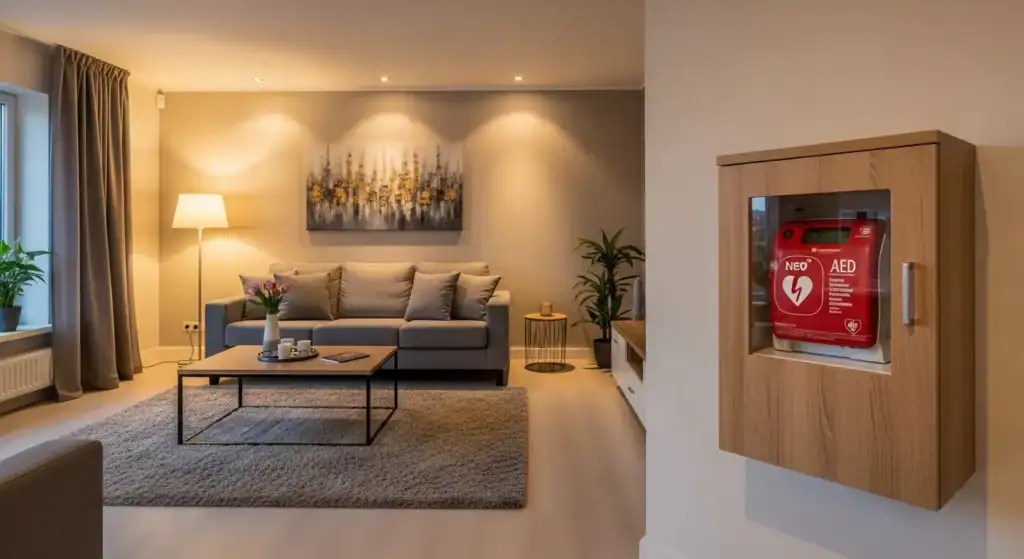
Store the AED where family members and visitors can find it quickly, such as a main hallway, kitchen-adjacent wall, entry area, or another central location. Avoid locked closets, garages with extreme temperatures, or places where the device could be hidden behind household items. The best location is visible, consistent, and easy to explain to babysitters, relatives, neighbors, and caregivers.
If the AED will be used in a larger home, guest house, pool area, or home gym, consider whether one central device is enough. The goal is fast access during the first minutes of sudden cardiac arrest. A visible cabinet, clear signage, and a short family walkthrough can make the device easier to use under pressure.
Do You Need a Prescription to Buy a Home AED?
Most AEDs are FDA Class III medical devices that require a physician’s prescription. This sounds like a barrier, but authorized retailers like Response Ready handle the prescription process for you at no extra charge. The one exception is the Philips HeartStart OnSite, which has FDA approval for over-the-counter sale and can be purchased without any prescription.
Understanding the Total Cost of Ownership
The sticker price is only part of the equation. Every AED requires periodic replacement of electrode pads and batteries. Here is what to expect:
- Electrode pads: $50 to $230 depending on brand. Replace every 2 to 5 years or after any use.
- Batteries: $100 to $310 depending on model. Typical lifespan is 4 to 7 years.
- Value packages save money: Buying an AED value package that includes a carry case, signage, extra pads, and a first responder kit often saves 10% to 15% compared to buying components separately.
- HSA and FSA eligible: AEDs qualify as medical devices under IRS guidelines, so you can use pre-tax health savings or flexible spending account funds.
Response Ready’s AED rental program starting at $45 per month is another path if you prefer to spread the expense over time with full maintenance and replacement supplies included.
Where to Store Your AED at Home
Place your AED in a central, visible location that every household member can reach within 60 seconds. Good spots include the main hallway, kitchen wall, or near the front entrance. Avoid closets, locked cabinets, or rooms that might be hard to access in a panic. Wall-mounted AED cabinets with signage make the device easy to find for anyone, including guests or babysitters.
Are Home AEDs FDA Approved and Safe to Use?
Yes. Every AED sold by Response Ready is FDA approved and cleared for home use. The FDA regulates AEDs as Class III medical devices, which means each model has undergone rigorous clinical testing to demonstrate safety and effectiveness. These devices are engineered with multiple safeguards: they analyze the patient’s heart rhythm before allowing a shock, and they will not deliver a shock unless a life-threatening arrhythmia is detected. You cannot accidentally harm someone with a home AED.
All six FDA-approved AED manufacturers produce models specifically designed for non-medical users. The combination of automatic heart rhythm analysis, clear voice prompts, and visual instructions means any adult in your household can operate the device effectively during an emergency.
Frequently Asked Questions
How much does an affordable AED for home use cost in 2026?
Home AEDs range from $1,411 for the HeartSine Samaritan PAD 350P to around $2,300 for advanced models like the ZOLL AED 3. Value packages that include a carry case, extra pads, signage, and a first responder kit start at $1,461. AEDs are HSA and FSA eligible, and Response Ready offers AED rental programs starting at $45 per month.
Can anyone use a home AED without medical training?
Yes. Every FDA-approved AED is designed for use by people with no medical background. The device provides step-by-step voice instructions, analyzes the patient’s heart rhythm automatically, and will only deliver a shock if it detects a life-threatening arrhythmia. You cannot accidentally shock someone who does not need it.
Do I need a prescription to buy an AED for my home?
Most AEDs require a physician’s prescription because they are classified as FDA Class III medical devices. Response Ready handles this paperwork for you at no extra cost. The Philips HeartStart OnSite is the one exception; it has FDA approval for over-the-counter sale and requires no prescription at all.
What is the cheapest AED you can buy for home use?
The cheapest new, FDA-approved AED for home use is the HeartSine Samaritan PAD 350P at $1,411. If you are open to refurbished options, professionally recertified AEDs from authorized dealers start at around $800 to $1,200 and come with new pads, batteries, and a warranty.
What maintenance does a home AED require?
Home AED maintenance is minimal. Most devices run automatic daily or weekly self-checks and display a status light indicating readiness. You need to replace electrode pads every 2 to 5 years and batteries every 4 to 7 years, depending on the model. Response Ready’s AED Total Solution program tracks these dates and sends reminders so you never miss a replacement.
Is a refurbished AED a safe option for home use?
Professionally refurbished AEDs from an authorized dealer are safe and reliable. These devices are thoroughly inspected, tested to manufacturer specifications, and fitted with new pads and batteries. They typically come with a warranty. Refurbished AEDs are a practical way to get a life-saving device at a lower upfront cost without sacrificing performance.
Where should I store my AED at home?
Store your AED in a central, visible location where every household member can find it in under 60 seconds. A hallway wall, kitchen, or area near the front door are common choices. Avoid locked cabinets or hard-to-reach closets. Wall-mounted AED cabinets with signage ensure guests and visitors can locate it quickly during an emergency.
What is the difference between semi-automatic and fully automatic AEDs?
A semi-automatic AED analyzes the heart rhythm and instructs you to press a button to deliver the shock. A fully automatic AED delivers the shock on its own after a countdown. Both types are safe and effective for home use. Semi-automatic models give you a moment to ensure no one is touching the patient before the shock is delivered.
Can I use my HSA or FSA to buy a home AED?
Yes. AEDs are classified as medical devices under IRS guidelines, which makes them eligible for purchase with Health Savings Account (HSA) and Flexible Spending Account (FSA) funds. This effectively reduces your out-of-pocket cost by allowing you to pay with pre-tax dollars.
What is the best price for an AED in 2026?
The best AED prices in 2026 start at $1,411 for a new HeartSine 350P or $1,461 for a value package that includes accessories. Response Ready price-matches authorized competitors and offers free shipping on orders over $99. For the full pricing comparison across all brands, see our complete AED cost guide.
Does Response Ready offer support after I purchase an AED?
Yes. Response Ready provides lifetime support including a post-event loaner program at no cost, replacement supply reminders, and access to the AED Total Solution compliance management platform. The company also offers CPR and AED training through a nationwide instructor network so your whole family knows what to do in an emergency.

Not sure which AED or training fits your needs?
A Response Ready product expert walks you through it — no obligation.
Related AED Resources
Learn more about AEDs and emergency preparedness with these guides from our team:
- Best AED Buyer’s Guide – Comprehensive comparison of all 6 FDA-approved AED brands
- Best AED for Home Use – Top 5 personal defibrillators compared for home buyers
- FDA-Approved AEDs for Home – The 4 best FDA-approved models for residential use
- Where to Buy an AED for Home – A simple guide to finding the right retailer
- AED Grants and Funding – How to get a free or discounted defibrillator for your home or organization
- AED Battery Guide – Understanding battery life, replacement costs, and maintenance
- Cardiac Arrest Survival Rates – How AEDs and CPR dramatically improve your chances
- Good Samaritan Law and AEDs – Legal protections when you use a defibrillator
- How to Perform CPR – Step-by-step guide for adults, children, and infants
- Best Anti-Choking Devices – Complement your AED with a choking rescue device