Why Does Your Workplace Need an AED?
Sudden cardiac arrest (SCA) is one of the leading causes of death in the United States, claiming more than 350,000 lives each year outside of hospital settings. Approximately 10,000 of those cardiac emergencies happen in the workplace. An automated external defibrillator (AED) for the workplace can mean the difference between life and death, because for every minute without defibrillation, survival rates drop by 7% to 10%. Having a workplace defibrillator on-site reduces emergency response time from the national EMS average of 7 to 14 minutes to under 3 minutes, giving victims the best possible chance of survival.
Response Ready, an authorized distributor of all six FDA-approved AED manufacturers in the U.S., has spent more than a decade helping businesses, schools, churches, and fitness centers build life-saving AED programs. This guide covers everything employers need to know about implementing an AED for the workplace, from OSHA recommendations and state mandates to program setup, employee training, choosing the best AED for your business, and understanding liability protections.
What Does OSHA Recommend for Workplace AED Programs?
The Occupational Safety and Health Administration (OSHA) strongly recommends that employers maintain AEDs in the workplace as part of a comprehensive first aid and emergency response program. While OSHA does not currently mandate AEDs as a federal requirement, its guidelines under 29 CFR 1910.151 require employers to ensure the availability of medical personnel for advice and consultation on workplace health matters. OSHA’s best practices publication explicitly encourages employers to include AED programs wherever employees work.
OSHA’s recommendations emphasize several key components for an effective office AED program:
- Physician oversight: A licensed physician should oversee the AED program, including device selection, placement, training protocols, and post-event review.
- Written emergency action plan: The plan should include the location of each AED, the roles of trained responders, and step-by-step procedures for cardiac emergencies.
- Employee training: OSHA recommends CPR and AED training for designated responders, with refresher courses at regular intervals.
- Regular maintenance: AEDs must be inspected routinely to confirm that batteries and electrode pads are functional and within their expiration dates.
- Post-event procedures: After any AED use, the program should include protocols for device data download, psychological support for responders, and incident documentation.
Even without a federal mandate, OSHA has cited employers under the General Duty Clause (Section 5(a)(1)) for failing to provide adequate emergency medical response when employees are at known risk. For workplaces located more than 3 to 4 minutes from emergency medical services, OSHA’s guidelines are particularly relevant. Employers in remote locations, industrial facilities, and large campuses should consider AEDs a baseline safety measure, not an optional upgrade. For a broader overview of compliance requirements across all settings, read our complete AED requirements and compliance guide.
Which States Require AEDs in the Workplace?
While no federal law mandates AEDs in every business, a growing number of states have enacted legislation requiring AEDs in specific workplace settings. These state mandates vary significantly in scope. Some target specific industries like fitness centers or schools, while others apply more broadly to commercial buildings above certain occupancy thresholds. For a complete state-by-state breakdown, see our guide to AED requirements by state for businesses.
States with notable workplace AED requirements include:
| State | Where AEDs Are Required | Key Details |
|---|---|---|
| New York | Health clubs, schools, public places of assembly, dental offices | Requires trained personnel on-site during operating hours |
| California | Health/fitness facilities, specific commercial buildings | Mandatory training for designated users |
| Illinois | Fitness facilities, swimming pools, state buildings | AED registration with local EMS required |
| New Jersey | Health clubs, schools, government buildings | Requires notification to local EMS of AED placement |
| Florida | Dental offices, certain public buildings | Good Samaritan protections for AED users |
| Massachusetts | Schools, health clubs | Training and maintenance plans required |
| Oregon | Health clubs | Must maintain AED in an accessible location |
| Louisiana | Health/athletic facilities, state buildings | Requires training for all designated AED users |
Over 20 states now require AEDs in fitness centers and gyms, and 16 states mandate them in schools. For workplaces outside these specific mandates, having an AED is still considered a best practice and can reduce liability exposure significantly. This includes dental and medical offices, where patients under sedation or with pre-existing cardiac conditions face elevated risk. The trend is clear: more states are expanding AED requirements each legislative session. For employers in fitness settings, see our detailed AED requirements for gyms and fitness centers.
How Do You Set Up a Workplace AED Program in 5 Steps?
Setting up an effective AED program for your workplace does not need to be complicated. Response Ready has helped thousands of organizations implement AED programs, and the process follows five straightforward steps. A well-structured office AED program protects employees, demonstrates a commitment to safety, and can reduce workers’ compensation and liability costs.
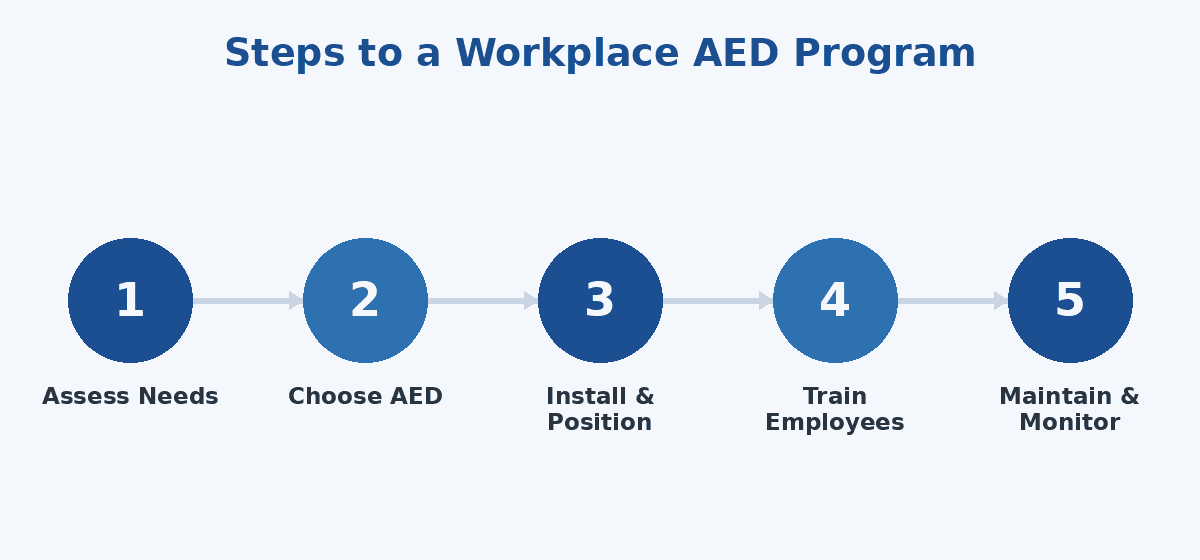
Step 1: Assess Your Workplace Needs
Start by evaluating your facility size, employee count, and average emergency response time for your location. OSHA recommends an AED be reachable within 3 to 4 minutes of any location in your building. For multi-floor offices, this typically means at least one AED per floor. Large campuses, warehouses, and manufacturing plants may need multiple units placed at strategic intervals.
Consider these factors when assessing your needs:
- Total square footage and number of floors
- Number of employees and regular visitors
- Average age of your workforce (cardiac risk increases with age)
- Distance from the nearest hospital or fire station
- Presence of high-risk activities (physical labor, fitness facilities, cafeterias)
- Existing first aid resources and trained responders
Step 2: Choose the Right AED for Your Business
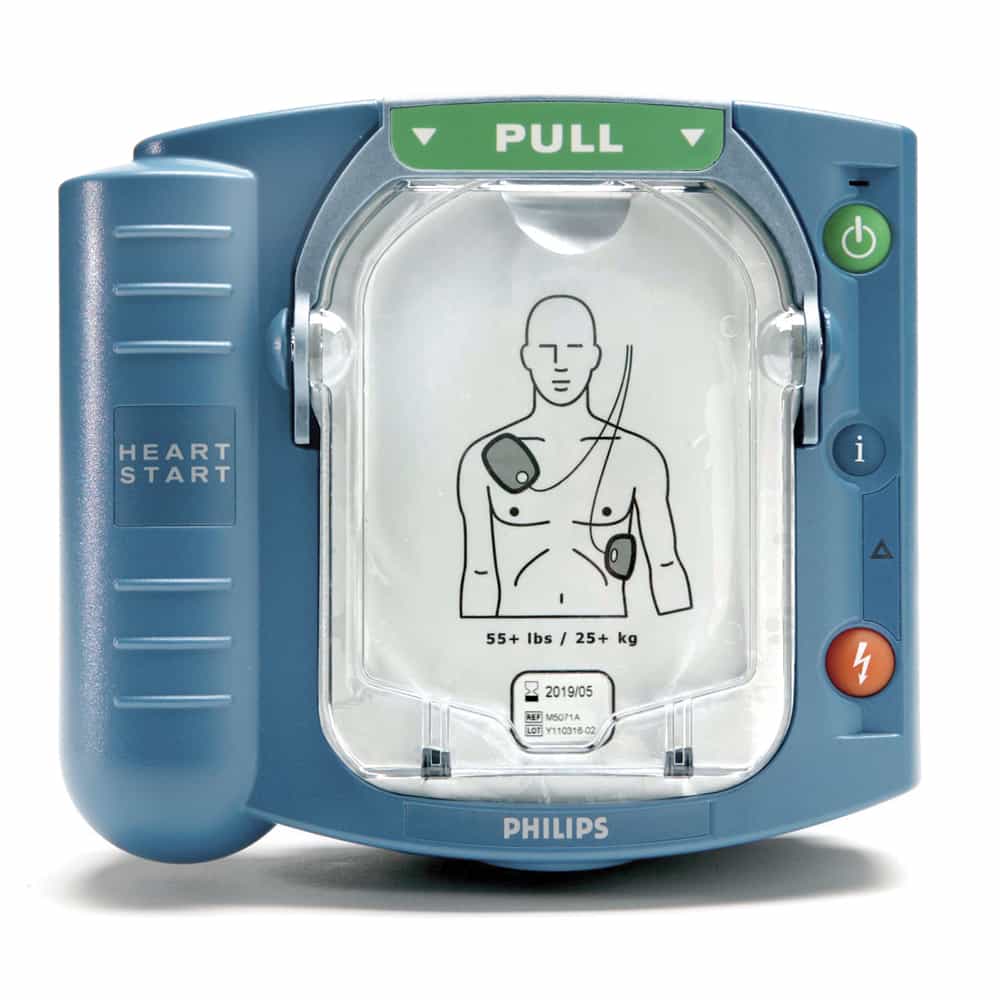
Selecting the best AED for your business depends on your environment, budget, and the training level of your staff. Response Ready carries all six FDA-approved AED brands, including Philips, ZOLL, HeartSine, Stryker/Physio-Control, Cardiac Science, and Defibtech. This allows businesses to compare options side by side rather than being limited to a single manufacturer. For a side-by-side comparison of popular workplace models, see our guide on choosing between Philips and ZOLL AEDs for workplace safety.
Key features to prioritize for a workplace defibrillator include:
- Clear voice prompts: Look for AEDs with step-by-step audio instructions that guide any user through the rescue process, even without prior training.
- Real-time CPR feedback: Models like the ZOLL AED Plus provide coaching on compression depth and rate, helping untrained rescuers perform effective CPR.
- Long battery life: Workplace AEDs should offer 4 to 5 years of standby battery life to minimize maintenance costs.
- Durability: Office environments are generally climate-controlled, but warehouse or outdoor workplaces need AEDs rated for dust and moisture resistance.
- Total cost of ownership: Factor in pad replacements, battery replacements, and long-term cost of ownership when comparing models.
Step 3: Install and Position Your AEDs
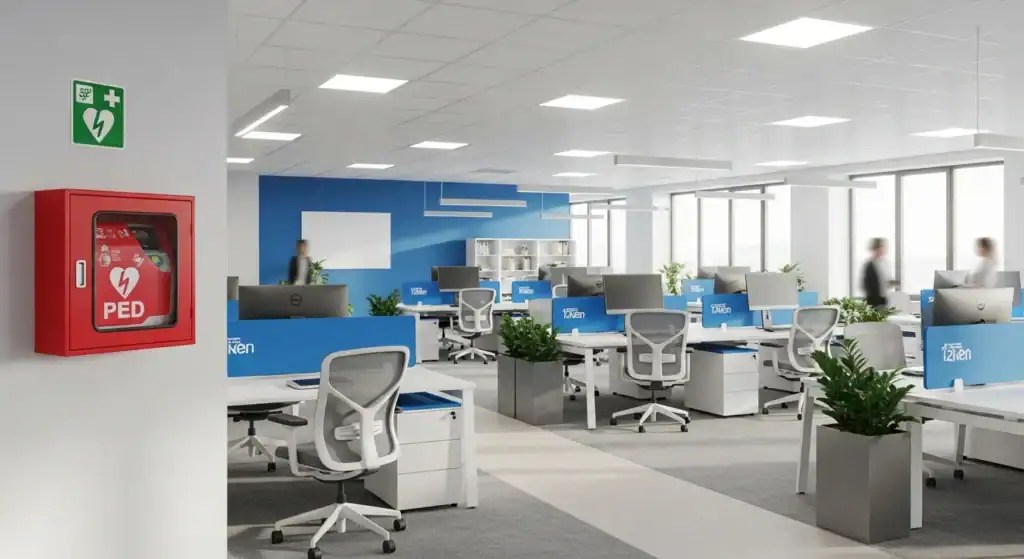
Proper placement is critical for an effective workplace AED program. The goal is to have a rescuer retrieve the AED and return to the victim within 3 minutes. Mount your AEDs in high-visibility locations using wall cabinets with alarm features to deter tampering and attract attention during emergencies.
Recommended placement locations include:
- Near main entrances and reception areas
- On each floor near elevators or central stairwells
- Adjacent to cafeterias and break rooms
- Near fitness areas or gyms within the facility
- In loading docks and warehouse areas
- Near conference rooms and large gathering spaces
Mark each AED location with clear signage visible from a distance. Include the AED locations on your building’s emergency maps and ensure all employees know where the nearest device is located.
Step 4: Train Your Employees
While AEDs are designed for use by anyone, including bystanders with no medical training, formal CPR and AED training builds confidence and improves response times. OSHA recommends that employers designate and train specific employees as first responders, with a target of having at least one trained person per floor or work area during all operating hours.
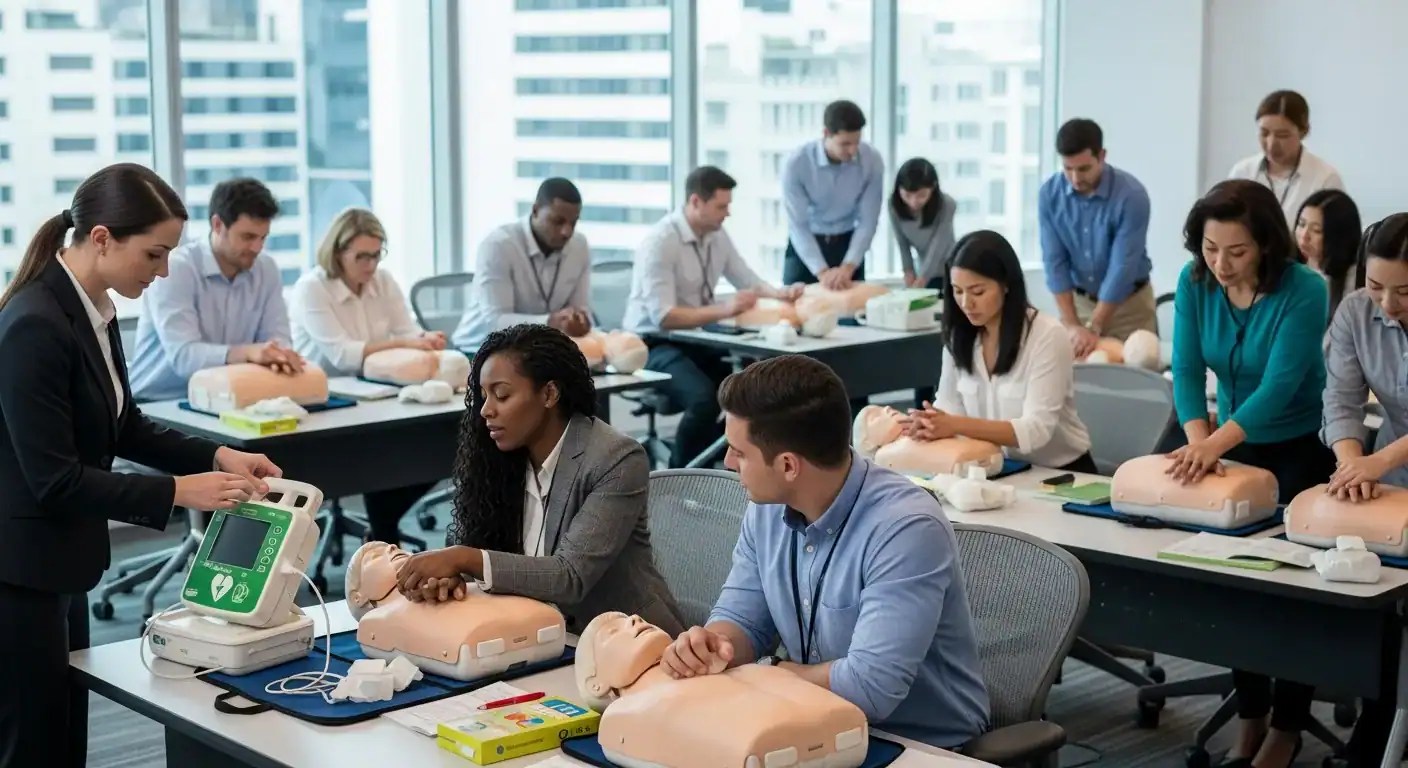
Effective workplace AED training programs include:
- Initial certification: American Heart Association or American Red Cross CPR/AED courses for designated responders (typically 2 to 4 hours)
- Annual refresher training: Hands-on practice sessions to maintain skills and confidence
- AED orientation for all employees: Brief sessions showing all staff where AEDs are located and how to activate the emergency response plan
- Scenario drills: Quarterly or semi-annual practice drills that simulate a cardiac emergency
Response Ready’s nationwide instructor network through CPR1 can provide on-site training tailored to your workplace, covering CPR technique, AED operation, and first aid fundamentals.
Step 5: Maintain and Monitor Your AED Program
An AED is only effective if it is rescue-ready when needed. Regular maintenance ensures your devices are always prepared. Most AEDs perform daily self-checks and display a status indicator (green checkmark or ready light) to confirm they have passed their diagnostic test.
Your maintenance routine should include:
- Monthly visual inspections of the status indicator light
- Tracking electrode pad and battery expiration dates
- Replacing consumables before they expire
- Documenting all inspections in a maintenance log
- Testing AED cabinet alarms quarterly
For businesses that want to simplify program management, Response Ready’s AED Total Solution program provides comprehensive compliance management for $99 per year. The program includes automated expiration tracking, replacement reminders, medical director oversight from Dr. Ann Jarris (MD, MBA, FACEP), and post-event support including loaner devices at no additional cost. For a complete inspection routine, see our AED maintenance guide.
How Do You Choose the Best AED for Your Business?
Choosing the best AED for business use requires balancing ease of use, durability, total cost of ownership, and the specific needs of your environment. Response Ready is the only distributor that carries all six FDA-approved AED brands, giving employers an unbiased comparison across the full range of available devices. AED prices typically range from $1,400 to $2,900 depending on the model and included accessories.
| Feature | Why It Matters for the Workplace | What to Look For |
|---|---|---|
| Voice Prompts | Guides untrained employees through rescue steps | Clear, loud instructions in a calm voice |
| CPR Feedback | Helps maintain effective compressions during rescue | Real-time depth and rate coaching |
| Battery Standby Life | Reduces maintenance frequency and replacement costs | 4+ years standby, easy replacement |
| Pad Shelf Life | Longer shelf life means lower ongoing costs | 2+ year electrode pad expiration |
| Weight and Portability | Enables quick retrieval and transport to the victim | Under 5 lbs with carry case |
| Dust/Water Resistance | Essential for warehouses, construction, and outdoor work | IP55 or higher rating |
| Pediatric Capability | Important for workplaces with daycare or family events | Pediatric pads or child mode |
| Warranty | Protects your investment over the device lifespan | 7 to 8 year manufacturer warranty |
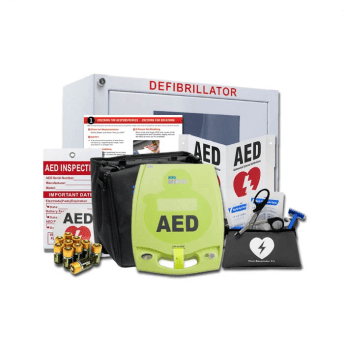
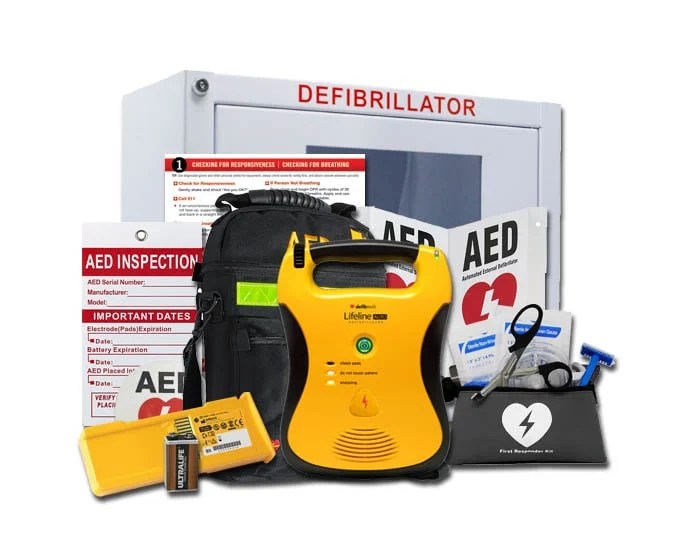
Response Ready also offers AED value packages that bundle the device with a wall cabinet, signage, a first responder kit, and inspection tags, making setup simple and cost-effective. For businesses that prefer not to purchase outright, Response Ready’s AED rental program starts at $45 per month and includes the device, all consumable replacements, and ongoing program management.
What Liability Protections Exist for Employers With AED Programs?
One of the most common concerns employers have about implementing a workplace AED program is liability. The good news is that both federal and state laws provide strong legal protections for organizations and individuals who maintain and use AEDs in good faith.
Good Samaritan Laws
All 50 U.S. states and the District of Columbia have enacted Good Samaritan laws that protect individuals who use an AED during a cardiac emergency. These laws shield bystanders, employees, and employers from civil liability when they act in good faith to help a person in cardiac arrest. The protections are strongest when the AED program includes proper training and regular device maintenance. For a detailed breakdown of how these laws work in every state, see our guide to Good Samaritan laws and AEDs.
Federal Cardiac Arrest Survival Act
The Federal Cardiac Arrest Survival Act (42 U.S.C. 238q) provides additional liability protection for entities that acquire and maintain AEDs. To qualify for these protections, organizations must ensure that their AEDs are properly maintained and tested, that expected users are trained in CPR and AED use, and that there is a connection with local EMS.
Reducing Liability Exposure
Employers who take proactive steps to implement an AED program actually reduce their overall liability compared to organizations without AEDs. Courts have increasingly recognized that the absence of an AED, rather than its presence, creates greater legal risk. To maximize your protection:
- Maintain a written AED program policy reviewed by a medical director
- Keep detailed records of all training, inspections, and maintenance
- Register your AEDs with local emergency medical services
- Ensure trained responders are available during all business hours
- Document post-event procedures and incident response
- Use a managed compliance program like AED Total Solution that provides physician oversight and compliance documentation
Frequently Asked Questions About AEDs in the Workplace
Does OSHA require AEDs in the workplace?
OSHA does not currently require AEDs in most workplaces as a blanket federal mandate. However, OSHA strongly recommends AED programs as part of comprehensive workplace first aid and emergency response plans. Employers in locations more than 3 to 4 minutes from emergency medical services should consider AEDs essential, not optional. OSHA has cited employers under the General Duty Clause for inadequate emergency medical response.
How much does a workplace AED program cost?
A workplace AED program typically costs between $1,400 and $2,900 per device, plus a wall cabinet ($70 to $150), signage, and training. Response Ready offers value packages that bundle everything together at competitive prices. For businesses that prefer monthly payments, AED rental programs start at $45 per month and include the device, maintenance, and all consumable replacements.
How many AEDs does my office need?
The general guideline is that any person in the building should be able to retrieve an AED and return to the victim within 3 minutes. For most offices, this means one AED per floor. Large facilities, warehouses, and campuses with buildings spread across multiple acres may need additional units at strategic locations throughout the property.
Can untrained employees use a workplace AED?
Yes. AEDs are designed for use by anyone, including people with no medical training. The device provides step-by-step voice instructions and will only deliver a shock when it detects a life-threatening heart rhythm. Good Samaritan laws in all 50 states protect bystanders who use an AED in good faith during a cardiac emergency. However, formal training is recommended because it builds confidence and improves response times.
What happens if someone uses our workplace AED and the patient does not survive?
Good Samaritan laws protect both the rescuer and the employer from civil liability when an AED is used in good faith. The survival rate for cardiac arrest without any intervention is approximately 10%. Using an AED significantly improves outcomes, but survival is never guaranteed. Courts consistently recognize that attempting to help with an AED is legally protected, and that having an AED demonstrates a commitment to employee safety.
How often should workplace AEDs be inspected?
Workplace AEDs should receive a brief visual inspection at least once per month. Check the device’s status indicator to confirm it has passed its self-test, verify that electrode pads and batteries have not expired, and ensure the AED is in its designated location. Response Ready’s AED Total Solution program automates these compliance checks and sends reminders when consumables are approaching their expiration dates.