Why Your Workplace Needs an AED
Every year, more than 350,000 people in the United States experience sudden cardiac arrest (SCA) outside of a hospital. Many of these events happen at work, where adults spend a significant portion of their waking hours. A workplace AED gives your team the power to respond in the first critical minutes, before emergency services can arrive. For every minute that passes without defibrillation, the chance of survival drops by 7% to 10%. Having an automated external defibrillator on-site can raise survival rates from under 10% to as high as 70% when used within the first few minutes.
Explore Response Ready’s workplace AED packages to find the right fit for your office.
Response Ready is the only distributor in the United States that carries all six FDA-approved AED brands, giving business owners and office managers a single source for every major device on the market. Whether you manage a small office or a large corporate campus, this guide covers everything you need to know about buying, placing, and maintaining a workplace defibrillator program that keeps your team safe and your organization compliant.
Does OSHA Require AEDs in the Workplace?
The Occupational Safety and Health Administration (OSHA) does not have a specific regulation that mandates AEDs in every workplace. However, OSHA’s General Duty Clause (Section 5(a)(1)) requires employers to provide a workplace “free from recognized hazards that are causing or are likely to cause death or serious physical harm.” Because sudden cardiac arrest is a well-documented risk in any setting where people gather, many safety professionals and legal experts recommend that employers treat AED placement as a best practice under this clause. OSHA has also published guidance encouraging employers to include AEDs as part of their first aid programs, particularly in workplaces where emergency medical response times may exceed five minutes. Incorporating AEDs into your written emergency action plan ensures that designated responders know where devices are located and how to use them.
Which States Require Workplace Defibrillators?
While federal law stops short of a blanket mandate, a growing number of states have enacted their own AED requirements for certain types of workplaces and public-access buildings. Read our detailed AED requirements by state guide for the full breakdown. Requirements vary by state, but here are some common patterns:
- Fitness centers and health clubs: More than 20 states require gyms and fitness facilities to have AEDs on-site.
- Schools: At least 16 states mandate AEDs in K-12 schools, and several others strongly recommend them.
- Government buildings: Some states require AEDs in state-owned or public-access buildings.
- Large employers: A handful of states require businesses above a certain employee threshold to maintain AED programs.
Here are a few specific examples of how state laws apply to workplaces:
- New York: Public places of assembly with a capacity of 300 or more must have AEDs on-site. Health clubs and general hospital settings are also required to maintain AED programs under New York Public Health Law.
- California: Health studios and fitness facilities must have AEDs under California Health and Safety Code Section 104113. California also provides strong Good Samaritan immunity for trained AED users under Civil Code Section 1714.21.
- Illinois: Physical fitness facilities must have at least one AED on the premises and at least one employee on-site trained in CPR and AED use. The state also requires AEDs in all public schools.
Penalties for noncompliance vary by state but can include fines, increased civil liability in the event of an incident, and loss of Good Samaritan protections for the organization. Staying informed about your state’s requirements is critical to reducing legal exposure.
Good Samaritan protections in most states shield trained AED users from civil liability when they act in good faith during an emergency. Response Ready maintains a comprehensive state-by-state AED legislation guide to help you understand the specific requirements where your business operates.
Learn how Response Ready’s AED Total Solution keeps your program compliant year-round.
How to Choose the Right AED for Your Office
Selecting a workplace AED comes down to matching the device to your environment, your team, and your budget. Response Ready carries all six FDA-approved AED manufacturers, so you can compare every option in one place. Here are the key factors to evaluate:
Ease of Use
Most workplace AED responders will not have a medical background. Choose a device with clear voice prompts, visual guides, and a simple one-button or two-button design. Semi-automatic models prompt the rescuer to press a button to deliver a shock, while fully automatic models deliver the shock without user input once a shockable rhythm is detected.
Durability and Environment
A standard office environment does not expose an AED to extreme conditions, but consider dust, temperature swings, and foot traffic near the device. Look for models with a strong IP (Ingress Protection) rating if your workplace includes warehouses, loading docks, or outdoor areas.
Recommended Models for Office Settings
| AED Model | Key Strengths | Best For |
|---|---|---|
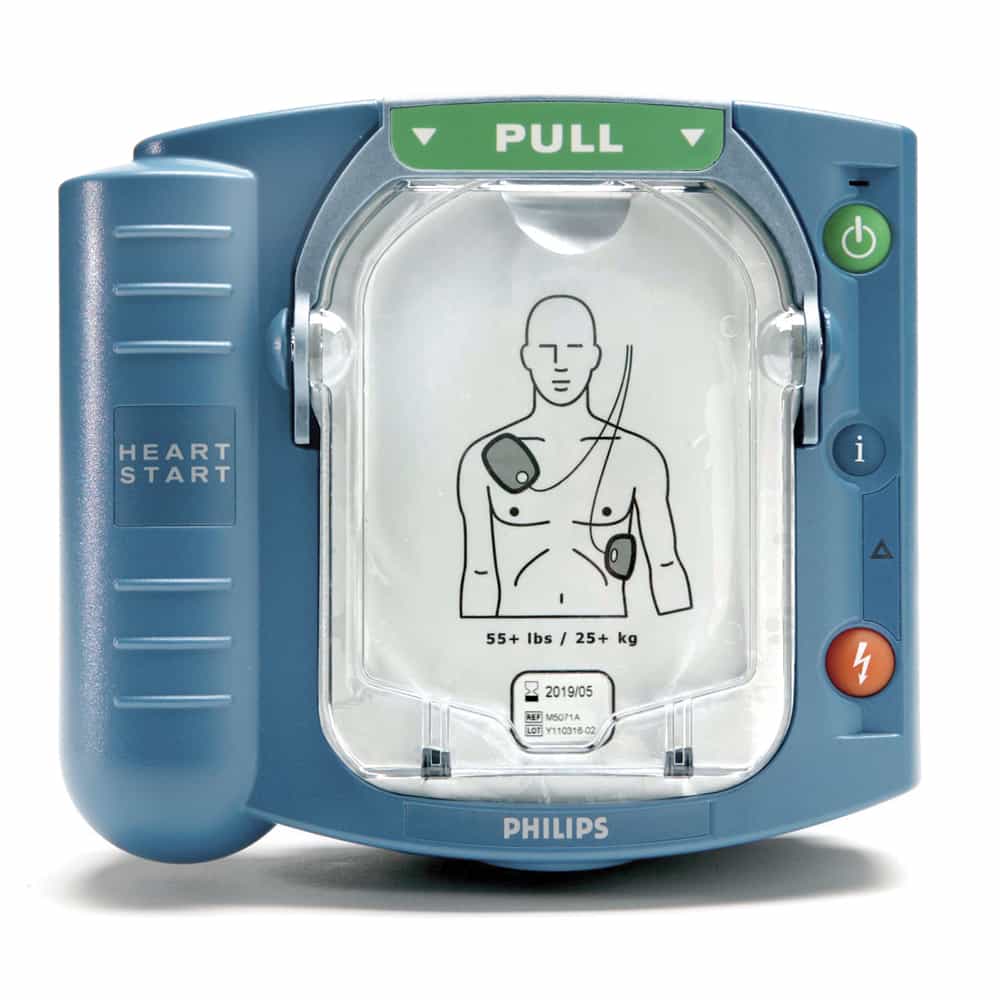
| Philips HeartStart OnSite | Pre-installed pads, 85 monthly self-tests, intuitive voice guidance | Small to mid-size offices |
| ZOLL AED 3 | Real-time CPR feedback, universal electrode pads for adults and children | Large offices with varied staff |
| Stryker LIFEPAK CR2 | Wi-Fi connectivity for remote monitoring, ClearVoice adaptive instructions | Multi-site corporate campuses |
For detailed comparisons across all six brands, visit the AED brands comparison guide or browse the full AED machine catalog.
Staff Training Requirements for Workplace AED Programs
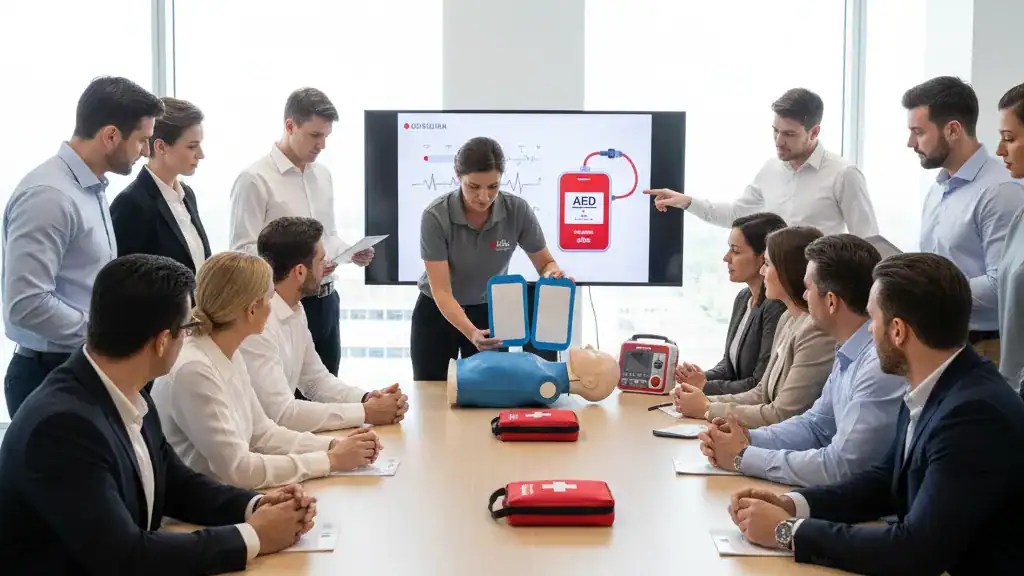
An AED is designed so that anyone can use it, even without formal training. Clear voice instructions guide the user through every step, and the device will not deliver a shock unless it detects a heart rhythm that requires one. That said, training dramatically increases confidence and response speed. The American Heart Association (AHA) and the American Red Cross both offer CPR/AED certification courses that take as little as two to four hours.
Response Ready partners with a nationwide network of certified instructors through its workplace CPR training program. Key training recommendations for businesses include:
- Train at least one person per floor or department so a responder is always nearby.
- Recertify every two years to keep skills current with AHA or Red Cross guidelines.
- Run practice drills annually so your team knows the location of the AED and their role in an emergency.
- Include new hires in your training rotation to maintain coverage as staff turns over.
Several states require formal CPR/AED training for designated workplace responders. Check your state AED legislation page to confirm requirements for your location.
What Is the AED Total Solution Program?
The AED Total Solution from Response Ready is a managed compliance program designed to take the administrative burden off business owners and office managers. For $99 per year, the program includes medical director oversight from Dr. Ann Jarris (MD, MBA, FACEP), automated pad and battery expiration tracking, compliance documentation, and post-event support including a free loaner device while yours is being serviced.
This program is especially valuable for organizations that need to satisfy regulatory requirements or internal safety audits. For companies deploying AEDs across multiple offices or floors, wholesale AED purchasing through Response Ready offers volume discounts and dedicated account support. This is especially helpful for those that do not have a dedicated safety officer on staff. The AED Total Solution ensures your device is always inspection-ready and your team has access to expert guidance when it matters most.
Contact Response Ready at 858-665-2025 to set up an AED Total Solution plan for your workplace.
How Much Does a Workplace AED Program Cost?
The total cost of a workplace defibrillator program depends on the device you choose, any accessories you add, and whether you opt for a managed compliance service. Here is a general breakdown:
- AED device: $1,400 to $2,900 depending on brand and features.
- Wall cabinet and signage: $150 to $300 for a standard alarmed cabinet.
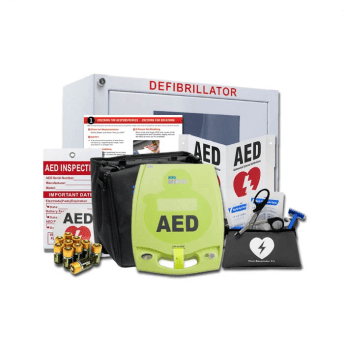
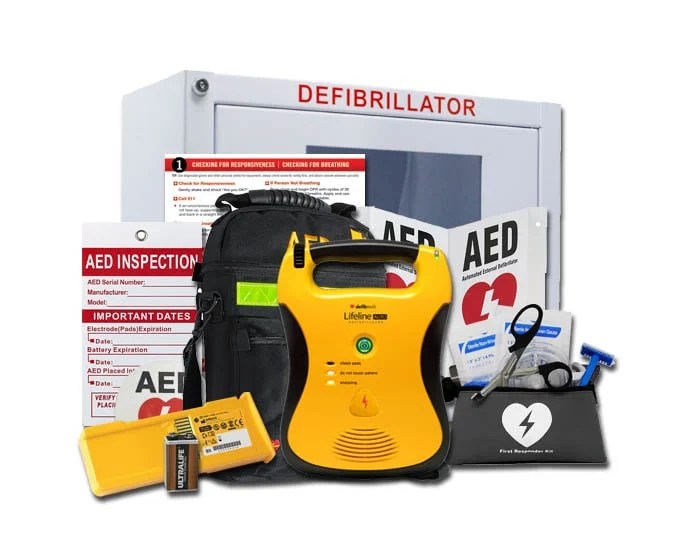
- Value package (AED + cabinet + first responder kit): Often saves 10% to 15% vs. buying items separately. Browse AED value packages here.
- AED Total Solution compliance management: $99 per year.
- CPR/AED training: $25 to $75 per employee depending on class size and format.
- Ongoing maintenance (pads and batteries): $50 to $200 every two to five years depending on the model.
Return on Investment
The financial case for a workplace AED extends beyond the moral imperative to protect lives. See our AED battery and pad replacement guide for brand-specific maintenance schedules. A single workplace cardiac arrest without an AED on-site can result in wrongful death claims, OSHA citations, and reputational damage that far exceed the cost of the device. Companies that maintain visible safety programs also report higher employee retention and reduced workers’ compensation premiums. Response Ready offers free shipping on orders over $99 and a 30-day money-back guarantee, so there is minimal risk in getting started.
Buying outright is not the only path. AED leasing gives offices the same FDA-approved devices on a monthly plan that includes consumable replacements and physician oversight. For workplaces with limited capital budgets — or those still figuring out the right number of units across floors and buildings — leasing removes the upfront commitment while keeping you OSHA-aligned from week one.
Where to Place an AED in Your Office
Proper AED placement can mean the difference between a three-minute response and a five-minute response. Follow these guidelines for your workplace:
- Target a three-minute retrieval time from any point in your facility.
- Mount the AED in a high-traffic, visible location such as a main hallway, lobby, or break room.
- Use a wall cabinet with clear signage so employees and visitors can find it quickly. Learn more about AED cabinet placement and compliance.
- Place additional units on each floor in multi-story buildings.
- Keep the device near common emergency zones such as fitness areas, cafeterias, or conference rooms where large groups gather.
How Do You Build a Workplace Emergency Response Plan?
Purchasing a workplace AED is an important first step, but the device is most effective when it is part of a written emergency response plan. A clear plan ensures that every employee knows what to do, who to call, and where to find the AED when seconds count. Here is what your plan should include:
- Designate trained responders: Identify specific employees on each floor or in each department who will serve as first responders. These individuals should maintain current CPR/AED certification through the AHA, Red Cross, or a similar accredited provider.
- Establish a communication protocol: Define who calls 911, who retrieves the AED, and who begins CPR. Assign backup roles in case the primary responder is unavailable.
- Post emergency instructions: Display a printed quick-reference guide next to each AED that includes the location of the nearest phone, the building address (for 911 calls), and step-by-step AED instructions.
- Schedule regular drills: Run at least one cardiac emergency drill per year so your team can practice their roles in a low-pressure setting. Drills reveal gaps in your plan before a real emergency does.
- Review and update annually: Staff changes, office moves, and new AED models all require updates to your emergency response plan. Assign a safety coordinator or use Response Ready’s AED Total Solution program to track compliance automatically.
Frequently Asked Questions
Is an AED required in the workplace by OSHA?
OSHA does not mandate AEDs in every workplace through a specific standard. However, OSHA’s General Duty Clause requires employers to address recognized hazards, and sudden cardiac arrest qualifies. Many safety professionals recommend AEDs as a best practice to meet this obligation.
How much does a workplace AED cost?
Workplace AED devices from FDA-approved manufacturers range from $1,400 to $2,900. Value packages that include a wall cabinet, signage, and a first responder kit typically save 10% to 15% compared to purchasing items individually.
Do employees need to be trained to use an AED?
No formal training is legally required in most states to use an AED. The devices provide step-by-step voice instructions. However, CPR/AED training from the AHA or Red Cross builds confidence and speeds response time, so training at least one person per department is strongly recommended.
How often does a workplace AED need maintenance?
AED pads typically need replacement every two to five years, and batteries last two to four years depending on the model. Monthly visual inspections confirm the device’s readiness indicator is active. Response Ready’s AED Total Solution program automates expiration tracking and sends replacement reminders.
What is the AED Total Solution from Response Ready?
The AED Total Solution is a managed compliance program for $99 per year. It includes medical director oversight, automated pad and battery expiration alerts, compliance documentation, and post-event loaner device support. It is designed for businesses that want peace of mind without hiring a dedicated safety officer.
Can you be sued for using an AED on someone at work?
Good Samaritan laws in most states protect people who use an AED in good faith during an emergency from civil liability. Response Ready’s state-by-state AED legislation guide explains the protections available in your location.