Why AED Battery and Pad Maintenance Matters
An Automated External Defibrillator (AED) is only as reliable as its consumable components. According to research on AED performance, battery power issues cause approximately 23% of all device failures, while pad and connector problems account for another 24%. That means nearly half of all AED failures trace back to expired or degraded batteries and pads. These are completely preventable failures.
Whether your AED sits in a school hallway, a gym lobby, or your home, the batteries and pads have expiration dates. Once those dates pass, your device may not deliver a life-saving shock when someone experiences sudden cardiac arrest. Keeping your AED batteries and AED pads current is not optional. It is a core responsibility of AED ownership.
Ready to check your AED supplies? Browse replacement batteries and pads from all six FDA-approved AED manufacturers at Response Ready.
Brand-by-Brand AED Battery and Pad Replacement Schedules
Every AED manufacturer uses a different battery chemistry, pad design, and replacement timeline. Below is a detailed breakdown of what to expect from each of the six FDA-approved brands carried by Response Ready.
Philips AED Batteries and Pads
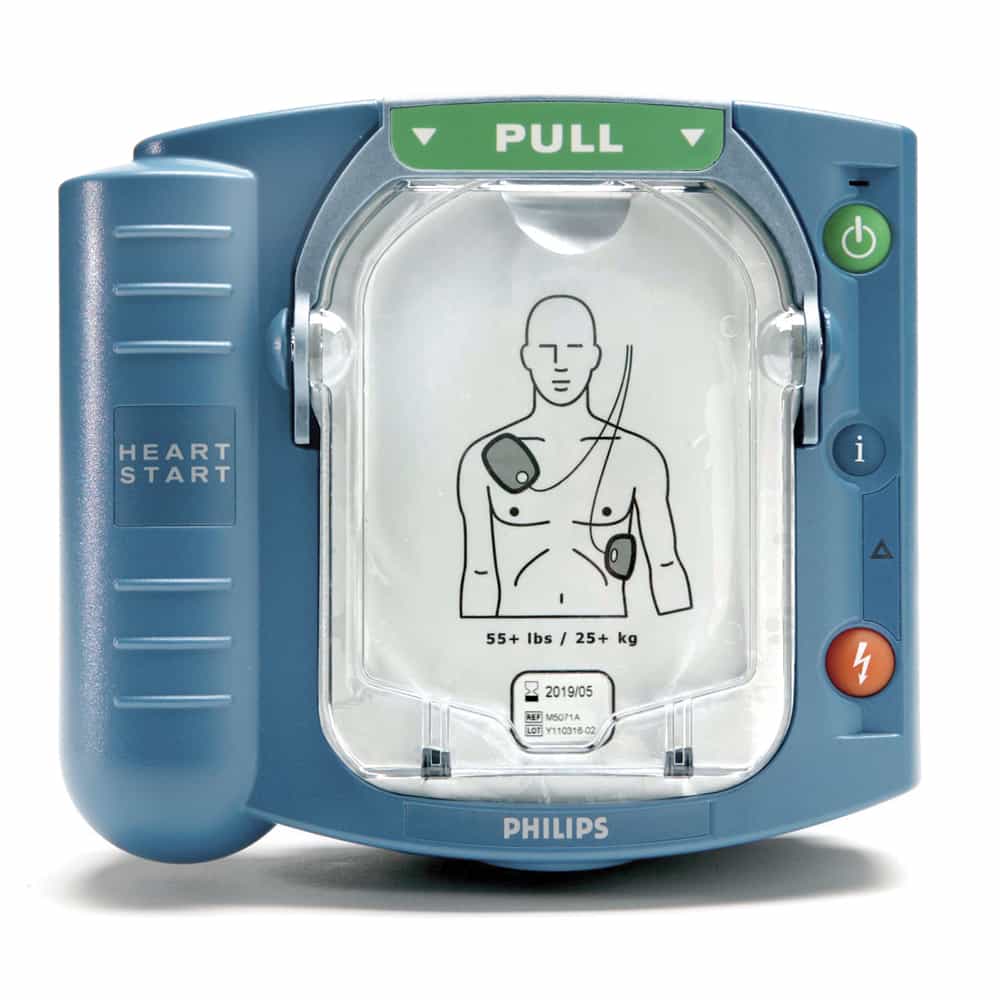
Philips HeartStart AEDs use lithium manganese dioxide batteries. The Philips HeartStart FRx and OnSite models share a similar battery design with a standby life of approximately 4 years. Philips AED pads typically have a shelf life of about 2 years from the date of manufacture. The FRx uses SMART Pads II, while the OnSite uses SMART Pads Cartridge. Both are pre-connected for fast deployment.
- Battery standby life: ~4 years
- Pad shelf life: ~2 years
- Key note: The battery gauge on the device handle indicates remaining capacity. Replace when one bar remains.
ZOLL AED Batteries and Pads
ZOLL AEDs, including the popular AED Plus and AED 3, use different battery configurations. The ZOLL AED Plus runs on 10 CR123A lithium batteries, providing approximately 5 years of standby life and up to 300 shocks. The newer ZOLL AED 3 uses a proprietary lithium battery pack. ZOLL CPR-D-padz are unique because they include a built-in CPR feedback sensor and have a shelf life of approximately 2.5 years.
- Battery standby life: ~5 years (AED Plus), ~4 years (AED 3)
- Pad shelf life: ~2.5 years
- Key note: ZOLL’s real-time CPR feedback pads are a single-piece design placed on the patient’s chest, simplifying use under stress.
HeartSine AED Batteries and Pads
HeartSine Samaritan PAD models (350P, 360P, 450P, and 500P) use an integrated Pad-Pak system that combines the battery and electrode pads into one replaceable cartridge. This simplifies maintenance because you only track one expiration date instead of two. The Pad-Pak has a shelf life of approximately 4 years.
- Pad-Pak shelf life: ~4 years
- Key note: The integrated design eliminates the risk of replacing one component but forgetting the other. When the Pad-Pak expires, you replace everything at once.
Stryker/Physio-Control (LIFEPAK) Batteries and Pads
Stryker LIFEPAK AEDs, including the LIFEPAK CR2 and LIFEPAK 1000, use lithium manganese dioxide batteries. The LIFEPAK CR2 battery provides approximately 4 years of standby life. QUIK-PAK electrode pads for the LIFEPAK CR2 have a shelf life of about 2 years. The LIFEPAK 1000 uses a rechargeable or non-rechargeable battery option with different replacement intervals.
- Battery standby life: ~4 years (CR2), ~5 years (LIFEPAK 1000 non-rechargeable)
- Pad shelf life: ~2 years
- Key note: LIFEPAK CR2 features QUIK-STEP electrode pads with an intuitive pull-and-place design.
Cardiac Science AED Batteries and Pads
Cardiac Science Powerheart G3 and G5 AEDs use Intellisense batteries that perform daily, weekly, and monthly self-tests. The G5 battery provides up to 4 years of standby life and approximately 400 shocks. Cardiac Science Intellisense pads have a shelf life of about 2 years.
- Battery standby life: ~4 years
- Pad shelf life: ~2 years
- Key note: The Powerheart G5 runs automatic self-checks on both the battery and pads, alerting you through a status indicator if either component needs attention.
Defibtech AED Batteries and Pads
Defibtech Lifeline AEDs use a proprietary battery pack with an industry-leading standby life of approximately 7 years for the standard battery and 4 years for the high-capacity option. Defibtech electrode pads have a shelf life of about 2 years. The Defibtech Lifeline VIEW and ECG models use the same battery and pad platform.
- Battery standby life: ~7 years (standard), ~4 years (high-capacity)
- Pad shelf life: ~2 years
- Key note: Defibtech offers one of the longest battery standby lives in the industry, reducing long-term replacement costs.
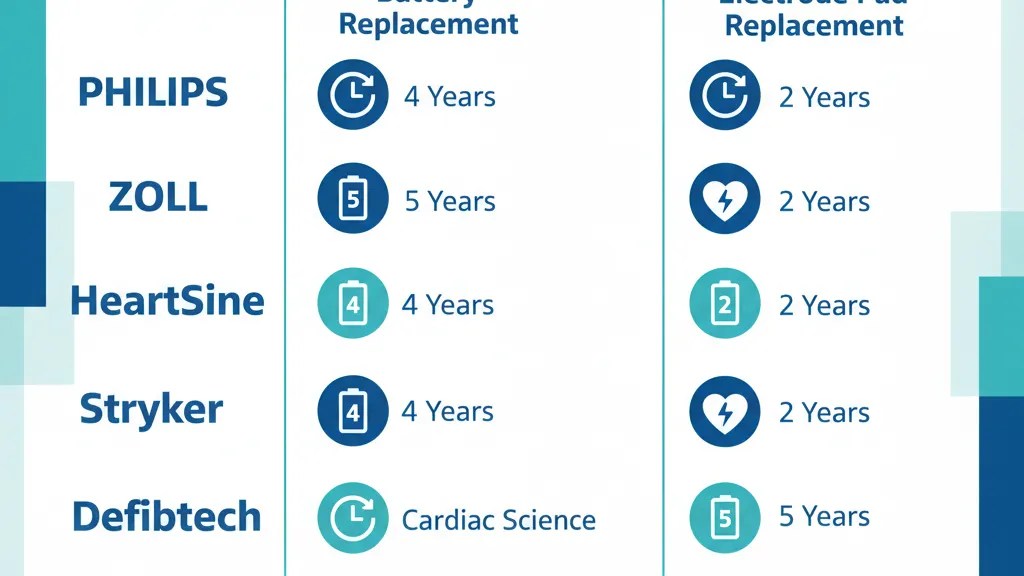
AED Battery and Pad Replacement Comparison Table
Use this quick-reference table to compare replacement intervals across all six FDA-approved AED manufacturers.
| AED Brand | Battery Standby Life | Pad Shelf Life | Integrated System | Self-Test Feature |
|---|---|---|---|---|
| Philips HeartStart | ~4 years | ~2 years | No | Yes (daily) |
| ZOLL AED Plus / AED 3 | ~5 years / ~4 years | ~2.5 years | No | Yes (daily) |
| HeartSine Samaritan PAD | ~4 years (Pad-Pak combined) | Yes | Yes (weekly) | |
| Stryker LIFEPAK | ~4-5 years | ~2 years | No | Yes (daily) |
| Cardiac Science Powerheart | ~4 years | ~2 years | No | Yes (daily/weekly/monthly) |
| Defibtech Lifeline | ~4-7 years | ~2 years | No | Yes (daily) |
Need replacement pads or batteries for your specific AED? Response Ready carries AED batteries and AED replacement pads from every brand listed above.
How Do You Check AED Battery and Pad Expiration Dates?
Checking your AED battery and pad expiration dates should be part of a regular maintenance routine. Here is how to find the key dates on your device and supplies.
Checking Battery Expiration
- Look at the battery label. Most AED batteries have a “use by” or “install by” date printed directly on the battery pack or its packaging.
- Check the device status indicator. Nearly all modern AEDs have an external status light (green checkmark or blinking indicator) that shows the battery is functional. A red “X” or flashing warning means the battery needs replacement.
- Record the installation date. When you install a new battery, write the date on a label and attach it to the AED or its cabinet. This lets you calculate when the standby life expires.
- Review self-test logs. Some AEDs store self-test results that include battery voltage readings. Access these through the device menu or management software.
Checking Pad Expiration
- Look at the pad packaging. Every sealed pad package has an expiration date printed on it. Do not open the sealed packaging until you are ready to use the pads in an emergency.
- Check for gel degradation. If the pad packaging appears damaged, puffy, or compromised, replace the pads immediately regardless of the printed date.
- Inspect the connector. Make sure the pad connector is clean and undamaged. A faulty connection can prevent the AED from analyzing heart rhythm or delivering a shock.
What Are the Signs Your AED Needs Maintenance?
Beyond tracking expiration dates, watch for these warning signs that your AED batteries or pads need immediate attention.
- Status indicator shows a warning. A red indicator, flashing light, or audible alarm means the AED has detected an issue during its self-test. This is the most common and reliable alert.
- Battery indicator shows low charge. If your AED has a battery gauge (like Philips models), replace the battery when it reaches the last bar, not after it dies completely.
- Pad packaging is damaged or swollen. Heat exposure, humidity, or physical damage can degrade the conductive gel on electrode pads before the printed expiration date.
- The AED fails to power on during a routine check. If your monthly check reveals the device will not turn on, the battery is likely depleted and needs immediate replacement.
- You used the AED in a rescue event. After any use on a patient, replace the electrode pads immediately. The battery may also need replacement depending on the number of shocks delivered and the duration of use.

What Are the Best Practices for AED Maintenance?
Keeping your AED rescue-ready goes beyond swapping batteries and pads when they expire. Here are the maintenance habits that ensure your device will perform when it matters most.
Create a Maintenance Schedule
Set calendar reminders for monthly visual inspections and document every check. During each inspection, verify the status indicator shows “rescue ready,” confirm pad and battery expiration dates have not passed, and check that all accessories (spare pads, razor, scissors, gloves) are present in the AED cabinet or carry case.
Track Expiration Dates Proactively
Do not wait for components to expire before ordering replacements. Order new AED replacement pads and batteries at least 30 days before the current ones expire. This buffer accounts for shipping time and prevents any gap in readiness. Response Ready’s AED Total Solution program handles this tracking automatically, sending replacement components before they expire.
Store Your AED Properly
Extreme temperatures can shorten both battery and pad life. Most AEDs are designed to operate and be stored between 32 and 122 degrees Fahrenheit (0 to 50 degrees Celsius). Avoid placing your AED in direct sunlight, unheated garages, or vehicles during extreme weather. A wall-mounted AED cabinet in a climate-controlled indoor area is the best storage option.
Use Only OEM or Authorized Replacement Parts
Counterfeit or third-party AED batteries and pads may not meet the manufacturer’s specifications. Using unauthorized components can void your warranty, cause device malfunction, and create liability issues. Always purchase AED batteries and AED pads from an authorized distributor like Response Ready.
Want expert help managing your AED program? Response Ready’s AED Total Solution program provides ongoing compliance management, automated expiration tracking, and replacement component delivery for just $99 per year. Contact us to learn more.
Frequently Asked Questions
How often should AED pads be replaced?
Most AED pads have a shelf life of approximately 2 to 2.5 years from the date of manufacture. Check the expiration date printed on your pad packaging and replace them before that date. Also replace pads immediately after any use on a patient.
How long do AED batteries last?
AED battery standby life varies by brand, ranging from approximately 4 years for most manufacturers up to 7 years for Defibtech’s standard battery. The actual lifespan depends on the frequency of self-tests, environmental conditions, and whether the AED has been used to deliver shocks.
Can I use third-party AED batteries or pads?
Using third-party or counterfeit batteries and pads is not recommended. These components may not meet the manufacturer’s quality standards and can cause device malfunctions. They may also void your AED warranty. Always purchase from an authorized distributor that carries genuine OEM parts.
What happens if I use an AED with expired pads?
Expired pads may have degraded conductive gel, which can result in poor skin contact and unreliable heart rhythm analysis. In a worst-case scenario, the AED may fail to deliver a shock or deliver an inadequate shock. Keeping pads current is essential for device reliability.
Do AEDs check their own batteries and pads?
Yes. Most modern AEDs perform automatic self-tests daily, weekly, or monthly depending on the brand. These tests check battery voltage, pad connectivity, and internal circuitry. A status indicator on the outside of the device displays the results. However, self-tests do not check pad expiration dates, so manual tracking is still necessary.
Where can I buy replacement AED batteries and pads?
Response Ready is an authorized distributor for all six FDA-approved AED manufacturers. You can shop for AED batteries and AED replacement pads by brand, with free shipping on orders over $99.