Why Portable Defibrillators Save Lives Beyond the Hospital
Sudden cardiac arrest strikes more than 350,000 Americans outside of hospitals every year. When someone collapses, survival depends on how fast a defibrillator reaches them. For every minute without defibrillation, the chance of survival drops by roughly 10 percent. A portable AED closes that gap by putting life-saving technology in your hands, wherever you happen to be.
Ready to find the right portable defibrillator for your needs? Browse our full selection of AEDs from all 6 FDA-approved brands or call us at 858-665-2025 for personalized guidance.
Unlike the large, wall-mounted units you see in airports and office lobbies, a portable defibrillator is built to travel with you. These lightweight devices fit inside a backpack, glove box, or carry-on bag. They are designed for people who spend time in places where a fixed AED may be several minutes away, or may not exist at all.
Whether you lead outdoor group hikes, manage a remote job site, or simply want peace of mind for your family, the right portable AED can be the difference between life and death in a cardiac emergency.
What Makes an AED Truly Portable?
Every AED is technically portable compared to hospital equipment, but not every unit is practical to carry on a daily basis. When shopping for a portable defibrillator, focus on these key factors:
- Weight: The lightest FDA-approved AEDs weigh between 2.5 and 5 pounds including batteries and pads. If you plan to hike, travel, or carry the device in a go-bag, every ounce matters.
- Size and form factor: Compact models are roughly the size of a paperback book. Others are closer to a small laptop. Consider whether the device needs to fit in a backpack, vehicle console, or wall cabinet.
- Durability (IP rating): An IP rating tells you how well the device handles dust and water. Look for at least IP55 if you plan to use the AED outdoors or in wet conditions.
- Battery life: Standby battery life ranges from 2 to 7 years depending on the model. Longer standby means less maintenance and lower long-term cost.
- Ease of use: Clear voice prompts, visual guides, and automatic shock delivery help even untrained bystanders respond effectively.
- FAA compliance: All FDA-approved AEDs are allowed on commercial flights. The FAA permits lithium batteries under 100 watt-hours in carry-on luggage, and every portable AED on the market falls well within that limit.

Best Portable AEDs from All 6 FDA-Approved Brands
The United States has six manufacturers with FDA clearance to sell automated external defibrillators. Here is a comparison of the most portable models from each brand, along with their key specifications:
| Brand | Model | Weight | IP Rating | Standby Battery Life | Best For |
|---|---|---|---|---|---|
| Philips | HeartStart FRx | 3.5 lbs | IP55 | 4 years | Outdoor and rugged environments |
| ZOLL | AED 3 | 5.5 lbs | IP55 | 5 years | Workplaces with CPR feedback |
| HeartSine | Samaritan PAD 360P | 2.5 lbs | IP56 | 4 years | Ultralight travel and hiking |
| Stryker/Physio-Control | LIFEPAK CR2 | 4.6 lbs | IP55 | 4 years | Events and group activities |
| Cardiac Science | Powerheart G5 | 5.1 lbs | IP55 | 4 years | Schools and public facilities |
| Defibtech | Lifeline VIEW | 3.0 lbs | IP55 | 4 years | Visual learners and first-time users |
Response Ready is an authorized distributor for all six of these manufacturers. That means you get genuine devices, factory warranties, and direct support, all from one source. Read our complete AED buyer’s guide for a deeper breakdown of each brand.
When comparing models, pay close attention to the weight-to-durability ratio. The HeartSine Samaritan PAD 360P offers the best portability at just 2.5 pounds with an IP56 rating, making it the top choice for hikers and travelers. For workplaces that also want CPR coaching technology, the ZOLL AED 3 is heavier but delivers real-time feedback that can improve the quality of chest compressions during a rescue. Every model in the table above ships with a complete rescue-ready kit from Response Ready, including fresh pads, a charged battery, and a carrying case.
Top Use Cases for a Portable Defibrillator
Travel and Road Trips
If you or a family member has a heart condition, carrying a portable AED during travel adds a critical safety net. Lightweight models like the HeartSine Samaritan PAD 360P (2.5 lbs) easily fit in a carry-on bag. All FDA-approved AEDs meet FAA lithium battery guidelines, so you can fly with them without special documentation. For road trips, a compact AED stored in the center console or trunk is accessible in seconds.
Outdoor Events, Sports, and Recreation
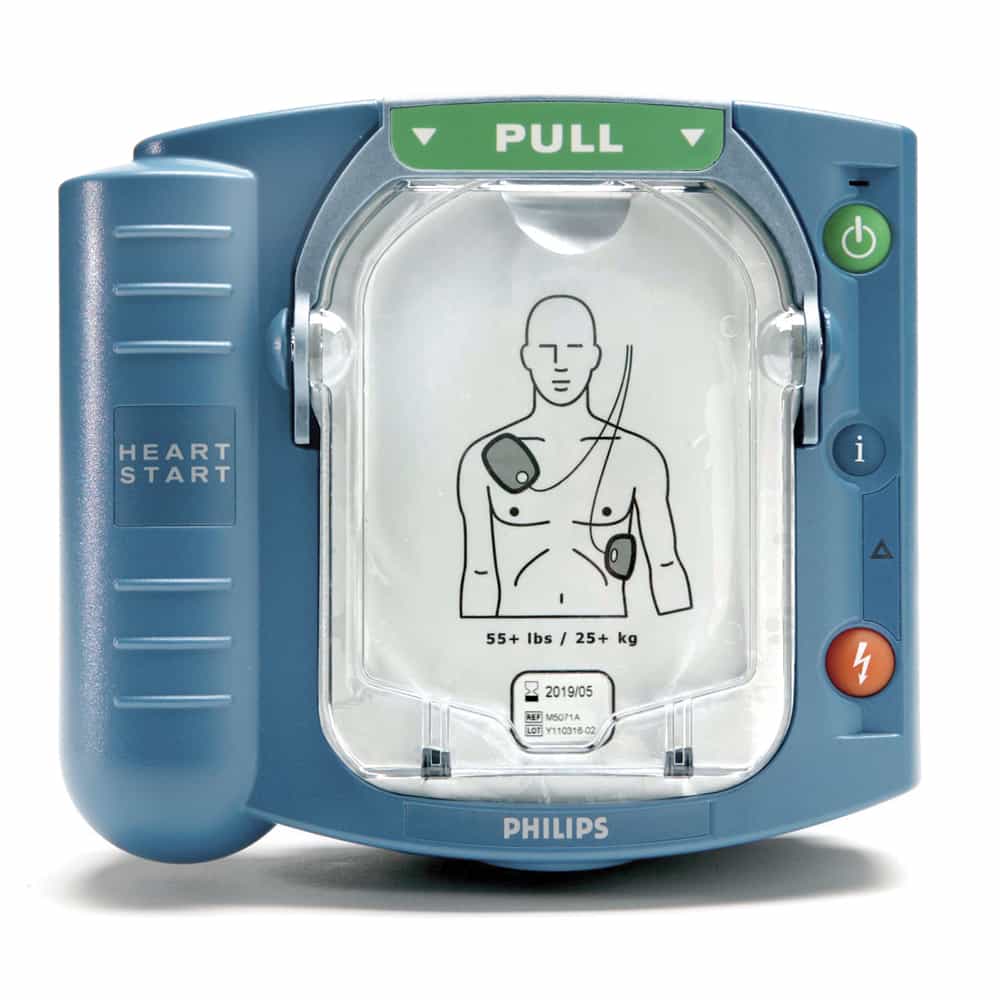
Youth sports leagues, charity runs, hiking groups, and outdoor festivals often take place far from medical facilities. Sudden cardiac arrest can affect athletes of any age, including seemingly healthy young adults. A durable, weather-resistant AED with an IP55 or higher rating is essential for these environments. The Philips HeartStart FRx was designed specifically for rugged use and performs reliably in rain, dust, and extreme temperatures.
Looking for a short-term solution for your next event? Explore our AED rental program starting at $45 per month, or call 858-665-2025 to discuss your needs.
Remote Workplaces and Job Sites
Construction sites, agricultural operations, oil rigs, and other remote work environments may be 20 minutes or more from the nearest hospital. OSHA does not currently mandate AEDs in the workplace, but many states require them in specific settings such as health clubs and schools. Regardless of legal requirements, having a portable AED on a remote job site can be the deciding factor when cardiac arrest strikes far from emergency services.
Home and Vehicle
People with a personal or family history of heart disease increasingly keep an AED at home. A portable model that lives in a hallway closet or vehicle glove box provides instant access without the complexity of a full medical kit. For a detailed look at home-specific options, visit our guide on the best AEDs for home use.
Features to Look for in a Portable AED
Not every feature matters equally for every buyer. Here is what to prioritize based on how you plan to use your device:
- Real-time CPR feedback: Some models, like the ZOLL AED 3, measure chest compression depth and rate, then coach you in real time. This is especially valuable in workplaces where responders may have minimal training.
- Pediatric mode or pediatric pads: If children will be present, choose a model that supports pediatric settings. The Philips FRx uses a simple key to switch between adult and child modes.
- Visual display: The Defibtech Lifeline VIEW features a full-color video screen that shows rescue steps visually. This is helpful in loud environments or for visual learners.
- Automatic shock delivery: Fully automatic models like the HeartSine 360P analyze the heart rhythm and deliver the shock without requiring the user to press a button. This removes hesitation during a high-stress emergency.
- Wi-Fi or cellular connectivity: Connected AEDs like the LIFEPAK CR2 can alert emergency services automatically when the device is activated. They also send maintenance reminders so you never miss a battery or pad replacement.
- Long standby battery life: Every AED requires periodic battery and pad replacement. A 4 to 5-year standby life reduces ongoing maintenance. Browse replacement batteries and electrode pads for all brands.
How Much Does a Portable AED Typically Run?
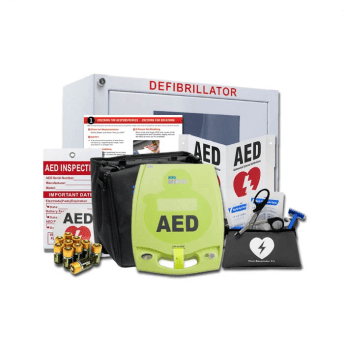
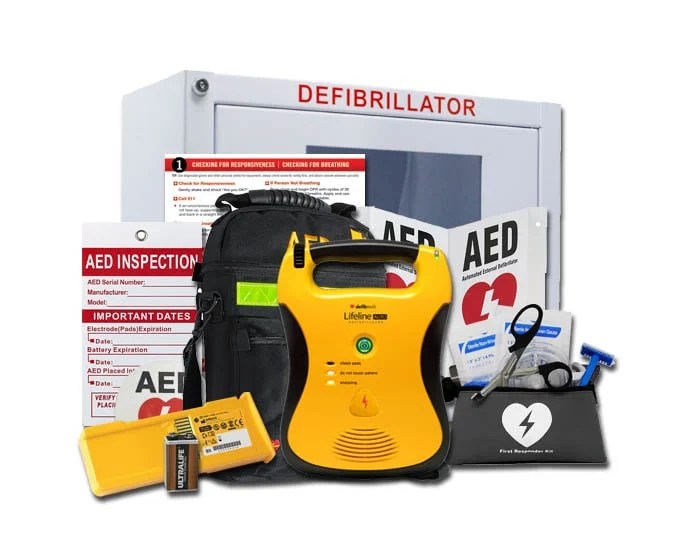
Portable AEDs from FDA-approved manufacturers generally range from about $1,400 to $2,900 depending on the brand, features, and included accessories. Value packages that bundle a cabinet, signage, spare pads, and a first responder kit offer better long-term value than buying components separately.
If outright purchase does not fit your budget, AED rental programs start at $45 per month and include maintenance, pad and battery replacements, and compliance support. Organizations that need ongoing management can also explore the AED Total Solution program for $99 per year.
Need help choosing the right portable defibrillator for your situation? Contact our team or call 858-665-2025. Our emergency preparedness specialists will match you with the right device based on your use case, budget, and environment.
Maintaining Your Portable AED
A portable defibrillator only works when it is ready. Follow these maintenance basics to keep your device prepared:
- Check the status indicator light monthly. A green light or checkmark means the device has passed its self-test.
- Replace electrode pads before their expiration date, typically every 2 to 4 years.
- Replace the battery according to the manufacturer’s schedule. Most portable AED batteries last 4 to 5 years on standby.
- Store the device in a clean, dry location between 32 and 122 degrees Fahrenheit.
- Register your AED with your local emergency dispatch system so first responders know its location.
For organizations managing multiple devices, the AED Program Management service from Response Ready handles tracking, reminders, and compliance documentation so nothing falls through the cracks. Learn more about device readiness in our complete guide to AED device readiness.
Frequently Asked Questions
Can you bring a portable AED on an airplane?
Yes. The FAA allows AEDs in carry-on luggage. All FDA-approved portable defibrillators use lithium batteries well under the 100 watt-hour limit. No special permits or documentation are required for domestic or international flights.
Do you need training to use a portable AED?
No formal training is required. Portable AEDs are designed for use by untrained bystanders with clear voice and visual prompts. However, CPR and AED training improves confidence and response time. Response Ready offers CPR and AED training programs nationwide.
How long do portable AED batteries last?
Most portable AED batteries last 4 to 5 years on standby. Some models offer up to 7 years. The device performs regular self-tests and alerts you when a battery replacement is needed.
What is the lightest FDA-approved AED?
The HeartSine Samaritan PAD series is among the lightest at approximately 2.5 pounds. The Defibtech Lifeline VIEW is another lightweight option at about 3 pounds.
Are portable AEDs waterproof?
Most portable AEDs are water-resistant, not fully waterproof. Look for an IP55 or IP56 rating, which means the device can handle rain, splashing, and dusty conditions. Avoid submerging any AED in water.
How much does a portable defibrillator weigh?
FDA-approved portable AEDs weigh between 2.5 and 5.5 pounds including batteries and pads. The most travel-friendly models stay under 3.5 pounds.