- Published
- June 16, 2026
Best AED for Home Use: Top 5 Personal Defibrillators Compared

Do You Really Need an AED at Home?
Most sudden cardiac arrests happen at home. Not at the gym, not at work, but in your living room, kitchen, or bedroom. When someone’s heart suddenly stops beating, every minute without treatment reduces their chance of survival by about 10%. The average ambulance response time in the United States is 7 to 14 minutes. That gap between collapse and professional help is where a home AED can save a life.
Browse all FDA-approved AEDs at Response Ready or call 858-665-2025 to speak with an emergency preparedness specialist.
An Automated External Defibrillator (AED) is a portable device that analyzes heart rhythm and delivers a controlled shock to restore a normal heartbeat. Modern AEDs are designed for people with zero medical training. You turn it on, follow the voice prompts, and the device handles the rest. It will only deliver a shock if one is needed, so you cannot accidentally harm someone.
If someone in your household has heart disease, high blood pressure, or a family history of cardiac events, a home AED is not a luxury. It is a practical safety tool, just like a smoke detector or fire extinguisher.
What to Look for When Choosing a Home AED
Choosing an AED for your home is different from selecting one for a workplace or school. At home, the person using the device is likely a family member with no medical background, acting under extreme stress. Here are the features that matter most:
Voice Guidance and Ease of Use
Every AED provides voice instructions, but clarity varies. The best home AEDs use calm, step-by-step prompts that tell you exactly what to do, from pad placement to chest compressions. Look for devices with visual diagrams on the pads themselves so you can see where to place them without second-guessing.
Weight and Size
Home AEDs should be compact enough to store in a visible, accessible location like a hallway closet or kitchen cabinet. Devices under 4 pounds are easiest to grab and carry quickly.
CPR Coaching
High-quality CPR between shocks dramatically improves survival. Some AEDs provide real-time feedback on compression depth and rate, which is especially valuable for untrained users who may not know how hard or fast to push.
Battery and Pad Lifespan
AED pads and batteries expire every 2 to 5 years and must be replaced even if the device is never used. Longer-lasting components mean lower ongoing costs. Some devices combine the battery and pads into a single cartridge, which simplifies tracking.
Warranty
Most quality AEDs come with a 7 to 8 year warranty. A strong warranty protects your investment and signals manufacturer confidence in the product.
For families who want a defibrillator on-hand without the $1,400+ upfront price, a home AED rental starts at $45 per month and includes automatic pad and battery replacements before they expire. This is especially valuable for households in rural areas where EMS response times can stretch to 10 to 15 minutes — having the device ready at home closes that gap.
Top 5 Personal Defibrillators for Home Use
We compared five AEDs from Response Ready’s catalog based on ease of use, price, features, and suitability for a non-medical home user. All five are FDA-approved and designed for lay responders.
1. HeartSine Samaritan PAD 350P: Best Value for Families
The HeartSine Samaritan PAD 350P is the lightest AED on this list at just 2.4 pounds, making it easy to store anywhere in your home. Its standout feature is the Pad-Pak system, which combines the battery and electrode pads into a single replaceable cartridge. Instead of tracking two separate expiration dates, you only monitor one.
- Price: $1,461.60
- Weight: 2.4 lbs
- Warranty: 8 years
- Key feature: Pad-Pak single cartridge (battery + pads in one)
- IP rating: IP56 (dust-tight, water-resistant)
- Best for: Budget-conscious families, small homes, first-time AED buyers
The 350P is semi-automatic, meaning you press a button to deliver the shock when prompted. Its voice and visual prompts guide you through the entire process. With an IP56 durability rating, it can handle storage in garages, sheds, or near pools without concern.
2. Defibtech Lifeline: Simplest Operation
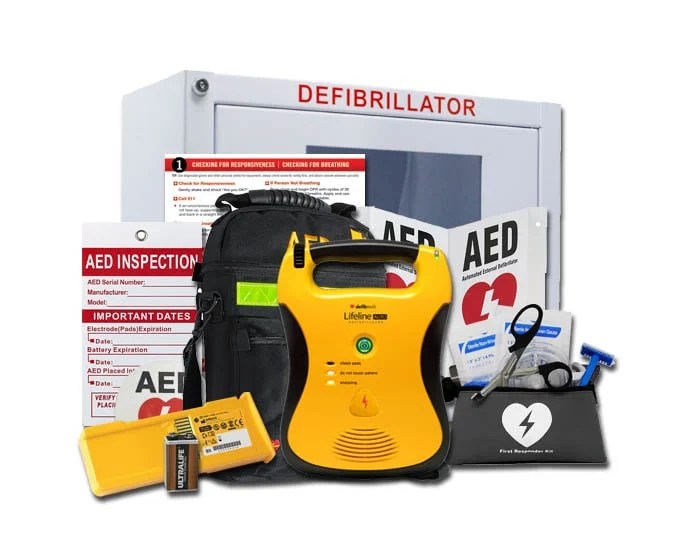
The Defibtech Lifeline is built around a two-button design: one green button to turn it on, one red button to deliver the shock. That is all you need to operate it. For someone who wants absolute simplicity during a high-stress moment, this device removes every possible point of confusion.
- Price: $1,539.30
- Weight: 4.2 lbs
- Warranty: 8 years
- Key feature: Two-button operation with clear indicator lights
- Data storage: Records 100 minutes of ECG and audio data
- Best for: Elderly households, anyone prioritizing simplicity
The Lifeline also records ECG and audio data on a removable data card, which can be shared with emergency responders when they arrive. Three indicator lights on the device tell you when to check pads, stand clear, or wait for analysis.
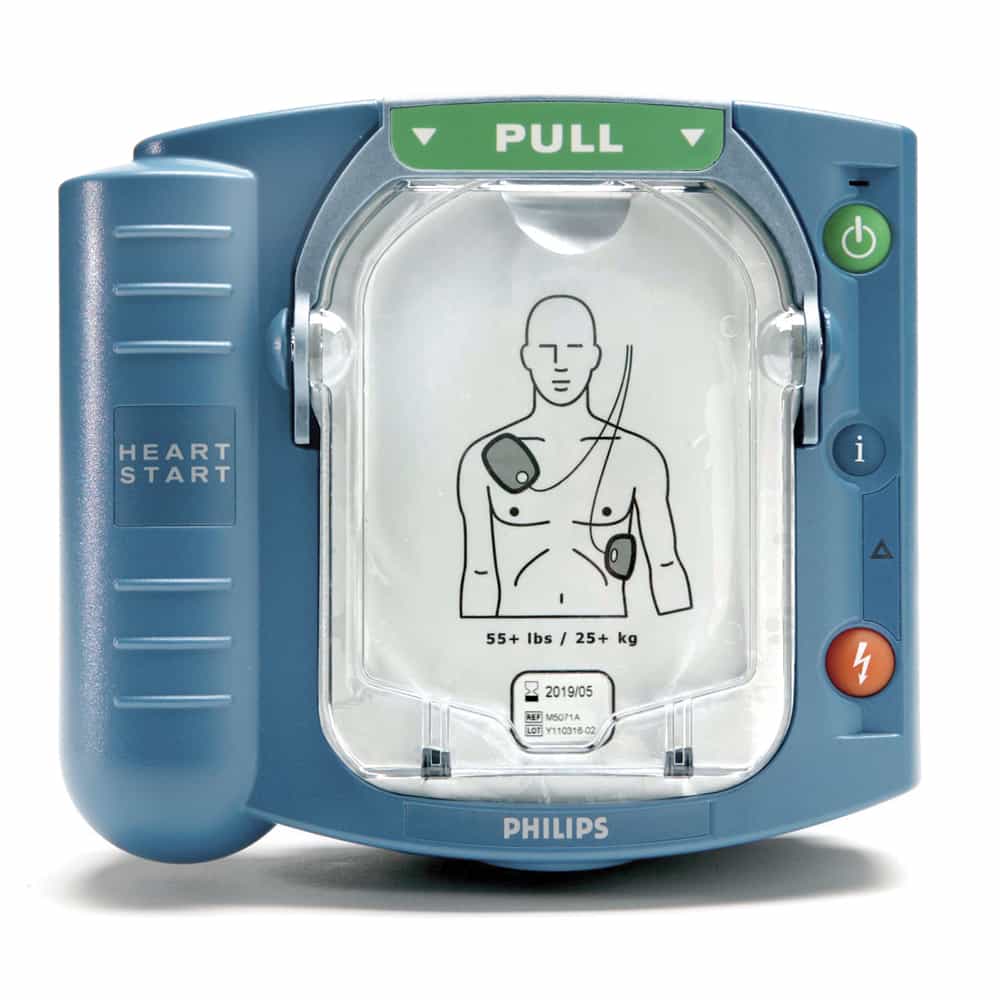
3. Philips HeartStart OnSite: Most Popular Home AED
The Philips HeartStart OnSite is the most widely recognized AED for home use and the only model available without a prescription. This makes it the most accessible option if you want to purchase one immediately without any additional paperwork.
View the Philips HeartStart OnSite at Response Ready: the only AED you can buy without a prescription.
- Price: $1,579.00
- Weight: 3.3 lbs
- Warranty: 8 years
- Key feature: No prescription required (only OTC-approved AED)
- Pads: Pre-connected SMART Pads with placement sensing
- Best for: First-time buyers who want hassle-free purchasing
The OnSite’s SMART Pads detect placement on the patient’s chest and tailor the voice guidance based on pad signals. It includes a CPR coaching metronome to help you maintain the correct compression rate. The pads come pre-connected to the device, so there is zero setup required in an emergency.
4. ZOLL AED Plus: Best CPR Feedback
The ZOLL AED Plus stands apart with its Real CPR Help technology. A sensor built into the electrode pads measures your chest compressions in real time and tells you whether to push harder, faster, or slower. For an untrained family member performing CPR for the first time, this feedback can be the difference between effective compressions and ineffective ones.
- Price: $2,082.00
- Weight: 6.7 lbs
- Warranty: 7 years
- Key feature: Real CPR Help with real-time compression feedback
- Battery: Uses consumer lithium batteries (easy to find)
- Best for: Families with high-risk members who want maximum guidance
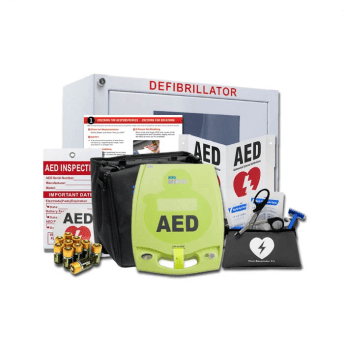
The ZOLL AED Plus uses standard lithium camera batteries that are readily available at any electronics store, unlike proprietary battery packs. Learn more about replacement timelines in our AED battery and pad replacement guide. This makes replacement simple and affordable. The trade-off is a heavier unit at 6.7 pounds, but the CPR coaching capability makes it worth the extra weight for families who want the most guided rescue experience.
5. Stryker LIFEPAK CR2: Most Advanced Technology
The Stryker LIFEPAK CR2 is the premium option on this list, packed with features designed for the fastest possible rescue. Its cprINSIGHT technology analyzes heart rhythm during chest compressions, which means you do not have to stop CPR for the device to determine if a shock is needed. This reduces pauses and keeps blood flowing to the brain.
- Price: From $2,256.00
- Weight: 4.6 lbs
- Warranty: 8 years
- Key feature: Wi-Fi connectivity with readiness alerts, cprINSIGHT analysis
- Child mode: Built-in button (no separate pediatric pads needed)
- Best for: Families with children, tech-savvy households, multi-story homes
The CR2’s Wi-Fi connectivity sends automatic readiness alerts to your phone or email, so you always know the device is functional without manual checks. The built-in child mode button instantly adjusts energy levels for pediatric rescues, eliminating the need to buy and store separate child pads. If you have young children at home, this feature alone may justify the higher price.
Side-by-Side Comparison
| Feature | HeartSine 350P | Defibtech Lifeline | Philips OnSite | ZOLL AED Plus | LIFEPAK CR2 |
|---|---|---|---|---|---|
| Price | $1,461.60 | $1,539.30 | $1,579.00 | $2,082.00 | From $2,256 |
| Weight | 2.4 lbs | 4.2 lbs | 3.3 lbs | 6.7 lbs | 4.6 lbs |
| Warranty | 8 years | 8 years | 8 years | 7 years | 8 years |
| CPR Coaching | Basic audio | Basic audio | Metronome | Real-time feedback | Real-time feedback |
| Prescription Required | Yes* | Yes* | No | Yes* | Yes* |
| Child Mode | Pediatric Pad-Pak | Pediatric pads | Pediatric pads | Pediatric pads | Built-in button |
| Wi-Fi Alerts | No | No | No | No | Yes |
*Response Ready handles the prescription process for you at no extra cost when you purchase through their site.Not sure which AED is right for your family? Response Ready carries all six FDA-approved brands and our emergency preparedness specialists can match you with the best device for your home. Browse home AEDs or call 858-665-2025 for a free consultation.
How to Maintain Your Home AED
A home AED requires minimal maintenance, but consistency matters. Here is a simple routine:
- Monthly visual check: Confirm the readiness indicator light is green. This takes 10 seconds.
- Track expiration dates: Set calendar reminders for pad and battery replacement dates (typically every 2 to 5 years).
- Store it properly: Keep the AED in a central, visible location away from extreme heat or moisture. A hallway, kitchen, or main living area works well.
- After any use: Replace pads and battery immediately, and contact your supplier for post-event support.
If managing maintenance feels like a hassle, Response Ready’s AED Total Solution program ($99/year) handles compliance tracking, automated supply reminders, and medical director oversight for you.
When to Replace Your AED
AEDs are built to last, but they do not last forever. Most manufacturers recommend replacing the entire device after 8 to 10 years, even if it still passes self-tests. Technology advances over time, and newer models offer improved features like faster analysis, better CPR coaching, and enhanced connectivity. If your AED is nearing the end of its warranty period, contact Response Ready to discuss upgrade options. Trading in an older device for a current model ensures your family always has access to the latest life-saving technology.
Beyond the device itself, electrode pads require replacement after every use and before their printed expiration date. Using expired pads can result in poor adhesion to the patient’s skin, which reduces the device’s ability to analyze heart rhythm and deliver an effective shock. Most AED models will alert you with an audible chirp or flashing indicator when pads or batteries approach their expiration date, but setting your own calendar reminders provides an extra layer of protection.
Consider enrolling in Response Ready’s AED Total Solution program for automated supply tracking and replacement reminders. The program also includes medical director oversight through Dr. Ann Jarris, MD, MBA, FACEP, ensuring your home AED program meets all regulatory requirements. For families who want complete peace of mind without managing maintenance themselves, this program handles every detail for $99 per year.
Shop AEDs at Response Ready: all devices include free shipping on orders over $99, a 30-day money-back guarantee, and lifetime customer support. Call 858-665-2025 for personalized recommendations.
Frequently Asked Questions
Can anyone use an AED without training?
Yes. Every modern AED is designed for people with no medical training. The device provides step-by-step voice instructions and will only deliver a shock if it detects a life-threatening heart rhythm. You cannot accidentally shock someone who does not need it. While CPR and AED training builds confidence, it is not required to operate the device.
Do I need a prescription to buy an AED?
Most AEDs technically require a prescription because the FDA classifies them as Class III medical devices. However, when you purchase from a specialized provider like Response Ready, the prescription is handled for you as part of the purchase process at no extra charge. The one exception is the Philips HeartStart OnSite, which is FDA-approved for over-the-counter purchase without any prescription.
How much does a home AED cost?
New FDA-approved AEDs for home use range from about $1,400 to $2,300 depending on the model and features. For a detailed breakdown of the most affordable AEDs for home use, see our dedicated buyer’s guide. Ongoing costs include replacement pads and batteries every 2 to 5 years, which typically run $150 to $400 per replacement cycle. Response Ready also offers AED rental programs starting at $45 per month for families who prefer not to purchase outright.
Can I use a home AED on a child?
Yes. For children under 8 years old or weighing less than 55 pounds, use pediatric pads that deliver a lower energy level. Most AEDs offer pediatric pads as an accessory. The LIFEPAK CR2 has a built-in child mode button that adjusts energy levels without needing separate pads.
How long do AED batteries and pads last?
Battery life ranges from 4 to 7 years on standby, depending on the model. Electrode pads typically expire every 2 to 5 years because the adhesive gel degrades over time. Both must be replaced on schedule, even if the AED has never been used, to ensure the device is ready for an emergency.
Disclaimer for information purposes only:
The information provided on this website is intended for general educational and informational purposes only. It is not medical advice and should not be used as a substitute for professional diagnosis, treatment, or care. Always consult a qualified healthcare or medical professional regarding any health-related questions or concerns.
While we strive to ensure the information shared is accurate and up to date, no guarantees are made regarding completeness, accuracy, or applicability to any individual situation. Use of this content is at the reader’s sole discretion and risk.
This website is part of the Response Ready family of emergency preparedness and training resources, including CPR & first aid training and compliance services, AED sales and program support, AED program management software, and medical oversight solutions provided through our affiliated platforms:
• CPR1.com
• AEDLeader.com
• AEDTotalSolution.com
• MDSIMedical.com
By accessing or using this website, you agree to release, indemnify, and hold harmless the website owners, authors, contributors, and affiliated entities from any claims, losses, damages, or liabilities arising from the use or reliance on the information presented.