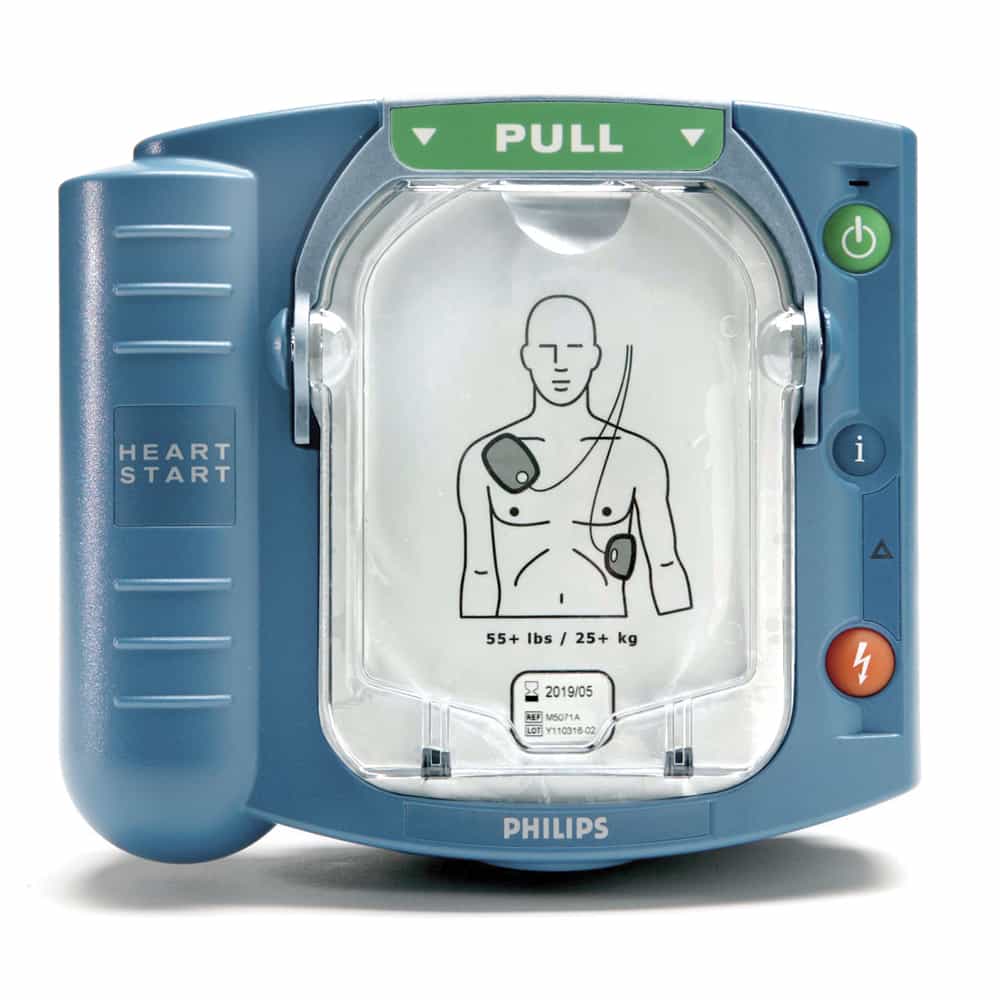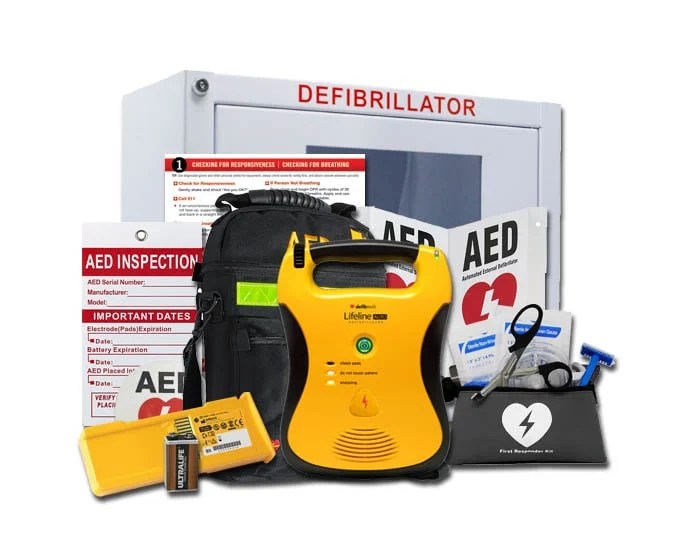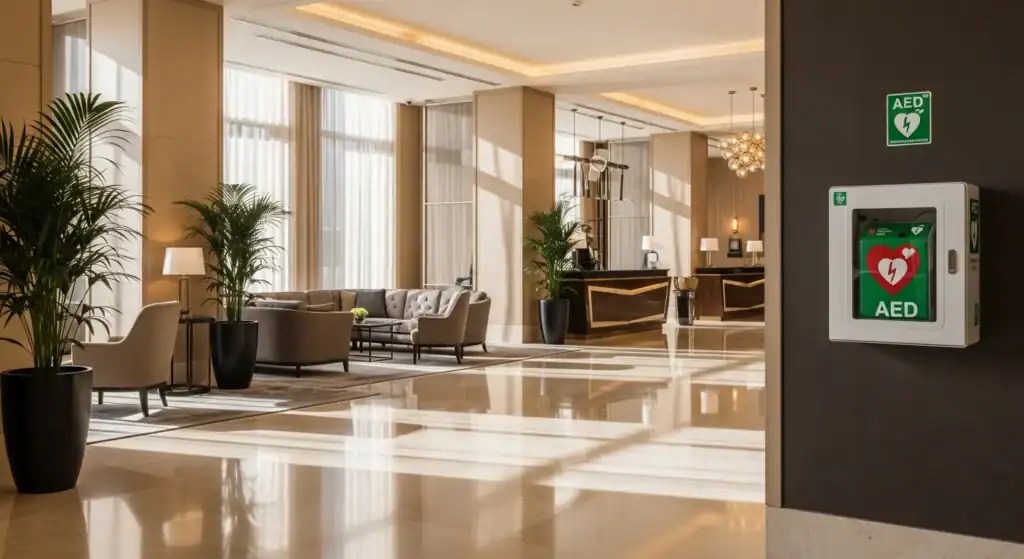
Every year, approximately 356,000 out-of-hospital cardiac arrests occur in the United States, and many happen in public spaces like hotels and resorts. For hotel owners and hospitality professionals, having an AED for hotels on the property can mean the difference between life and death.
Browse AED packages designed for hotels and commercial properties.
Sudden cardiac arrest does not discriminate. It can strike anyone, at any time, and hotels are no exception. This guide covers everything hotel owners and resort managers need to know about hotel emergency preparedness, from legal requirements and AED placement to staff training and choosing the right equipment.
Why Hotels and Resorts Need AEDs
Hotels serve thousands of guests each year, many traveling away from their regular healthcare providers. Here are the unique risk factors that make AEDs essential for hospitality properties.
High-Risk Guest Demographics
Hotels accommodate a diverse population including elderly travelers, business professionals under stress, and vacationers engaging in physical activities they may not be accustomed to. Guests with underlying heart conditions, high blood pressure, or diabetes face elevated cardiac risk, especially combined with travel-related stress, jet lag, and changes in routine.
Spread-Out Properties and Delayed EMS Response
Large resorts, multi-building complexes, and high-rise hotels present a logistical challenge for emergency responders. Paramedics may need extra time to navigate hallways, elevators, and sprawling grounds. Every minute without defibrillation reduces survival chances by 7 to 10 percent. Having AED devices strategically placed throughout the property bridges this critical gap.
Physical Demands on Staff
Hospitality work is physically demanding. Housekeepers, kitchen staff, and maintenance crews work long shifts involving heavy lifting and heat exposure. These conditions can contribute to cardiac events among employees, making on-site AEDs essential for protecting your workforce as well as your guests.
Guest Expectations and Brand Reputation
Today’s travelers are increasingly safety-conscious. Properties that demonstrate a commitment to hotel emergency preparedness through visible AED placement and trained staff build stronger guest confidence and loyalty. A well-publicized safety program can also differentiate your property from competitors and protect your brand reputation.
Ready to protect your guests and staff? Response Ready carries AED value packages designed for commercial properties, including hotels and resorts. Every package includes the device, cabinet, signage, and first responder supplies. Contact us today to discuss your property’s needs.
Legal Requirements and Liability for Hotel AEDs
Understanding hospitality AED requirements is critical for hotel owners and general managers. While there is no single federal law mandating AEDs in hotels, the regulatory landscape is evolving rapidly at the state and local level.
State AED Mandates
Several states have enacted legislation requiring or encouraging AEDs in public-access facilities. States like New York, California, Illinois, and Florida require AED programs in health clubs, schools, and large assembly venues. Many of these laws encompass hotel fitness centers, conference facilities, and pool areas. For a comprehensive overview, see our AED requirements compliance guide.
Good Samaritan Law Protections
All 50 states have Good Samaritan laws providing legal protection for individuals who use an AED in good faith during cardiac arrest. These protections typically extend to both the person using the device and the entity that owns it, provided the AED program meets maintenance and training standards.
Liability Considerations
Hotels face a duty of care obligation to their guests. Courts increasingly view the absence of an AED as a potential liability exposure. Properties that lack AEDs or fail to maintain them could face negligence claims if a cardiac arrest occurs on-site. A well-documented AED program with regular maintenance checks and staff training actually strengthens your legal position.
Brand and Insurance Requirements
Major hotel brands and franchise groups increasingly include AED placement in their safety standards. Additionally, some commercial insurance providers offer reduced premiums for properties with documented AED programs and trained staff. Check with your franchise agreement and insurance carrier to understand your specific obligations and potential benefits.
AED Placement Guidelines for Hotels and Resorts
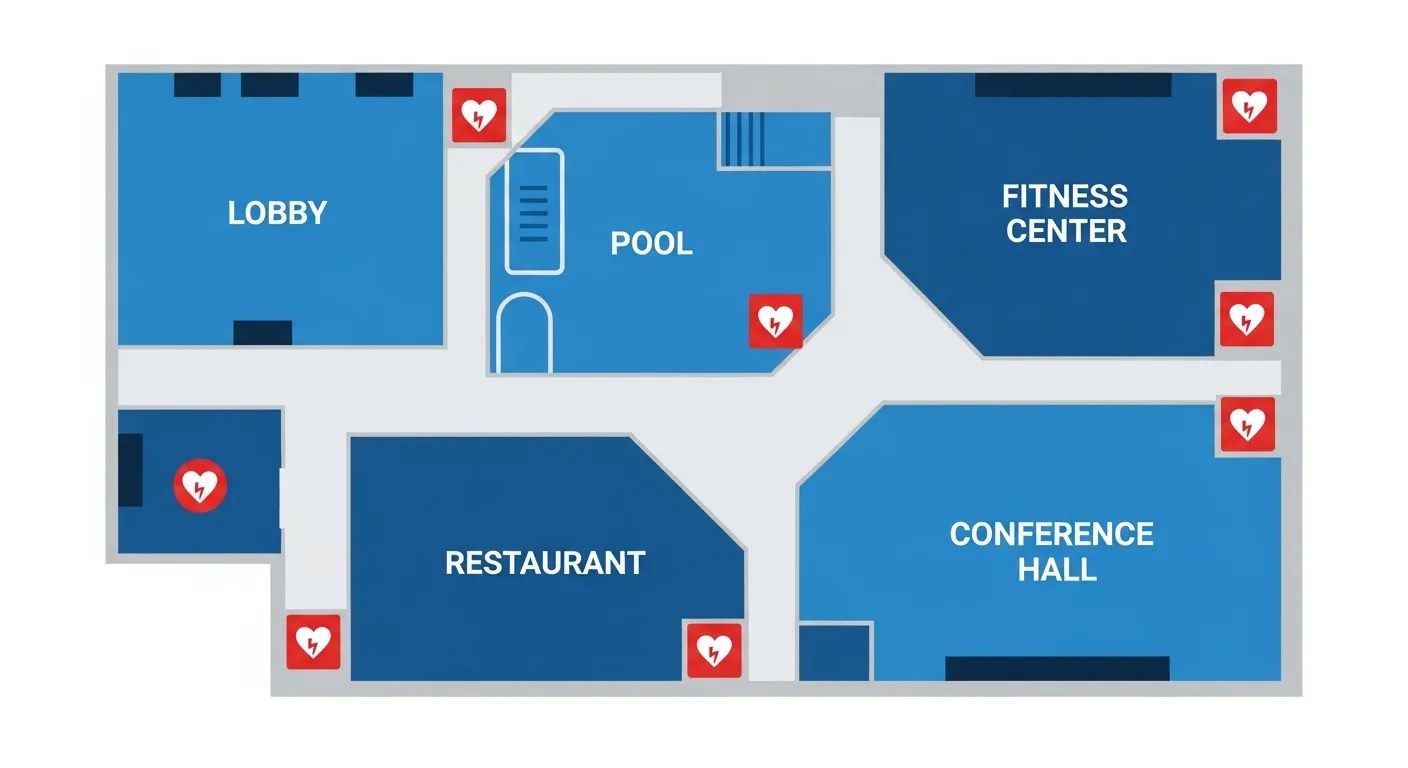
Strategic AED placement ensures rapid access during an emergency. The goal is to position devices so that any person on the property can reach an AED and return to the victim within three minutes.
Priority Locations
Based on foot traffic patterns and risk factors, the following areas should be top priorities for AED placement in hotels:
- Main lobby and front desk area – The central hub of the hotel where staff and guests concentrate
- Fitness center and spa – High cardiac risk due to physical exertion
- Pool and aquatic areas – Water-related incidents compound cardiac risk
- Convention and banquet halls – Large gatherings of guests, often with older attendees
- Restaurant and bar areas – Alcohol consumption can mask cardiac symptoms
- Each floor of a high-rise property – Elevator delays can cost critical minutes
- Outdoor recreation areas – Golf courses, tennis courts, hiking trails at resorts
How Many AEDs Does a Hotel Need?
The number of AEDs depends on the size and layout of your property. A general guideline is to ensure no location on the property is more than a three-minute round trip from an AED. For a standard mid-size hotel (150 to 300 rooms), this typically means three to five devices. Large resorts with multiple buildings, pools, and recreation areas may need eight or more. Our emergency AED guide provides additional details on calculating your needs.
Visibility and Signage
AEDs must be easy to find during an emergency. Mount them in clearly marked cabinets with standard AED signage at eye level. Place directional signs at key decision points and include device locations on property maps provided to guests.
Not sure how many AEDs your property needs? Response Ready offers free property assessments to help hotel owners determine optimal AED placement. We carry all 6 FDA-approved AED brands to match your facility’s needs. Browse our AED selection or call us at 858-665-2025.
Staff Training: Building a Cardiac Emergency Response Team
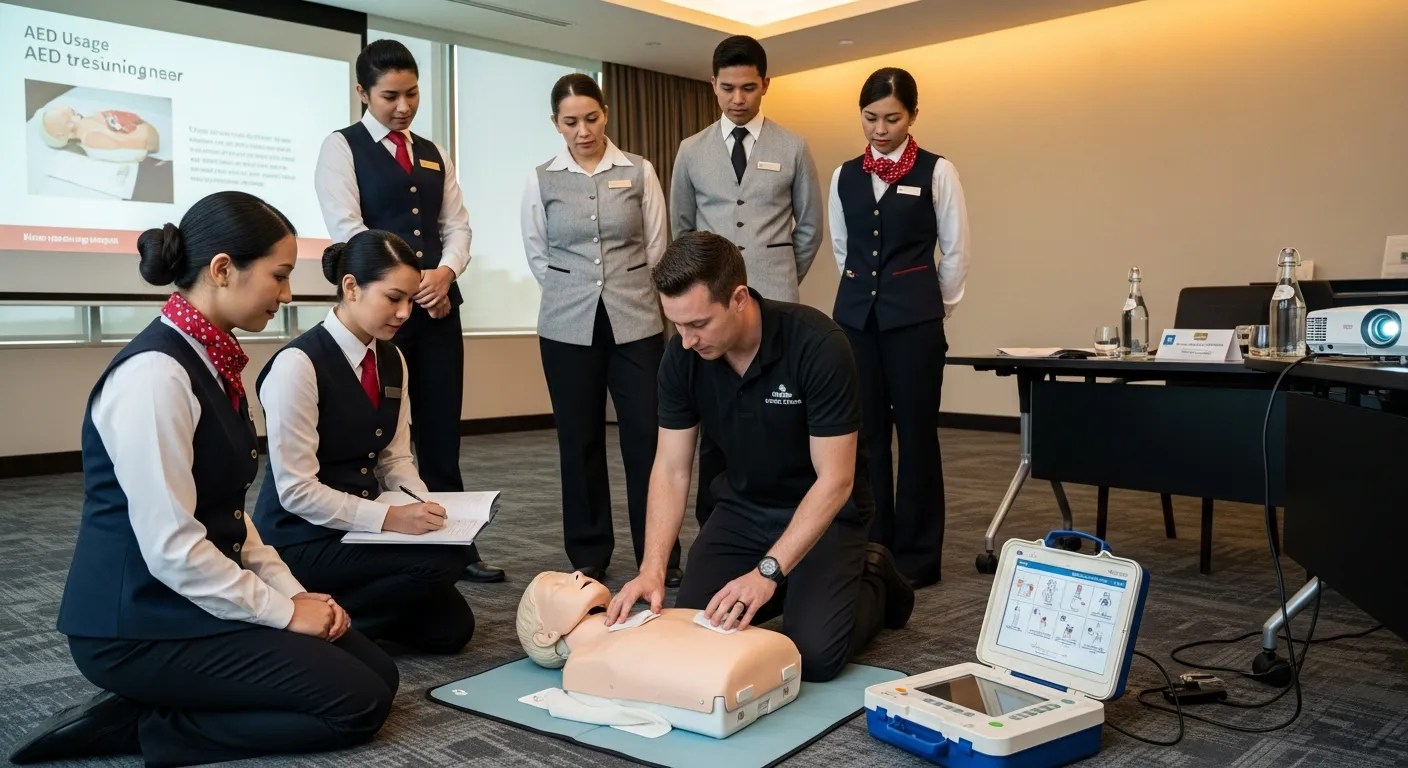
An AED is only effective if someone on-site knows how to use it quickly and confidently. While modern AEDs provide voice-guided instructions that allow untrained bystanders to operate them, formal training significantly improves response times and outcomes.
Who Should Be Trained
At minimum, train the following hotel staff members in CPR and AED use:
- Front desk and concierge staff – First point of contact during most emergencies
- Security team – Often the fastest responders on large properties
- Fitness center and pool attendants – Present in highest-risk areas
- Housekeeping supervisors – Present on guest room floors throughout the day
- Restaurant and event managers – Responsible for large guest gatherings
- Engineering and maintenance staff – Cover back-of-house areas
Training Requirements and Frequency
CPR/AED certification courses typically take two to four hours and are valid for two years. For hotels, aim to have at least one trained responder on duty during every shift. Response Ready partners with certified CPR/AED training providers who can deliver on-site group training sessions tailored to hospitality settings, minimizing disruption to your operations.
Creating an Emergency Action Plan
Training alone is not enough. Every hotel should have a written cardiac emergency response plan that includes:
- Designated roles (who calls 911, who retrieves the AED, who performs CPR)
- Clear communication protocols (radio channels, code phrases)
- AED locations mapped and distributed to all trained staff
- Post-event procedures (equipment replacement, incident documentation, employee support)
- Regular drills at least twice per year
Choosing the Right AED for Your Hotel Property
Not all AEDs are created equal, and hospitality settings have specific needs. When evaluating AED options and costs, consider these factors:
Ease of Use
Choose AEDs with clear voice prompts and visual guides. In a high-stress emergency, the device should guide any user, trained or untrained, through every step. Models like the Philips HeartStart OnSite and the ZOLL AED 3 are designed for simplicity in exactly these situations.
Durability and Environment
Hotels have diverse environments. An AED near the pool needs water resistance. A device in the parking garage needs to withstand temperature extremes. AEDs placed in outdoor recreation areas at resorts should carry an IP55 or higher ingress protection rating.
Maintenance and Total Cost of Ownership
Look beyond the purchase price. Battery life, pad replacement frequency, and ongoing maintenance costs all factor into total cost of ownership. Some models feature self-testing technology that runs daily diagnostics, reducing the burden on your maintenance staff.
Managed AED Programs
For hotel groups managing multiple properties, a managed AED program simplifies compliance across all locations. Response Ready’s AED Total Solution handles pad and battery tracking, maintenance reminders, and compliance documentation for a predictable annual fee.
Equip your hotel with confidence. Response Ready is the only AED distributor carrying all 6 FDA-approved manufacturers, so you get unbiased recommendations based on your property’s specific needs. Shop AED packages for hotels or call 858-665-2025 to speak with a specialist.
Many hotels prefer a flexible AED rental for hotels over outright purchase, especially when equipping multiple properties or seasonal venues. Rental plans bundle pad and battery replacements with centralized compliance tracking, which simplifies reporting across locations and reduces the burden on individual property managers. For brand-standard rollouts, monthly rentals scale predictably without large capital outlays.
Frequently Asked Questions
Are hotels legally required to have AEDs?
There is no single federal law requiring AEDs in hotels. However, many states have laws mandating AEDs in fitness centers, large assembly venues, and public-access buildings, which can include hotel facilities. Check your state and local regulations or consult our AED requirements compliance guide for details.
How many AEDs does a hotel need?
The number depends on property size and layout. A general rule is to position AEDs so no location is more than a three-minute round trip away. Mid-size hotels typically need three to five devices, while large resorts may need eight or more.
Where should AEDs be placed in a hotel?
Priority locations include the main lobby, fitness center, pool area, convention halls, restaurant areas, and each floor of a high-rise building. Any area with high foot traffic or elevated cardiac risk should have an AED within quick reach.
Do hotel staff need CPR and AED training?
While modern AEDs can be used by untrained bystanders, formal CPR/AED training is strongly recommended. Hotels should aim to have at least one trained responder on every shift. Training takes two to four hours and certification lasts two years.
How much does an AED program cost for a hotel?
Individual AED devices range from approximately $1,400 to $2,900. Value packages that include the device, cabinet, signage, and supplies offer the best overall value. Managed compliance programs like the AED Total Solution start at $99 per year per device for ongoing maintenance tracking.
Can untrained guests use a hotel AED in an emergency?
Yes. AEDs are designed for use by anyone, including untrained bystanders. The device analyzes the heart rhythm automatically and will only deliver a shock if one is needed. Good Samaritan laws in all 50 states protect people who use an AED in good faith during an emergency.