- Published
- March 25, 2026
What's the Best AED for Schools? Our Top 5 Picks


Placing a life-saving device in your school is a powerful commitment to the well-being of your students and staff. But this important decision can also feel heavy, and the fear of choosing the wrong equipment can be paralyzing. You need absolute confidence that you’re investing in a reliable, effective tool that’s ready when you need it most. This guide is designed to provide that certainty. We’ll compare top models and explain the features that are most important for a school setting, helping you find the best AED for schools and build a complete preparedness plan around it.
This guide is designed to remove the guesswork. We’ll walk you through a simple framework to help you select the perfect AED for your specific needs, whether you’re protecting your family at home, your students at school, or your employees at your small business.
Is Your School Prepared for a Cardiac Emergency?
The most critical factor in a cardiac arrest emergency is time. According to the American Heart Association, effective AED programs are built to deliver a shock within three to five minutes of collapse. While first responders are incredibly skilled, their arrival time can be unpredictable. An on-site AED empowers anyone to deliver life-saving care immediately, bridging the crucial gap until professional help arrives. Placing this power in your hands is the single most important step you can take.
Why Every Second Counts: Sudden Cardiac Arrest in Schools
Schools are bustling hubs of activity, filled with students, teachers, staff, and visitors. While we often think of cardiac arrest as something that affects older adults, it can happen to anyone, at any age, at any time. When it occurs on school grounds, the response in the first few minutes is absolutely critical. Having a clear emergency plan and the right equipment isn’t just a good idea—it’s a fundamental part of creating a safe environment for everyone. An on-site AED and trained responders can turn a potential tragedy into a story of survival, ensuring the community is prepared to act decisively when it matters most.
The Critical Window for Survival
When someone experiences sudden cardiac arrest, their heart stops beating effectively, and blood flow to the brain and other vital organs ceases. The chance of survival decreases by about 10% for every minute that passes without intervention. A defibrillator is the only thing that can restart a heart in this state, delivering a controlled electrical shock to restore a normal rhythm. Since paramedics can take several minutes to arrive, having an Automated External Defibrillator (AED) accessible on-site is essential. These devices are designed for use by anyone, providing clear, step-by-step instructions to guide the user through the entire process, empowering school staff to provide immediate, life-saving care.
AEDs in Schools: Understanding the Legal Landscape
One of the most common questions is whether schools are legally required to have AEDs. The answer isn’t straightforward, as there is no single national mandate. Instead, requirements vary from state to state, creating a patchwork of different laws and levels of preparedness across the country. Some states require AEDs in all schools, while others may only require them in high schools or during athletic events. Regardless of the specific laws in your area, the reality is that an AED is a proven tool for saving lives. Having a device is the first step, but a truly effective program also includes regular maintenance checks and ensuring staff know how to respond with confidence through CPR and AED training.
State Requirements and Unfunded Mandates
Even when states do require AEDs, they often don’t provide the funding to purchase them. This leaves many schools and districts in a tough position, understanding the importance of having these devices but struggling to fit them into tight budgets. This financial hurdle is a significant reason why some states only recommend AEDs instead of making them mandatory. Fortunately, there are practical ways to make preparedness more accessible. Cost-effective AED packages bundle the device with necessary accessories, while flexible options like an AED rental program can help schools implement a life-saving program without a large upfront investment, ensuring safety isn’t compromised by financial constraints. The good news is that multiple AED funding options exist, including federal grants, corporate programs, and community fundraising strategies.
5 Factors to Consider When Choosing an AED
Navigating the world of medical devices doesn’t have to be complicated. For non-medical users, the best AED isn’t the one with the most features, it’s the one that’s easiest to use and maintain in a high-stress situation. Here we break down the five factors that truly matter.
How Easy Is It to Use?
In an emergency, clarity is everything. Look for an AED with clear, calm voice prompts that guide you step-by-step through the entire process, from pad placement to delivering a shock. Some models also include visual guides or even real-time CPR feedback, coaching you on the rate and depth of chest compressions. This feature is invaluable for ensuring the user is performing effective CPR, which is a critical part of the rescue.
What’s the True Long-Term Cost?
The initial purchase price is only part of the story. Every AED requires ongoing maintenance, specifically replacing the AED pads and batteries which have a shelf life of two to five years. When comparing models, consider the long-term replacement costs. Some devices, like the HeartSine Samaritan, combine the battery and pads into a single cartridge, simplifying maintenance. At Response Ready, we believe in transparent pricing, so you can confidently budget for both the initial device and its future upkeep. Our value packages are designed to give you everything you need upfront at the best possible price.
Is It Durable and Portable?
Where will your AED live? An AED for a climate-controlled office has different needs than one for a dusty workshop or a mobile business. Look for the device’s IP (Ingress Protection) rating, which tells you how resistant it is to dust and water. A higher IP rating means greater durability in challenging environments. Additionally, consider the size and weight if you plan to move the AED frequently, such as for a sports team or an off-site event.
Is It FDA-Approved and Reliable?
This is non-negotiable. An AED is a medical device regulated by the Food and Drug Administration (FDA). Only purchase FDA-approved devices from a reputable and established vendor. This ensures the AED has met rigorous safety and effectiveness standards. Response Ready has been a trusted provider for over a decade, exclusively offering a curated selection of leading, FDA-approved AEDs to ensure you receive a safe and reliable device.
Can It Be Used on Children?
If your AED will be in a home with children, a school, or a community center, the ability to treat a child is essential. Sudden cardiac arrest can affect people of all ages. Most AEDs offer pediatric capability through special, smaller pads that deliver a reduced electrical shock. Some models, like the Philips FRx, use a single set of pads and a pediatric “key” to switch to child mode, simplifying the process in a frantic moment.
Navigating the Cost: Funding and Budgeting for a School AED
We understand that for many schools, the biggest hurdle to implementing an AED program isn’t desire, but budget. School administrators and parent organizations often recognize the importance of having these devices, but tight finances can make the purchase seem out of reach. This is why many states recommend AEDs rather than requiring them, leaving schools to find the funding on their own. The good news is that with a little creativity and community support, you can absolutely make it happen. Let’s explore a few practical ways to fund this life-saving investment for your students and staff.
Fundraising and Grant Opportunities
Your school community is your greatest asset. Tapping into that collective spirit through fundraising is a powerful way to cover the cost of an AED. You can organize classic events like bake sales, school fairs, or car washes that bring everyone together for a common cause. Another great option is to host a sponsored event, like a fun run or walk-a-thon, where students collect pledges. Don’t forget to reach out to local businesses for sponsorships or donations. Many are eager to support initiatives that improve community safety. You can also search for grants from local foundations or national organizations dedicated to heart health and public safety.
The Role of Refurbished AEDs
If a brand-new device is outside your budget, a refurbished AED is an excellent and safe alternative. These are not simply “used” devices; they are professionally recertified units that have been thoroughly inspected, tested, and updated with new pads and batteries to ensure they meet the manufacturer’s original specifications. When you purchase an AED from a trusted and established vendor, you can be confident that a refurbished model offers the same life-saving reliability as a new one, but at a more accessible price point. This approach allows you to protect your school community while making the most of every dollar in your budget.
Comparing the Best AEDs for Schools
To make your decision easier, here’s a look at three of the most trusted and user-friendly AEDs on the market, each suited for different environments.
|
Feature |
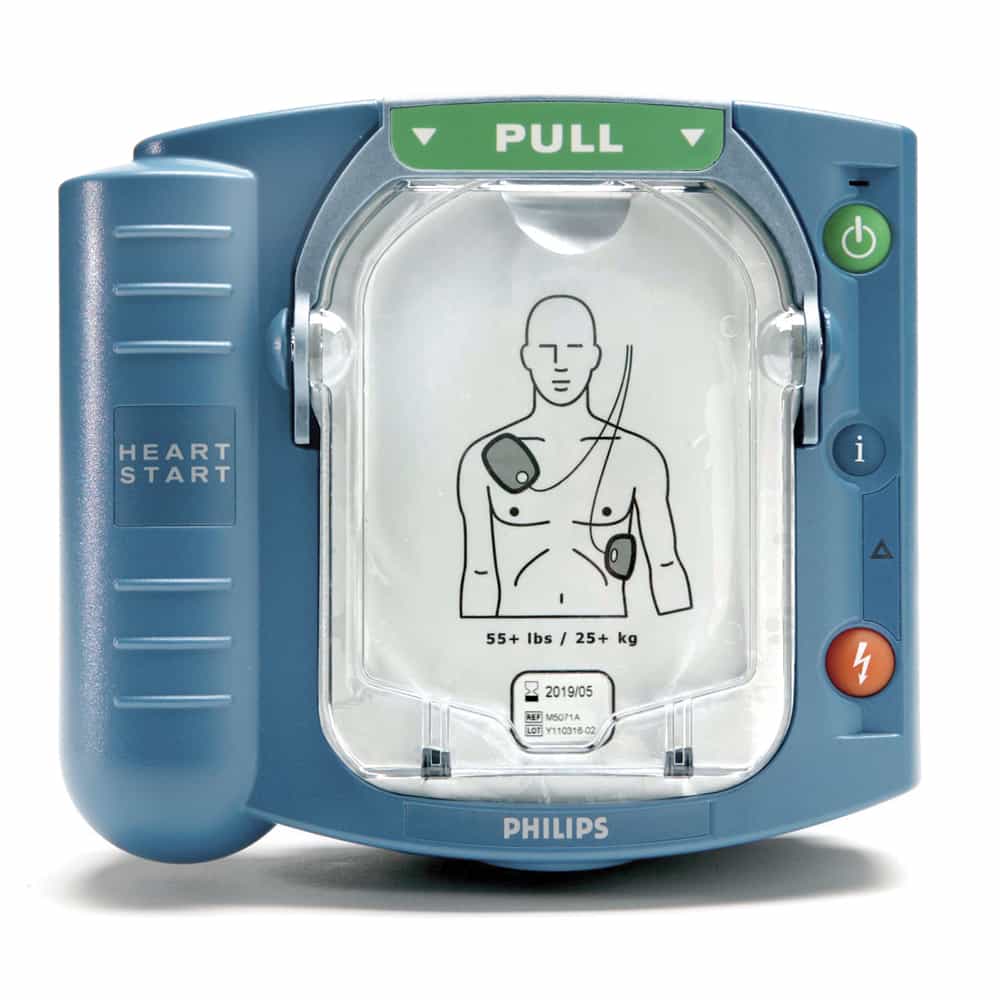
Philips HeartStart OnSite |
ZOLL AED Plus |
HeartSine Samaritan PAD 350P |
|
Best For |
Home, Office, General Use |
Small Business, Tough Environments |
Public Spaces, Budget-Conscious |
|
Ease of Use |
Extremely intuitive voice prompts |
Real-time CPR feedback |
Simple two-button operation |
|
Durability |
IP21 |
IP55 (Very high) |
IP56 (Highest) |
|
Pediatric Option |
Separate infant/child pads |
Special pediatric pads |
Combined Pad-Pak cartridge |
|
Maintenance |
Separate battery & pads |
Separate battery & pads |
Single battery/pad cartridge |
Best All-Rounder: Philips HeartStart OnSite
If you’re looking for the easiest-to-use AED for a non-medical responder, the Philips HeartStart OnSite is a top choice. It was designed specifically for laypeople and is the only AED available over-the-counter without a prescription. Its calm, clear voice instructions guide you confidently through every step. Its simplicity makes it an ideal solution for homeowners and office managers who want a device that is virtually foolproof.
Most Durable: ZOLL AED Plus
For environments that demand more durability, the ZOLL AED Plus stands out. With a high IP55 rating, it withstands dust and water, making it perfect for workshops, manufacturing floors, or sports fields. Its most significant feature is Real CPR Help®, which provides live feedback to help you perform high-quality chest compressions. This added layer of guidance can make a life-or-death difference and is a key reason why many small businesses choose this model.
Best for Children: LIFEPAK CR2
For homes, schools, and community centers, the LIFEPAK CR2 offers incredible peace of mind. Its standout feature is a simple child mode button that instantly adjusts the shock level for a pediatric rescue, eliminating the need to swap out electrode pads in a high-stress moment. This device also provides clear CPR coaching and features cprINSIGHT™ analysis technology, which allows chest compressions to continue while the AED analyzes the heart rhythm, reducing pauses that can impact survival. With optional dual-language capabilities and Wi-Fi connectivity for easy management, the CR2 is designed to empower any responder to act with confidence when a child’s life is on the line.
Best for Extreme Temperatures: ZOLL AED 3
If your AED needs to withstand the elements, the ZOLL AED 3 is built for the job. It can be stored safely in environments ranging from a frigid -22°F to a sweltering 158°F, making it the perfect choice for work vehicles, outdoor facilities, or unheated workshops. Like other ZOLL models, it provides real-time CPR feedback on compression depth and rate, helping you perform a more effective rescue. It also uses a single set of universal pads for both adults and children; you simply press a button to switch to child mode. Plus, its Wi-Fi connectivity automatically reports its status, ensuring your device is always ready to perform, no matter the conditions.
Most Portable: HeartSine Samaritan PAD 350P
The HeartSine Samaritan PAD 350P offers a fantastic balance of performance, durability, and affordability. It boasts the highest durability rating (IP56) in a compact and lightweight design, making it easy to store and transport. Its key advantage is the innovative Pad-Pak, a single cartridge containing both the battery and electrode pads. This simplifies maintenance with just one expiration date to track, making it an excellent, low-maintenance choice for schools, churches, and community centers.
Other Reliable AED Brands to Consider
While we’ve highlighted three of our most popular models, the best AED is always the one that fits your specific environment and budget. The market includes several excellent, FDA-approved brands, and the key is matching the device’s features to your needs. For example, the ZOLL AED Plus is a fantastic choice for tougher settings like workshops or athletic fields because of its high durability and Real CPR Help® feature, which gives you live feedback on your chest compressions. Similarly, the HeartSine Samaritan PAD 350P is prized for its portability and simple maintenance, making it a reliable and cost-effective option for places like community halls or mobile response teams. The goal is to feel confident in your choice, knowing it’s ready when you need it.
Key Features: Automatic vs. Semi-Automatic and Language Options
Beyond brand and durability, a few key features can make a big difference in a rescue. One of the most important is choosing between a semi-automatic and a fully automatic model. A semi-automatic AED will instruct you to press a flashing button to deliver the shock, giving you final control. A fully automatic AED will provide a verbal warning and then deliver the shock on its own. For many lay rescuers, the fully automatic option simplifies an incredibly high-stress moment. Another vital feature for diverse communities and workplaces is bilingual support. Some AEDs offer voice prompts in multiple languages, ensuring that anyone can be a confident rescuer, regardless of their primary language. When you browse AEDs, consider which of these options will best serve the people in your environment.
What Else Do You Need with Your AED?
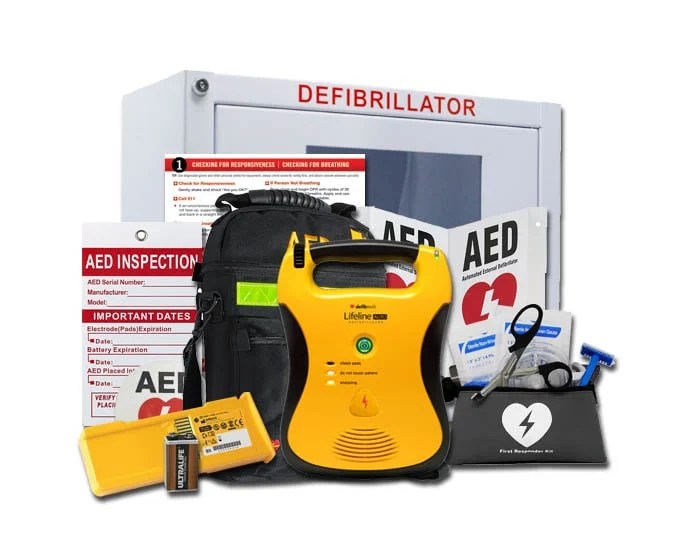
Once you’ve chosen your AED, a few key accessories will ensure it’s protected, visible, and ready when needed.
-
AED Cabinets:
A visible wall cabinet not only keeps the device secure but also makes it easy to find in an emergency. Alarmed cabinets alert everyone nearby that an event is in progress. -
Carrying Cases:
If your AED needs to be portable, a dedicated carrying case protects it from damage during transport. -
Signage:
Clear signage is crucial. An AED wall sign helps people locate the device quickly, saving precious seconds. -
Training:
While modern AEDs are easy to use, proper CPR and AED training builds the confidence to act decisively.
Public Accessibility and Device Registration
An AED is most effective when it’s available to anyone who needs it. For schools, businesses, and community centers, this means thinking beyond your own four walls. Placing your device in an unlocked, heated outdoor cabinet makes it a resource for the entire neighborhood, potentially saving a life after hours or on a weekend. Once you have your AED, it’s also a good practice to register it with your local emergency services. Many 911 dispatch systems can now locate and direct bystanders to a nearby registered AED. This simple step connects your life-saving device to a larger network of first responders, ensuring it can be found and used as quickly as possible during a crisis.
Essential Accessories: Cabinets, Pads, and Batteries
Beyond the device itself, a few key AED accessories are essential for a successful preparedness program. A clearly marked wall cabinet ensures your AED is both secure and highly visible, while an alarmed version alerts everyone nearby that an emergency is underway. Just as important is managing the device’s consumables. Every AED requires replacement pads and batteries, which typically expire every two to five years. Staying on top of these dates is critical for readiness. Some models simplify this by combining the pads and battery into a single cartridge, but regardless of the device, a clear maintenance plan is a must.
The Importance of CPR and AED Training
While modern AEDs are designed to be used by anyone, nothing replaces the confidence that comes from hands-on training. In a moment of panic, hesitation can cost precious seconds. Professional CPR and AED training empowers you to act decisively, teaching you not only how to operate the device but also how to recognize the signs of cardiac arrest and perform high-quality chest compressions. This knowledge transforms you from a bystander into a confident first responder, ready to manage the scene and provide effective care until professional help arrives. Investing in training is investing in the certainty that you’ll be ready to make a difference when it matters most.
Ready to Make Your School Safer?
Choosing an AED is one of the most empowering decisions you can make for your home, school, or business. It’s a proactive step that prepares you to handle one of life’s most critical emergencies. By focusing on ease of use, total cost, and the specific needs of your environment, you can select a device with confidence.
If you have more questions or would like personalized guidance, our team of experts is here to help. Explore our AED superstore or call us to find the perfect solution to protect your community.
Frequently asked questions
Q: Where is the best place to put my AED?
A: Your AED should be placed in a central, visible, and easily accessible location. For a home, this might be a main living area or kitchen. In a school or business, place it near high-traffic areas like lobbies, cafeterias, or gyms, and ensure it is not locked away. The goal is to retrieve it within 90 seconds.
Q: What are the maintenance requirements for an AED?
A: Maintenance is simple but crucial. It involves regular visual inspections to ensure the device’s status indicator shows it’s ready, and replacing the electrode pads and batteries before they expire (typically every 2-5 years). The Response Ready App can help automate these readiness checks and reminders, making compliance effortless.
Q: Is buying an AED tax-deductible for my small business?
A: In many cases, yes. The purchase of an AED can often be classified as a business expense, making it tax-deductible. We recommend consulting with your tax professional to understand the specific implications for your business.
Q: Do I need a prescription to buy an AED?
A: Most AEDs require a prescription, which is a simple process that we handle for you at no extra cost. However, the Philips HeartStart OnSite is available for purchase without a prescription, making it an exceptionally convenient choice for home users.
Q: Can I get in trouble for using an AED on someone?
A: All 50 states have Good Samaritan laws that protect bystanders who act in good faith during an emergency. These laws are in place to encourage people to help without fear of legal repercussions. Using an AED to save a life is exactly the kind of action these laws are designed to protect.
Key Takeaways
- Focus on ease of use and child safety: In a high-stress situation, clarity is key. Select an AED with simple voice instructions, helpful CPR feedback, and a straightforward way to switch to pediatric mode for younger students.
- Look beyond the sticker price: A successful program accounts for long-term costs. Factor in the price of replacement pads and batteries, and choose a device with the right durability for its specific location, like a busy gym or a main office.
- Build a complete response plan: An AED is just one piece of the puzzle. Make it effective by placing it in a visible cabinet, using clear signage to guide people, and providing CPR and AED training so your staff feels confident and prepared to act.
Related Articles
- Best AED for Schools – Protect Your Campus in an Emergency — Response Ready
- What makes HeartSine AEDs ideal for public spaces and schools?
- Your guide to pediatric AED pads for schools and community centers
- The essential guide to selecting an AED for schools and community centers
Disclaimer for information purposes only:
The information provided on this website is intended for general educational and informational purposes only. It is not medical advice and should not be used as a substitute for professional diagnosis, treatment, or care. Always consult a qualified healthcare or medical professional regarding any health-related questions or concerns.
While we strive to ensure the information shared is accurate and up to date, no guarantees are made regarding completeness, accuracy, or applicability to any individual situation. Use of this content is at the reader’s sole discretion and risk.
This website is part of the Response Ready family of emergency preparedness and training resources, including CPR & first aid training and compliance services, AED sales and program support, AED program management software, and medical oversight solutions provided through our affiliated platforms:
• CPR1.com
• AEDLeader.com
• AEDTotalSolution.com
• MDSIMedical.com
By accessing or using this website, you agree to release, indemnify, and hold harmless the website owners, authors, contributors, and affiliated entities from any claims, losses, damages, or liabilities arising from the use or reliance on the information presented.