- Published
- March 14, 2026
Protecting Your Family Small Business: A Guide


Building a successful family small business means planning for everything, from defining roles to managing finances and planning for the next generation. But what about the unexpected? A sudden medical emergency can disrupt everything in an instant, threatening the very people who make your business possible. True resilience isn’t just about weathering market changes; it’s about being prepared for a crisis when every second counts. This article will cover the practical steps you can take to create a response-ready workplace, giving you the confidence that comes from knowing you’ve protected your business and your family from the ground up.
What is a Family Business?
A family business is pretty much what it sounds like: a company where two or more family members are involved, and the majority ownership or control lies within the family. This could be a husband-and-wife duo running a local coffee shop, siblings who’ve started a tech company, or a multi-generational construction firm passed down from a great-grandparent. The key ingredient is that family is at the heart of the business, influencing its culture, decisions, and long-term vision. These businesses range from tiny startups to massive corporations, but they all share that unique blend of personal relationships and professional goals.
The Economic Impact of Family-Owned Businesses
It’s easy to underestimate just how vital family businesses are to the economy. They aren’t just small mom-and-pop shops; they are a major economic force. According to Family Enterprise USA, family businesses are responsible for creating 59% of all private sector jobs in the U.S., which adds up to over 83 million jobs. They also contribute a staggering $7.7 trillion to the country’s GDP. This means that more than half of the private sector’s economic activity comes from businesses run by families. They are the backbone of local communities and a powerful engine for national growth, proving that mixing family and business can lead to incredible success.
Common Ideas for Family Businesses
When you think about starting a business with your family, the possibilities are nearly endless. The best idea is often one that combines a genuine market need with your family’s unique skills, passions, and values. Whether you’re all great with your hands, have a shared love for food, or are masters of customer service, there’s likely a business model that fits. From service-based companies that rely on trust to online stores that can be run from anywhere, families can team up to build something meaningful and profitable together. The key is finding the right fit for your collective talents and goals.
Service-Based Businesses
Service-based businesses are a natural fit for families because they often rely on trust, reliability, and a personal touch—qualities that are already built into family dynamics. Think about ventures like cleaning services, landscaping companies, or handyman services where clients are letting you into their homes and lives. A family team can project a strong sense of unity and accountability. Other ideas include child care, where a nurturing family environment is a huge selling point, or even local errand and delivery services that thrive on community connection. These businesses often have lower startup costs and allow families to work together directly to build a stellar reputation.
Retail and E-Commerce
With online shopping continuing to grow, starting a retail or e-commerce business has become a popular and accessible option for families. An online store can be managed from home, offering the flexibility that many families need. You could sell handmade goods, curate products from other suppliers, or create your own unique brand. Different family members can handle various aspects of the business, like one person managing the website and marketing, another handling inventory and shipping, and another focusing on customer service. This model allows you to reach a global audience while still working closely as a family unit.
Food and Event-Based Businesses
If your family gatherings always revolve around amazing food or perfectly planned parties, a food or event-based business could be your calling. These ventures are all about creating memorable experiences, and the collaborative energy of a family can make them even more special. Common examples include opening a restaurant, launching a catering company, or running a food truck. You could also sell artisanal goods like baked treats or preserves at local farmers’ markets. These businesses allow each family member to contribute their unique talents, whether it’s cooking, baking, planning, or charming customers. It’s a great way to turn a shared passion into a thriving enterprise.
Advantages of Running a Family Business
Working with family can be one of the most rewarding professional experiences you’ll ever have. While it comes with its own set of challenges, the benefits are powerful. At its best, a family business operates on a deep foundation of shared history, mutual respect, and an instinctive understanding of one another. This can translate into a resilient, agile, and deeply committed organization. From the unwavering trust you share to the flexibility you can offer one another, the advantages of building a business with the people you know best are significant and can give you a unique edge in the marketplace.
Trust and Shared Commitment
One of the biggest advantages of a family business is the built-in foundation of trust. You’re working with people you’ve known your whole life, which fosters a level of loyalty and commitment that’s hard to replicate with non-family employees. Family members are often deeply invested in the long-term success of the business because its fate is tied to the family’s reputation and financial well-being. This shared stake means everyone is more likely to go the extra mile. As one source notes, family members have a natural bond and are more likely to stick with the business, which creates stability and a strong, unified team.
Flexibility and Shared Values
Family businesses are often guided by a set of shared values that have been part of the family for generations. This common ground makes it easier to create a company culture and mission that everyone genuinely believes in. This alignment can lead to quicker, more intuitive decision-making. Furthermore, family businesses can offer a level of flexibility that is rare in traditional corporate environments. Family members are often more understanding of personal commitments, whether it’s caring for a sick child or attending a school play. This supportive atmosphere can lead to greater job satisfaction and a healthier work-life balance for everyone involved.
Challenges in a Family Business
Of course, running a business with family isn’t always smooth sailing. The very things that make it great—the close relationships, shared history, and emotional investment—can also create unique complications. Personal disagreements can spill over into professional life, and business decisions can feel intensely personal. It’s important to go into it with your eyes wide open, prepared to face potential hurdles like maintaining a work-life balance and planning for the company’s future. Acknowledging these challenges upfront is the first step toward building a business that strengthens your family, rather than strains it.
Separating Work and Personal Life
One of the most common struggles in a family business is drawing a line between work and home. When your business partner is also your spouse, sibling, or parent, it can be difficult to stop shop talk at the dinner table. Business disagreements can easily become personal arguments, creating stress that follows you home. It’s crucial to set boundaries to protect both your professional and personal relationships. Without them, the pressure of running a business can strain family dynamics, making it feel like you’re never truly off the clock. This constant overlap requires deliberate effort to manage effectively.
Managing Conflict and Succession Planning
Conflict is inevitable in any business, but it can feel much heavier when it involves family. A simple disagreement over strategy can be complicated by years of family history. It’s essential to establish clear processes for resolving disputes fairly. An even bigger challenge is succession planning—deciding who will take over the business when the current generation is ready to retire. This can be particularly tricky if there are multiple children or grandchildren involved, as decisions about leadership and ownership can stir up feelings of fairness and entitlement. Without a clear, agreed-upon plan, succession can become a major point of contention.
Recommendations for a Successful Family Business
To build a family business that lasts, you need more than just a great idea and a strong work ethic. You need structure, clear communication, and thoughtful planning. The most successful family enterprises are those that operate with the same professionalism as any other company, while still holding onto the unique strengths that come from their family ties. By establishing clear rules of engagement from the start, you can avoid common pitfalls and create a healthy, sustainable environment where both the business and the family can flourish for generations to come.
Establish a Formal Structure
It might feel overly formal, but treating your family business like a “real” business from day one is one of the best things you can do for it. This means putting things in writing. According to U.S. Bank, creating a written agreement for your business, just like any other company, helps avoid future fights and legal issues. This document should outline ownership percentages, compensation, responsibilities, and a plan for how to handle disagreements or the exit of a family member. This structure provides clarity and protects everyone involved, ensuring that business decisions are made objectively rather than emotionally.
Legal and Financial Considerations
Beyond a partnership agreement, it’s important to get your legal and financial houses in order. This means choosing the right legal structure for your business (like an LLC or S-Corp), setting up a separate business bank account, and keeping meticulous financial records. Don’t mix personal and business finances—it can create a mess for taxes and legal liability. It’s wise to consult with a lawyer and an accountant who have experience with family businesses. They can help you set up everything correctly and provide unbiased advice, which is incredibly valuable when emotions are running high.
Set Clear Roles and Boundaries
To avoid confusion and resentment, it’s essential to define clear roles for every family member involved in the business. These roles should be based on skills, experience, and interests, not just on family hierarchy. When you figure out what each person is good at and give them roles that match their strengths, everyone becomes more productive and feels more valued. It’s also important to establish clear boundaries between work and family life. This could mean setting specific work hours or making a rule to not discuss business during family gatherings. These boundaries help preserve your personal relationships and prevent burnout.
Communicate and Plan for the Future
Open and honest communication is the lifeblood of any successful family business. Schedule regular meetings to discuss goals, celebrate wins, and address problems before they escalate. These check-ins create a dedicated space for business talk, helping to keep it from taking over family time. It’s also critical to plan for the future together. This includes not only long-term business strategy but also succession planning. Talking about who will eventually take over and how that transition will happen can be uncomfortable, but it’s necessary to ensure the business continues smoothly for the next generation.
Protecting Your Business and Your Family
When you run a family business, you’re not just protecting a financial asset; you’re protecting your family’s legacy and livelihood. This means thinking beyond balance sheets and marketing plans. True protection involves creating a safe and resilient environment where everyone—family and non-family employees alike—can thrive. It’s about being prepared for the unexpected, whether it’s a sudden medical emergency on-site or a natural disaster that disrupts your operations. A comprehensive safety plan is a fundamental part of responsible ownership and shows your team that you value their well-being above all else.
Why Emergency Preparedness is Non-Negotiable
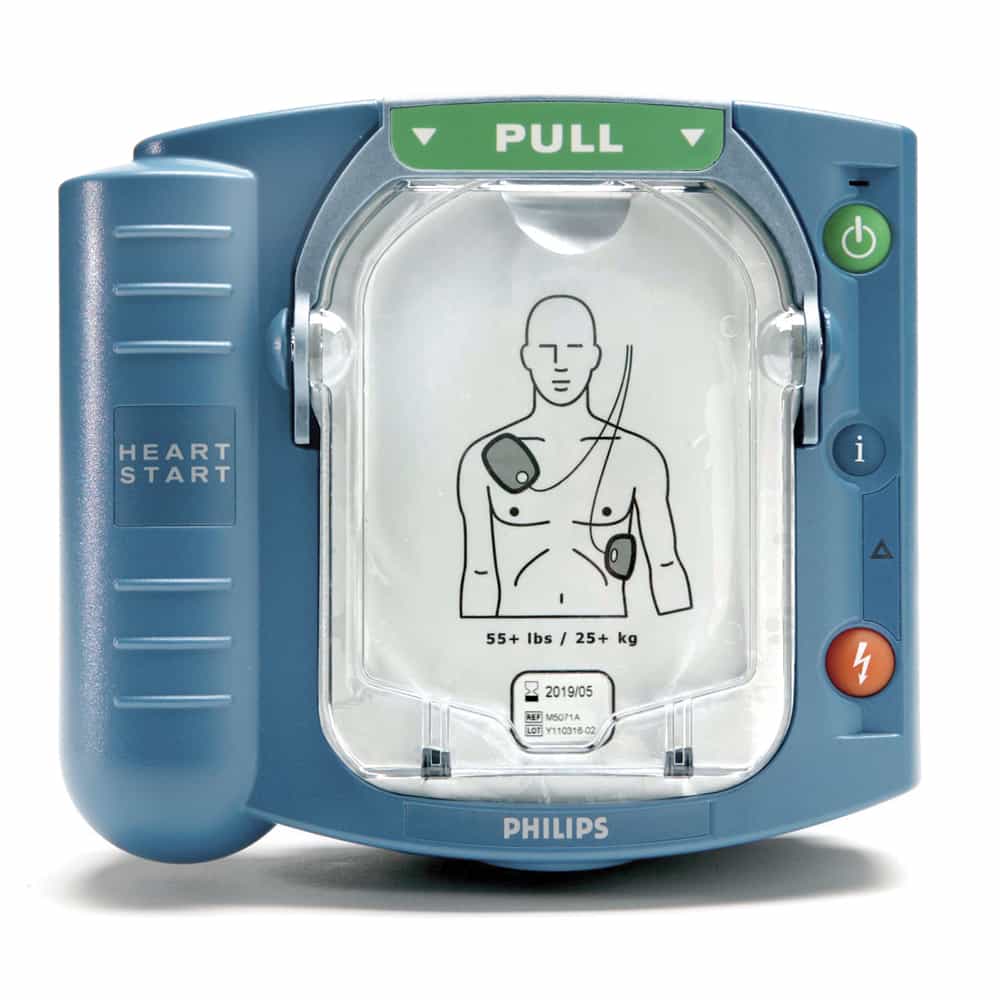
Just as you establish formal structures to prevent business conflicts, you need a plan to handle physical emergencies. A sudden cardiac arrest, a severe injury, or a natural disaster can halt your operations in an instant and have devastating consequences. Being prepared isn’t about fear; it’s about confidence and responsibility. Having well-stocked first aid kits and an easy-to-use Automated External Defibrillator (AED) accessible in the workplace can be life-saving. When help is delayed, these tools empower your team to act decisively. Investing in preparedness shows your employees and your family that their safety is your top priority. It’s a critical layer of protection for the people who are the heart of your business. Furthermore, providing CPR and AED training ensures that your team has the skills and confidence to respond effectively when it matters most.
How to Choose the Right AED for Your Family or Small Business
When a heart stops, the clock starts. In those first few critical moments of a sudden cardiac arrest, clarity is everything. You’re not thinking about manuals or complex procedures. You’re focused on one thing: saving a life. But for most of us who aren’t medical professionals, the thought of using an Automated External Defibrillator (AED) can be intimidating. The fear of making a mistake is real, and it can cause a dangerous hesitation.
The data is sobering. The American Heart Association reports that for every minute that passes without defibrillation, a person’s chance of survival drops by 7 to 10 percent. With over 356,000 cardiac arrests occurring outside of a hospital each year in the U.S., and nearly 74% of those happening in a home, being prepared is not just a good idea, it’s essential. The right AED in the right hands can turn a bystander into a rescuer, and in today’s world, the “right” AED is one that anyone can use with absolute confidence.
What’s the Single Most Important Feature in an AED?
In a high stress situation, your brain processes information differently. Complex instructions become confusing, and simple audio prompts can get lost in the noise and panic. This is where user friendliness becomes more than a convenience, it’s a life saving feature. Research highlights a common challenge: untrained bystanders are often hesitant to use AEDs because they’re afraid of doing something wrong.
An ideal AED for a home, school, or small business must be designed to cut through that fear. It needs to guide the user calmly and clearly, leaving no room for guesswork. While voice prompts are a standard feature on all modern AEDs, a device that provides multi sensory guidance, both showing and telling you what to do, can dramatically improve a rescuer’s performance. AEDs with real time CPR feedback and clear, direct instructions significantly boost the quality of care provided by a layperson.
How Video Guidance Sets a New Standard: The Defibtech Lifeline VIEW
This is precisely why we so often recommend the Defibtech Lifeline View AED to families and organizations. It was one of the first AEDs designed with a full color, high resolution video display that shows you exactly what to do, step by step.
Instead of just telling you where to place the electrode pads, it shows you on a clear diagram of the human body. It doesn’t just tell you to perform CPR, it demonstrates the correct hand placement and rhythm. For someone who has never performed CPR or used a defibrillator, this visual coaching is a game changer. It transforms a moment of potential panic into a series of clear, manageable actions, empowering you to act decisively when it matters most.
Matching Your AED to Your Specific Needs
Choosing an AED isn’t just about the technology, it’s about matching the device to the environment where it will be kept and the people who might need to use it.
Protecting Your Family at Home
With most cardiac arrests happening at home, having an AED is one of the most important safety measures you can take for your loved ones. The Lifeline View’s intuitive design means a visiting relative, a babysitter, or even a teenager can follow its video instructions. Its lightweight, durable construction makes it easy to store in a central location, ensuring it’s always within reach. Investing in a home defibrillator gives your family a powerful tool to respond effectively in an emergency.
Keeping Your School or Community Center Safe
Protecting children, staff, and visitors is the highest priority for any school or public gathering place. An AED needs to be simple enough for any staff member to operate under pressure. The Lifeline View’s video display removes ambiguity, which is crucial in a chaotic environment. It’s also compatible with pediatric pads for use on children. To build a complete circle of safety, pairing a user friendly device with one of our accessible CPR and AED training courses ensures your team is prepared for any event.
Equipping Your Small Business for an Emergency
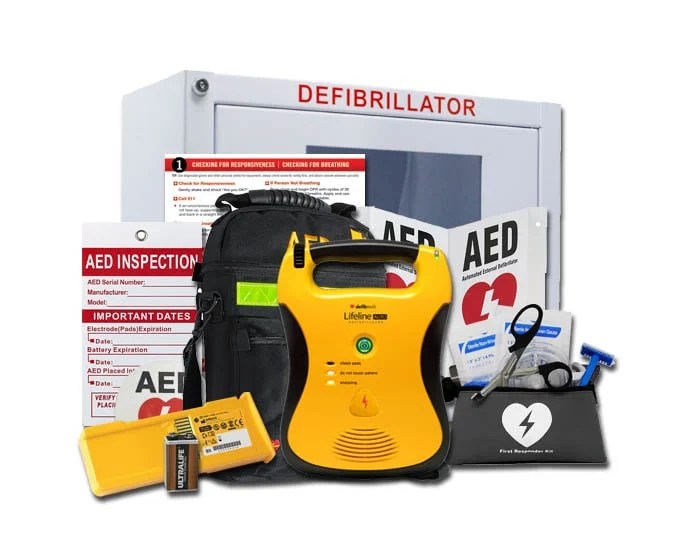
As a business owner, you have a duty of care to your employees and customers. An AED is a critical component of your workplace safety plan. A device like the Lifeline View minimizes the training burden on your staff while maximizing their ability to respond. Its clear instructions reduce the risk of user error and demonstrate a powerful commitment to workplace safety. For a complete solution, consider one of our value packages that includes the AED, a wall cabinet for high visibility, and a readiness kit.
Creating a Complete Safety Plan Around Your AED
Purchasing an AED is the first step. Creating a truly life saving program involves thinking about accessibility, support, and long term readiness.
Where Should You Keep Your AED?
An AED is only effective if people can find it quickly. It should be stored in a visible, unlocked, and central location. Clear signage helps ensure that in an emergency, no time is wasted searching for the device. You can learn more about strategic placement in our health center.
Understanding Warranty, Support, and Peace of Mind
When you purchase from Response Ready, you’re getting more than just a device. You’re getting over a decade of expertise and a commitment to your success. We stand behind every product we sell with comprehensive support, a one year price promise, and a 30 day money back guarantee. Our team is always available to help you choose from our entire AED superstore to find the perfect fit.
Frequently asked questions
Q: Can I really use an AED without medical training?
A: Absolutely. Modern AEDs are specifically designed for laypeople. Devices with advanced guidance like the Defibtech Lifeline View walk you through every step with voice and video commands, making the process simple and clear even for first time users.
Q: Can I accidentally shock someone who doesn’t need it?
A: No. An AED will not deliver a shock unless its internal computer detects a shockable heart rhythm. The device analyzes the person’s condition and will only advise a shock if it is medically necessary. You cannot harm someone by applying an AED.
Q: What’s the difference between video coaching and just voice prompts?
A: Voice prompts tell you what to do, while video coaching shows you. In a loud or chaotic environment, visual instructions can be much easier to follow. Video provides an extra layer of confidence for pad placement, CPR technique, and other critical steps.
Q: Are there special considerations for using an AED on a child?
A: Yes. For children under 8 years of age or weighing less than 55 pounds, you should use pediatric electrode pads. These pads deliver a lower energy shock. The Defibtech Lifeline View provides instructions for using both adult and pediatric pads.
Q: How do I know when to replace the battery and pads?
A: All AEDs perform regular self checks and will indicate when the battery or pads are nearing their expiration date, usually with a chirping sound or a visible status indicator. The Defibtech Lifeline View has a clear status screen that shows you it’s ready to use.
Key Takeaways
- Establish Clear Structures from Day One: Protect your business and your family by creating written agreements, defining roles based on individual skills, and setting firm boundaries between work and home. This professional approach prevents future conflicts and keeps everyone on the same page.
- Make Emergency Preparedness a Core Value: True business protection goes beyond finances; it’s about keeping your people safe. Equip your workplace with essential tools like first aid kits and an AED, and provide training so your team has the confidence to respond effectively in a crisis.
- Choose an AED Anyone Can Use with Confidence: In an emergency, simplicity is life-saving. Look for an AED with intuitive features like video instructions that show, not just tell, you what to do. This removes guesswork and empowers any bystander to become a rescuer.
Related Articles
- How to choose the right AED for your home or small business
- Why Defibtech AEDs are ideal for small businesses and public venues
- The Smart Buyer’s Office Defibrillator Guide
- Power Outage Emergency Response Plan PDF [Free Template]
- Your Emergency Kit Checklist: 20 Must-Have Items
Disclaimer for information purposes only:
The information provided on this website is intended for general educational and informational purposes only. It is not medical advice and should not be used as a substitute for professional diagnosis, treatment, or care. Always consult a qualified healthcare or medical professional regarding any health-related questions or concerns.
While we strive to ensure the information shared is accurate and up to date, no guarantees are made regarding completeness, accuracy, or applicability to any individual situation. Use of this content is at the reader’s sole discretion and risk.
This website is part of the Response Ready family of emergency preparedness and training resources, including CPR & first aid training and compliance services, AED sales and program support, AED program management software, and medical oversight solutions provided through our affiliated platforms:
• CPR1.com
• AEDLeader.com
• AEDTotalSolution.com
• MDSIMedical.com
By accessing or using this website, you agree to release, indemnify, and hold harmless the website owners, authors, contributors, and affiliated entities from any claims, losses, damages, or liabilities arising from the use or reliance on the information presented.