- Published
- June 16, 2026
AED Rental vs Purchase

AED Rental vs Purchase: Which Option Saves Your Organization More?
Should you rent or buy an AED? It is one of the first big questions for any organization setting up a cardiac emergency response plan. Both paths get you the same life-saving device on the wall, but the cost, control, and commitment look very different over time.
This AED rental vs purchase guide walks you through the real numbers, the situations where each option makes sense, and a side-by-side comparison so you can pick the right path for your team. By the end, you will know exactly which option fits your budget, your timeline, and your risk profile.
What Is the Difference Between Renting and Buying an AED?
When you buy an AED, you own the device outright. You pay one upfront price for the unit, then cover ongoing costs like pad and battery replacements, training, and any service plans you choose to add.
When you rent an AED (sometimes called an AED lease), you pay a monthly or annual fee that typically bundles the device, replacement pads and batteries, compliance management, and sometimes training. The device stays with the rental provider, and you return it when the contract ends.
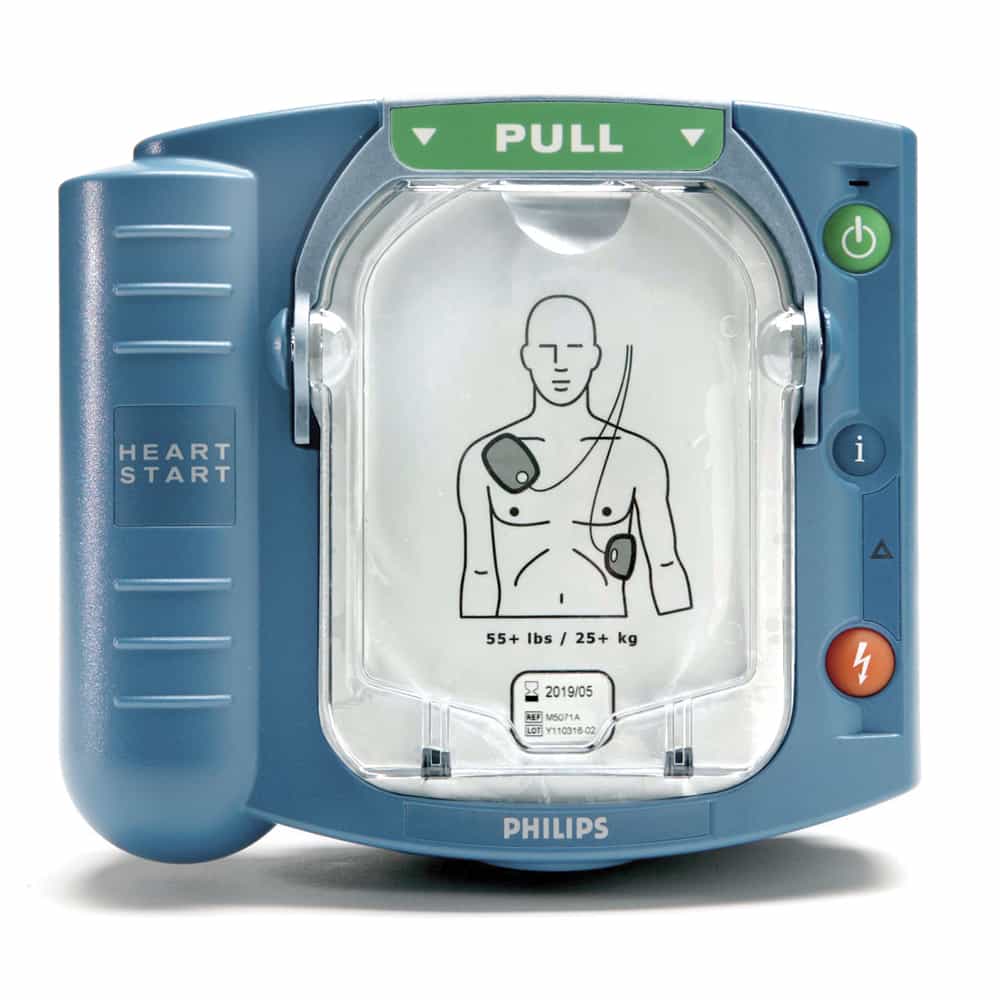
Both options give your team access to the same FDA-approved brands. ResponseReady offers AED rental on models like the HeartSine 350P, Philips HeartStart OnSite, ZOLL AED Plus, and Physio-Control LIFEPAK CR2, and you can shop the same units to buy directly.
AED Rental vs Purchase Comparison Table
The table below breaks down the key differences. Use it as a quick reference, then read the sections underneath for the full picture.
| Factor | AED Rental | AED Purchase |
|---|---|---|
| Upfront cost | Low (often $0 down) | $1,400 to $2,700 per unit |
| Monthly cost | Fixed monthly fee | $0 (one-time payment) |
| Pads and batteries | Included | Replaced separately every 2 to 5 years |
| Compliance support | Usually included | Optional add-on or self-managed |
| Device ownership | Provider owns it | You own it |
| Contract commitment | Multi-year agreement | None |
| Best for short-term needs | Yes | No |
| Best for long-term value | No | Yes (after year 3 or 4) |
| Tax treatment (US) | Operating expense | Capital expense |
| Upgrades to newer model | Easier (at renewal) | Requires new purchase |
| Cancellation flexibility | Limited (early termination fees) | Full (you own the device) |
| Total cost over 8 years | Higher | Lower |
Total Cost of Ownership: Running the Numbers
Sticker price tells you almost nothing. The real question is what your total cost of ownership looks like over the full lifespan of the device, which is usually 8 to 10 years for a modern AED.
Sample 8-Year Cost: Buying an AED
Let us use the Philips HeartStart OnSite as a reference point, priced around $1,529 at ResponseReady.
| Cost item | Frequency | 8-year total |
|---|---|---|
| AED unit | Once | $1,529 |
| Adult pads | Every 2 years | $356 (4 sets at $89) |
| Battery | Every 4 years | $410 (2 batteries at $205) |
| Wall cabinet and signage | Once | $200 |
| Training (small team) | Every 2 years | $600 |
| Total over 8 years | $3,095 | |
| Average yearly cost | $387 |
This is a self-managed scenario. If you add a service plan or compliance management, expect $100 to $300 extra per year.
Sample 8-Year Cost: Renting an AED
AED rental cost varies by provider and model, but a typical AED rental in the US runs between $50 and $90 per month for a single unit, with pads, batteries, and compliance bundled in.
| Cost item | Frequency | 8-year total |
|---|---|---|
| Monthly rental fee at $70 | Monthly | $6,720 |
| Training (small team) | Every 2 years | $600 |
| Total over 8 years | $7,320 | |
| Average yearly cost | $915 |
What This Tells You
Over 8 years, buying saves around $4,200 per unit compared to renting. The break-even point usually lands somewhere between year 3 and year 4. Before that, renting can actually cost less because you avoid the upfront hit. After that, owning pulls ahead and keeps widening the gap.
If you only need an AED for a short event, a temporary office, or a 2-year contract, renting wins on cash flow. If your AED is going on a wall in a permanent location, buying wins on long-term value.
When Renting an AED Makes Sense
Rental is the right call in a handful of clear situations:
- Short-term events: Marathons, festivals, conferences, film sets, and seasonal venues need an AED for days or weeks, not years
- Limited budget right now: Spreading the cost over monthly payments protects cash flow when capital is tight
- Temporary or pop-up locations: Construction sites, traveling clinics, and short-lease offices benefit from flexibility
- Compliance complexity: If you do not have anyone internally to track pad expirations and battery cycles, a rental package handles it for you
- Testing the waters: Some organizations rent first to figure out the right model before committing to a purchase
ResponseReady includes pad and battery replacements in its rental program, plus the device is shipped pre-configured and ready to use. Browse available rental models here.
When Buying an AED Makes Sense
Purchase is the better path when these conditions apply:
- Permanent installation: Schools, gyms, offices, churches, and clinics that will need an AED for years
- Multiple units: The cost gap widens fast when you are equipping 5, 10, or 20 locations
- Stable budget for capital expenses: You can absorb the upfront cost and prefer lower yearly spending after that
- Internal compliance capability: You have someone who can track expiration dates and order replacements
- Long-term ownership preference: You want the device to belong to your organization, not a vendor
If budget is the main concern but you still want to buy, recertified AEDs cut the upfront cost by 20 to 40 percent and come with a 3-year warranty.
Hidden Costs to Watch For
Both paths have costs that buyers and renters often miss. Going in with eyes open prevents budget surprises.
Hidden Costs When Buying
- Pad expirations: Adult pads expire every 2 years and cost $65 to $130 per set
- Battery replacement: Most batteries last 2 to 5 years and run $200 to $500
- Pediatric accessories: If your location serves children, you need separate pediatric pads or a child key, usually $100 to $200
- Wall cabinet, signage, and a first responder kit: Plan for $150 to $400 in accessories
- Training: CPR and AED training for staff costs $30 to $100 per person, and certifications need renewal every 2 years
- State compliance: Some US states require physician oversight, registration with EMS, and post-event reporting
Hidden Costs When Renting
- Early termination fees: Most rental contracts run 3 to 5 years. Breaking early can cost the remainder of the contract
- Renewal price increases: Monthly rates often climb at renewal time
- Limited model selection: Rental fleets are smaller than the full purchase catalog
- No equity at the end: After 5 years of paying, you still own nothing
ResponseReady’s package deals bundle the cabinet, signage, and first responder kit with the AED at a lower combined price than buying each piece separately.
How to Decide: A Quick Decision Framework
Run through these four questions to land on the right answer for your organization.
1. How long do you need the AED?
Less than 12 months means rent. More than 4 years means buy. Anywhere in between depends on the next questions.
2. What is your cash flow situation?
If a $1,500 to $2,700 hit is a problem this quarter but $70 a month is fine, rental gives you the device without the budget shock. If you can absorb the upfront cost, buying wins long-term.
3. Who handles compliance?
If nobody on your team has time to track expiration dates, monitor self-tests, and reorder consumables, rental handles all of that. If you have a safety officer, an office manager, or a designated person who can own the program, buying works fine.
4. How many units do you need?
For a single unit, the gap is meaningful but manageable. For 10+ units, owning saves tens of thousands over an 8-year horizon. Most multi-site organizations buy.
What About Compliance and Maintenance?
Whichever path you choose, compliance is non-negotiable. AEDs are regulated medical devices, and federal and state rules apply.
The basics of an AED program include:
- Monthly visual checks of the device and indicator light
- Tracking pad and battery expiration dates
- Maintaining training records for designated responders
- Reporting any deployment to EMS and your AED provider
- Following any state-specific registration requirements
Rental programs typically handle expiration tracking and consumable replacement for you. If you buy, you can manage it internally or add a compliance service. ResponseReady offers compliance support across both paths, so you are not stuck managing a spreadsheet of pad expiration dates yourself.
For a deeper look at building an AED program, the AED Total Solution platform connects directly to ResponseReady and tracks every device, pad, and battery in one dashboard.
Recertified AEDs: A Third Option Worth Knowing About
If renting feels expensive but buying new feels steep, recertified AEDs sit in the middle. These are previously owned units that have been tested, restored, and verified to meet FDA standards.
A recertified Philips HeartStart OnSite or ZOLL AED Plus typically costs 25 to 40 percent less than new, and ResponseReady backs them with a 3-year warranty. For organizations that want ownership without the full retail price, this is often the smartest path.
Browse recertified AED options here.
Frequently Asked Questions
Is renting an AED cheaper than buying?
In the short term, yes. When you rent or buy an AED, the rental option avoids the upfront cost, so months 1 through 36 are usually cheaper. After year 3 or 4, owning becomes the cheaper option and the gap keeps growing. Over 8 years, buying saves around $4,000 per unit.
How long do AEDs last?
A modern AED has a useful life of 8 to 10 years. Pads need replacement every 2 years and batteries every 2 to 5 years, depending on the model.
Can I buy an AED used?
Yes. Recertified AEDs from authorized resellers are tested against FDA standards and come with warranties. They cost 20 to 40 percent less than new units and perform identically when properly recertified.
Do I need training to use an AED?
AEDs are designed for use by anyone, with voice prompts that guide you through every step. Formal training is not legally required in most situations, but it builds confidence and is often required by employers, schools, and state laws. ResponseReady offers both individual courses and organizational training packages.
Making the Right Choice for Your Organization
Renting and buying both put a working AED on your wall. The right choice comes down to how long you need it, how much cash you have today, and who is going to manage the program over time.
For most permanent locations, buying is the better deal once you cross the 3 to 4 year mark. For short-term or budget-constrained situations, rental keeps things simple and predictable.
If you are still unsure, the team at ResponseReady can walk through the numbers for your specific setup. Submit an inquiry or call 858-665-2025 to talk through which option fits best.
Disclaimer for information purposes only:
The information provided on this website is intended for general educational and informational purposes only. It is not medical advice and should not be used as a substitute for professional diagnosis, treatment, or care. Always consult a qualified healthcare or medical professional regarding any health-related questions or concerns.
While we strive to ensure the information shared is accurate and up to date, no guarantees are made regarding completeness, accuracy, or applicability to any individual situation. Use of this content is at the reader’s sole discretion and risk.
This website is part of the Response Ready family of emergency preparedness and training resources, including CPR & first aid training and compliance services, AED sales and program support, AED program management software, and medical oversight solutions provided through our affiliated platforms:
• CPR1.com
• AEDLeader.com
• AEDTotalSolution.com
• MDSIMedical.com
By accessing or using this website, you agree to release, indemnify, and hold harmless the website owners, authors, contributors, and affiliated entities from any claims, losses, damages, or liabilities arising from the use or reliance on the information presented.