An AED grant can help schools, nonprofits, churches, and businesses acquire life-saving automated external defibrillators at little or no cost. Whether you are searching for a free AED program, exploring defibrillator grants, or comparing AED funding options, multiple pathways exist to put these devices where they are needed most. Response Ready, an authorized distributor of all six FDA-approved AED manufacturers, works with organizations across the United States to identify funding options and build complete AED programs.
Contact Response Ready today at 858-665-2025 to learn how your organization can access AED funding, grant guidance, and complete program support.
What Is an AED Grant and Who Qualifies?
Key point: An AED grant is a financial award from government agencies, corporations, or private foundations that helps schools, nonprofits, churches, and other organizations purchase automated external defibrillators at reduced or no cost.
AED grants are typically available to 501(c)(3) nonprofits, government agencies, public and private schools, churches, community organizations, and first responder departments. Some programs also extend eligibility to private businesses and individual applicants. A free AED program may fully cover the device cost, while other programs offer significant discounts or matching funds.
Organizations that serve large populations, operate in areas with long emergency response times, or lack the budget for life-safety equipment are often prioritized. Schools with athletic programs, rural fire departments, and houses of worship are among the most common recipients.
What Federal and State AED Funding Programs Are Available?
Key point: Federal programs like FEMA Assistance to Firefighters Grant, HRSA Rural Access to Emergency Devices Grant, and DOJ School Violence Prevention Program provide AED funding. Many states also offer their own AED grant programs.
Several federal and state programs provide AED funding to qualified organizations. Understanding which programs apply to your situation is the first step toward securing a free or discounted defibrillator.
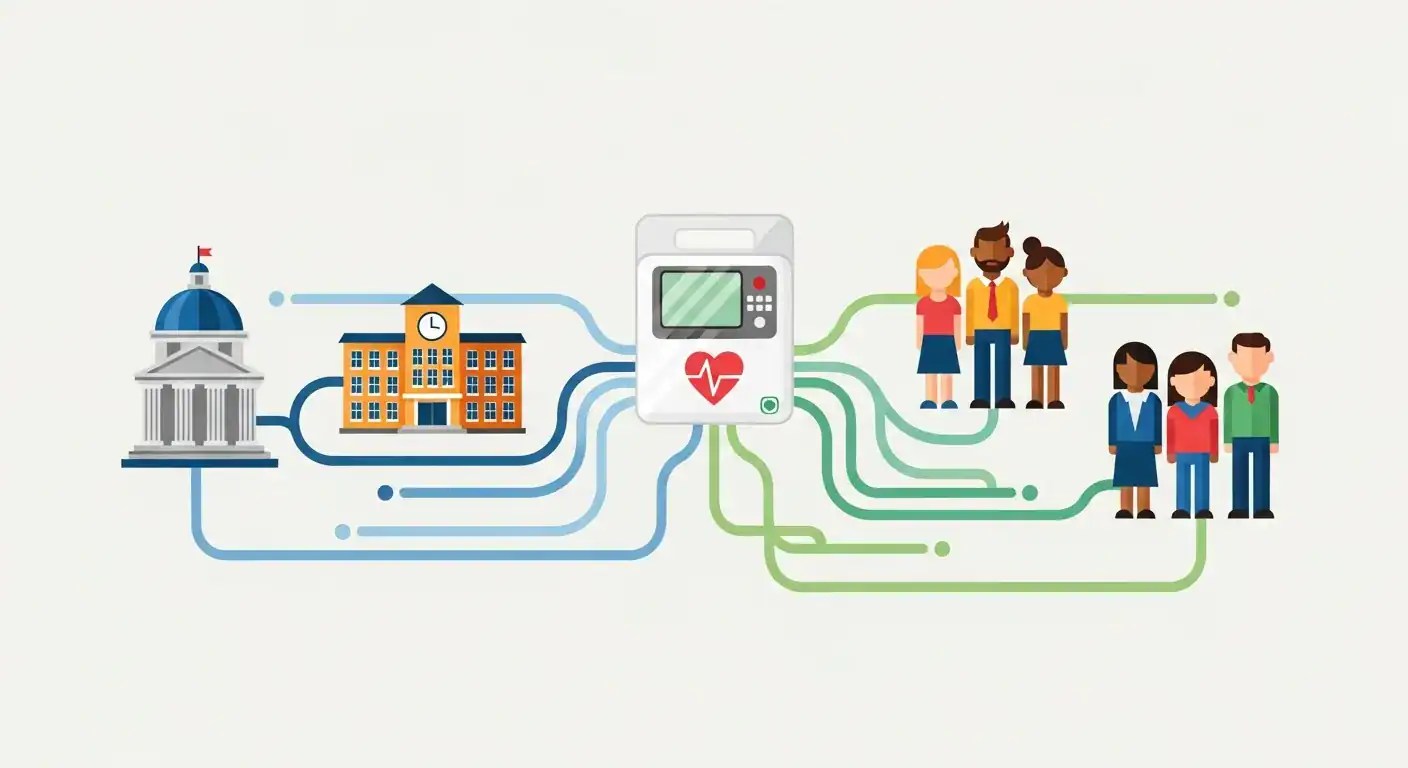
Federal Grant Sources
- FEMA Assistance to Firefighters Grant (AFG): This program funds fire departments, EMS organizations, and nonaffiliated EMS providers. AED equipment purchases fall within the eligible categories. Awards have historically ranged from $10,000 to over $1 million depending on department size and community need.
- HRSA Rural Access to Emergency Devices Grant: The Health Resources and Services Administration funds AED placement and CPR/AED training in rural communities. This program specifically targets areas with limited access to emergency medical services.
- Department of Justice SVPP Grant: The School Violence Prevention Program provides competitive grants up to $500,000 for K-12 physical security improvements, including life-safety equipment such as AEDs.
- USDA Community Facilities Grant: Rural organizations with populations under 20,000 may qualify for funding through the USDA’s Community Facilities program, which covers essential community equipment including defibrillators.
State-Level AED Programs
Many states offer their own AED funding initiatives. Minnesota allocated $836,000 in fiscal year 2026 through its Cardiac Emergency Response Plan (CERP) Assistance Grant, providing up to $50,000 per school district. California, Florida, Texas, and New York have enacted legislation requiring AEDs in certain public facilities, and several offer companion grant programs.
To find state-specific AED funding, contact your state’s department of education or emergency management agency. The Response Ready AEDs for Schools page provides additional guidance on requirements and recommended equipment.
Call 858-665-2025 or request a custom quote from Response Ready for help identifying AED grant opportunities available in your state.
Which Corporate and Foundation AED Grant Programs Accept Applications?
Key point: Corporate programs from Firehouse Subs Public Safety Foundation, AEDGrant.com, Walmart, State Farm, and Lowe’s Foundation offer AED grants ranging from $250 to $100,000 for schools, nonprofits, churches, and government entities.
Beyond government sources, several corporations and private foundations offer AED grants and funding support to community organizations.
| Grant Program | Eligible Organizations | Typical Award Range |
|---|---|---|
| Firehouse Subs Public Safety Foundation | Fire, EMS, law enforcement, nonprofits, schools | $15,000 – $35,000 |
| AEDGrant.com Corporate Buy-Down Program | Public and private entities, individuals | Varies by device |
| Walmart Community Grant Program | 501(c)(3) organizations, schools, churches, government entities | $250 – $5,000 |
| State Farm Community Grant | Nonprofits, schools, government institutions, volunteer fire companies | $500 – $25,000 |
| Lowe’s Foundation Gable Grant | Community-based nonprofits, community colleges | Up to $100,000 |
The AEDGrant.com program deserves special mention. Operating since 1993, this program works directly with manufacturers including Philips, ZOLL, Defibtech, Cardiac Science, HeartSine, and Stryker to provide corporate-sponsored discounts. Approval typically takes one to three weeks.
How to Write a Winning AED Grant Proposal
Key point: A successful AED grant proposal includes an organizational overview, a data-driven statement of need, a detailed project description, an itemized budget, a sustainability plan, and letters of support from community leaders.
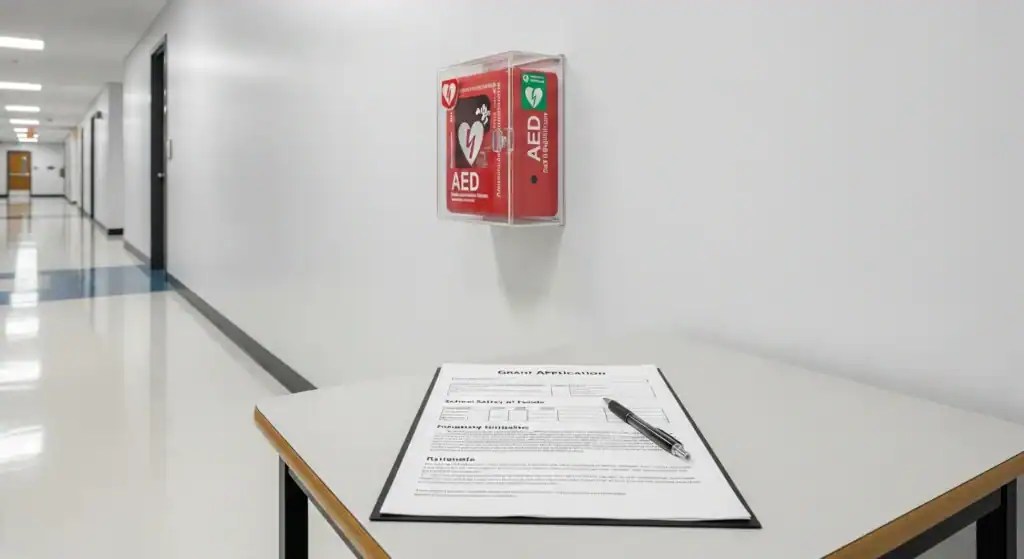
A well-structured AED grant proposal significantly increases your chances of receiving funding. Grant writing is a detail-driven process, and the most successful applicants follow a systematic approach.
Key Components of an AED Grant Proposal
- Organizational overview: Describe your organization’s mission, the population you serve, and your current emergency preparedness capabilities.
- Statement of need: Quantify the risk. Include data on sudden cardiac arrest incidence, your community’s EMS response times, and the number of people your facility serves daily. If your state mandates AEDs in your facility type, reference the specific legislation.
- Project description: Detail exactly how many AEDs you need, where they will be placed, who will be trained, and how the program will be maintained over time.
- Budget justification: Itemize all costs including the AED devices, wall cabinets, signage, replacement pads and batteries, training courses, and ongoing program management. This AED cost breakdown guide can help you estimate total ownership expenses.
- Sustainability plan: Explain how your organization will maintain the AED program after the grant period ends. This is where managed programs like Response Ready’s AED Total Solution strengthen your proposal by demonstrating a long-term compliance and maintenance strategy.
- Letters of support: Include endorsements from local government officials, medical professionals, community leaders, or partner organizations.
Grant Proposal Tips
- Begin the application process well before the deadline. Many federal grants have quarterly application windows.
- Use specific numbers rather than generalizations. “Our school serves 1,200 students and is 14 minutes from the nearest hospital” is stronger than “our students need protection.”
- Reference the American Heart Association’s recommendation of one AED for every 100 to 200 people in a public facility.
- If your budget is limited, consider requesting a matching grant where your organization raises partial funds that a donor matches.
What Are the Best Fundraising Strategies for AED Programs?
Key point: Organizations that do not qualify for traditional AED grants can raise funds through crowdfunding platforms like GoFundMe, local civic organizations such as Rotary and Kiwanis Clubs, employer matching programs, in-kind donations, and memorial fundraisers.
Organizations that do not qualify for traditional grants still have several effective paths to AED funding. Community-driven fundraising has helped thousands of schools, churches and places of worship, and sports leagues acquire defibrillators.
- Crowdfunding campaigns: Platforms like GoFundMe allow organizations to raise small amounts from a large number of supporters. Highlight the life-saving impact of AEDs and set a clear, specific goal that includes the device, accessories, and training.
- Local civic organizations: Rotary Clubs, Kiwanis Clubs, Lions Clubs, and local chapters of the American Legion frequently fund community safety projects. Present a brief proposal at a club meeting with specific AED recommendations and placement plans.
- Employer matching programs: Many corporations match employee charitable donations. Encourage your community members to check whether their employers offer matching gift programs.
- In-kind donations: Some AED manufacturers and distributors offer in-kind donation programs where organizations receive equipment rather than cash grants.
- Memorial fundraisers: Families affected by sudden cardiac arrest often establish memorial funds to place AEDs in schools and public spaces. These campaigns carry emotional resonance and frequently exceed their funding goals.
Response Ready’s AED rental program, starting at $45 to $75 per month depending on the device, also provides a budget-friendly alternative for organizations waiting on grant decisions or working within tight fiscal timelines.
Contact Response Ready at 858-665-2025 to discuss flexible payment options, rental programs, and volume discounts for your organization.
How Response Ready Helps Organizations Acquire AEDs
Key point: Response Ready carries all six FDA-approved AED manufacturers, and provides product guidance, managed compliance programs, CPR training, rental programs from $45 to $75 per month, and bundled value packages.
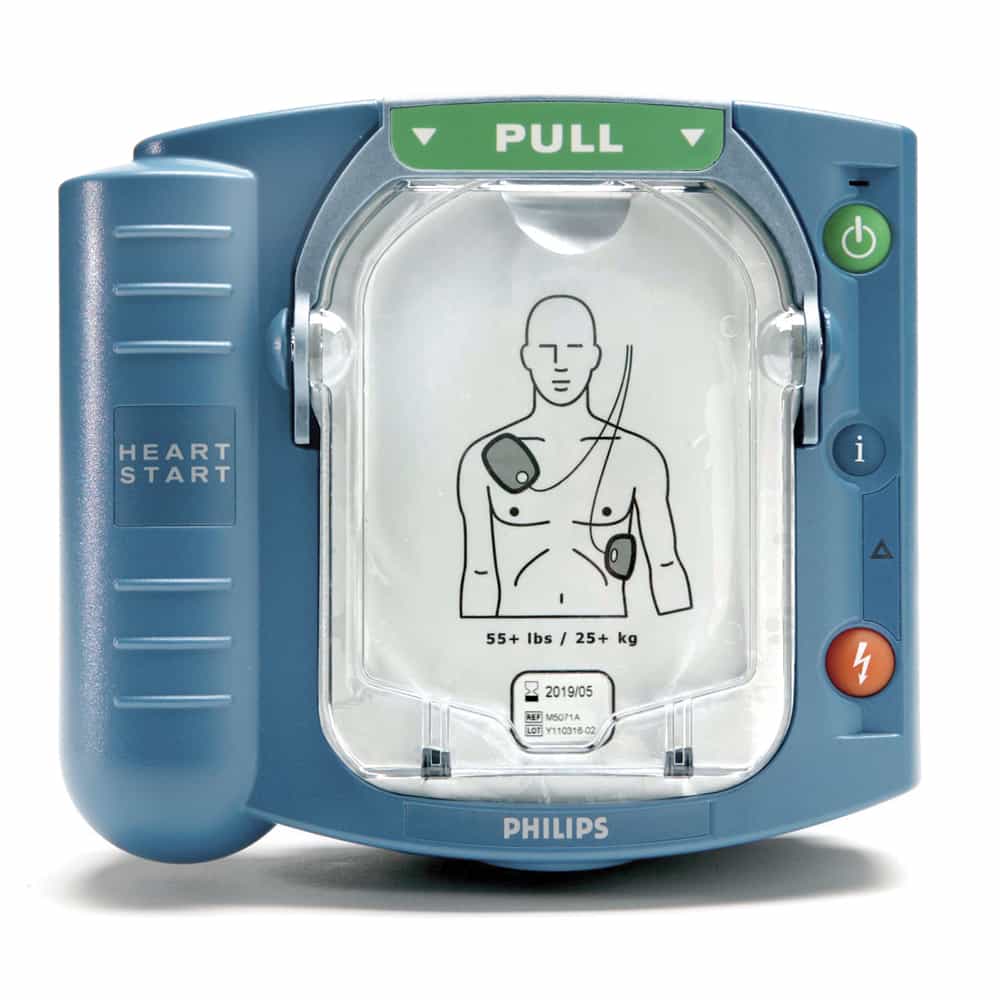
Response Ready is the only AED distributor in the United States that carries all six FDA-approved AED manufacturers: Philips, ZOLL, HeartSine, Stryker (Physio-Control), Cardiac Science, and Defibtech.
Beyond equipment sales, Response Ready provides services to support organizations at every stage of their AED program.
- Product guidance: Response Ready’s team helps organizations choose the right AED based on their environment, budget, and user experience requirements.
- AED Total Solution program: For $99 per year, this managed compliance program includes automated expiration alerts, inspection reminders, medical oversight from Dr. Ann Jarris (MD, MBA, FACEP), a post-event loaner program, and free replacement of consumables. This program is a strong addition to any grant proposal because it demonstrates long-term sustainability.
- CPR and AED training: Response Ready’s nationwide instructor network provides certified CPR/AED/First Aid training in person, on site, or in blended formats.
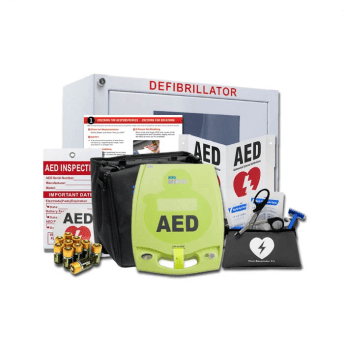
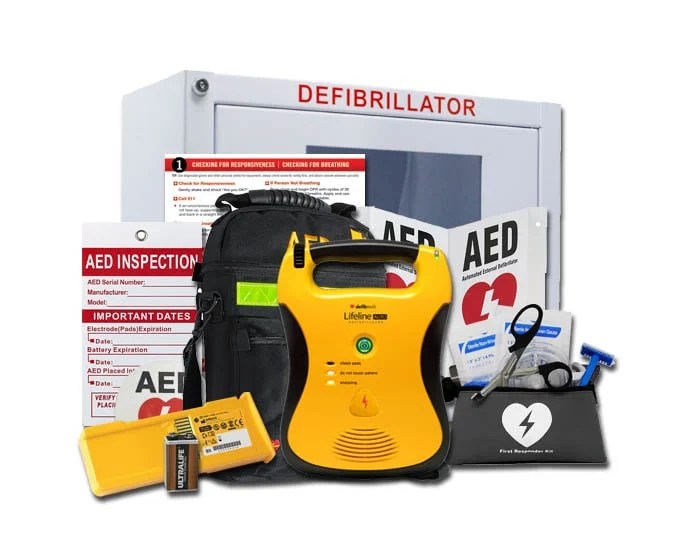
- Value packages: AED value packages bundle the device with a wall cabinet, signage, a first responder kit, and replacement supplies at a lower total cost than purchasing each component individually.
- Rental programs: Starting at $45 to $75 per month, Response Ready’s rental program includes the AED device, AED Total Solution management, free consumable replacements, and a lifetime guarantee.
- Free shipping: Orders over $99 ship free, and every purchase includes a 30-day money-back guarantee and one-year price protection promise.
Defibrillator Grants for Schools: What Administrators Need to Know
Key point: At least 16 states mandate AEDs in public schools, and many offer companion grant programs. Administrators should verify their state mandate, prioritize athletic areas, follow AHA placement guidelines, and select pediatric-ready devices.
Defibrillator grants for schools represent one of the most active segments of AED funding. At least 16 states currently mandate AEDs in public schools, and that number continues to grow. School administrators seeking AED funding should consider these key points.
- Check your state mandate: If your state requires AEDs in schools, compliance grants may be available through your state department of education or emergency management agency. Minnesota’s CERP Assistance Grant is one example, providing up to $50,000 per district.
- Athletic programs increase urgency: Student athletes face elevated cardiac arrest risk during high-intensity activity. Schools with active sports programs are often prioritized by grant-making bodies. Place AEDs near gymnasiums, athletic fields, and swimming pools.
- AHA placement guidelines: The American Heart Association recommends that an AED be reachable within a one to three minute walk from any point in a school building. Most schools need multiple devices to meet this standard.
- Training is part of the equation: Grant applications that include staff training components score higher. Response Ready’s AED training devices and manikins allow schools to maintain ongoing readiness without repeated certification costs.
- Pediatric-ready devices: Schools serving children under eight years old should select AEDs with pediatric capability. The Response Ready pediatric AED pads guide explains which devices and pads are appropriate for younger students.
Frequently Asked Questions About AED Grants
Can individuals apply for an AED grant?
Yes. Some programs, including AEDGrant.com’s Corporate Buy-Down Program, accept applications from individuals seeking a home AED. However, most AED grant programs prioritize organizations such as schools, nonprofits, government agencies, and houses of worship.
How long does the AED grant application process take?
Processing times vary by program. Corporate-sponsored programs like AEDGrant.com typically approve applications within one to three weeks. Federal grants may take three to six months from application to award notification. State programs fall somewhere in between.
What costs does an AED grant typically cover?
Most AED grants cover the device itself, and many also fund accessories such as wall cabinets, signage, carrying cases, and replacement pads and batteries. Some grants additionally cover CPR/AED training and program management services. Review each program’s eligible expense categories before applying.
Are there grants specifically for churches and faith-based organizations?
Yes. Programs like the Walmart Community Grant and State Farm Community Grant specifically list faith-based organizations as eligible applicants. Local civic organizations such as Rotary Clubs and Lions Clubs also frequently support church safety initiatives.
What if my organization does not qualify for a grant?
Organizations that do not meet grant eligibility criteria can still access AEDs through Response Ready’s rental program (starting at $45 to $75 per month), value packages that bundle equipment at reduced total cost, and community fundraising campaigns. Employer matching programs and crowdfunding platforms also provide effective alternatives to traditional grant funding.
Does Response Ready help with AED grant applications?
Response Ready provides product recommendations, detailed quotes, and program documentation that strengthen grant applications. The AED Total Solution management program is particularly valuable for grant proposals because it demonstrates a clear, sustainable maintenance and compliance plan.
Is there a free AED program available for my organization?
Several free AED program options exist depending on your organization type. The AEDGrant.com Corporate Buy-Down Program, Firehouse Subs Public Safety Foundation, and various state-funded initiatives can cover the full cost of an AED for qualifying applicants. Schools, fire departments, and 501(c)(3) nonprofits have the most free AED program options available. Contact Response Ready at 858-665-2025 for guidance on which programs match your eligibility.