Every year, roughly 356,000 out-of-hospital cardiac arrests occur in the United States, and many of these emergencies happen in places where people gather in large numbers. Churches, mosques, synagogues, and other houses of worship are no exception. With aging congregations, emotionally charged services, and hundreds of attendees at weekly gatherings, places of worship face a real and present cardiac risk. An automated external defibrillator (AED) can mean the difference between life and death when sudden cardiac arrest strikes during a service, wedding, funeral, or community event.
Browse AED options for churches at Response Ready or call 858-665-2025 for a custom quote on your congregation’s needs.
Why Do Churches Need an AED Program?
A church AED program addresses a critical gap in emergency preparedness that most congregations overlook. Sudden cardiac arrest (SCA) does not discriminate by location, and it can strike anyone at any time. When it happens in a worship environment, the unique characteristics of church settings create both elevated risk and significant response challenges. Response Ready recommends that every congregation evaluate its cardiac emergency readiness as part of its duty of care to members and visitors.
Aging Congregations Face Higher Cardiac Risk
Many churches serve congregations where a significant portion of members are over 50 years old. The risk of sudden cardiac arrest increases substantially with age, and older adults are disproportionately affected. According to the American Heart Association, the average age of out-of-hospital SCA victims is 60, and the majority of these events occur in people over 45. Churches with aging demographics simply face a higher statistical likelihood of experiencing a cardiac emergency during any given gathering.
Large Gatherings Increase Emergency Probability
Sunday services, holiday celebrations, weddings, funerals, potlucks, youth group events, and community outreach programs bring together dozens to thousands of people on a regular basis. The larger the gathering, the greater the probability that someone present may experience a cardiac event. Many churches also host external groups, daycare programs, fitness classes, and community meetings throughout the week, further increasing foot traffic and the overall risk profile of the facility.
Emotional and Physical Stress Factors
Worship services can involve intense emotional experiences, prolonged sitting or standing, temperature extremes in older buildings or outdoor settings, and physical exertion during music or movement. These factors can act as triggers for cardiac events in individuals with underlying heart conditions, many of whom may be unaware of their risk. The combination of emotional intensity and physical stress makes churches a setting where cardiac emergencies are not just possible but statistically predictable over time.
Delayed EMS Response in Rural and Suburban Areas
Many churches are located in rural communities or suburban areas where emergency medical services (EMS) response times can exceed 8 to 12 minutes. For every minute that passes without defibrillation after sudden cardiac arrest, the chance of survival drops by approximately 10%. An AED on-site bridges this critical gap, enabling trained volunteers to deliver a life-saving shock within minutes rather than waiting for an ambulance that may arrive too late.
How Many AEDs Does a Church Need?
Response Ready recommends that churches assess their facility layout and congregation size to determine the right number of AEDs. The goal is to ensure that any defibrillator can be retrieved and applied to a victim within three minutes of a cardiac arrest being recognized. Here are general guidelines for church AED placement:
- Small churches (under 200 members, single building): One AED placed in a central, visible location near the main worship area
- Medium churches (200 to 500 members, multiple rooms): Two AEDs, one near the sanctuary and one near the fellowship hall or gymnasium
- Large churches or campuses (500+ members, multiple buildings): Three or more AEDs placed so that no area is more than a 90-second walk from a device
- Churches with outdoor worship areas or sports fields: At least one portable AED designated for outdoor events
- Churches with childcare or youth programs: Consider AEDs with pediatric pads or pediatric mode capability
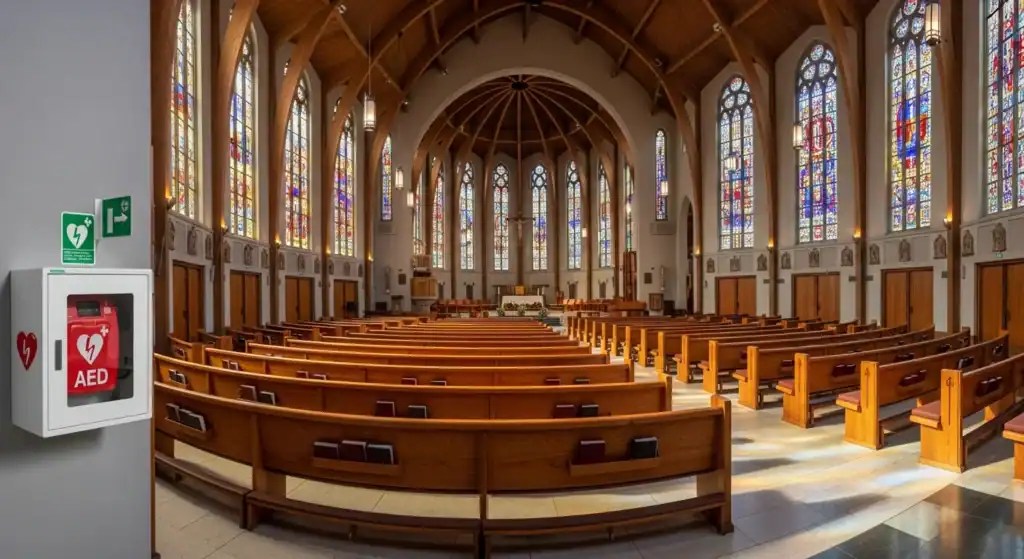
Every AED should be stored in a visible, wall-mounted cabinet with clear signage so that any person, whether a longtime church member or a first-time visitor, can locate it quickly during an emergency.
What Are the Best AED Models for Churches?
Choosing a defibrillator for a church means selecting a device that is simple enough for untrained volunteers to use effectively, reliable enough to remain ready for months or years between uses, and affordable enough to fit within a church budget. Response Ready carries all six FDA-approved AED manufacturers, giving congregations the widest selection available from any single distributor. Here are the top recommendations for church settings:
| AED Model | Best For | Key Features | Starting Price |
|---|---|---|---|
| HeartSine Samaritan PAD 350P | Budget-conscious churches | Lightest AED at 2.4 lbs, 8-year warranty, simple 2-button operation | $1,411.00 |
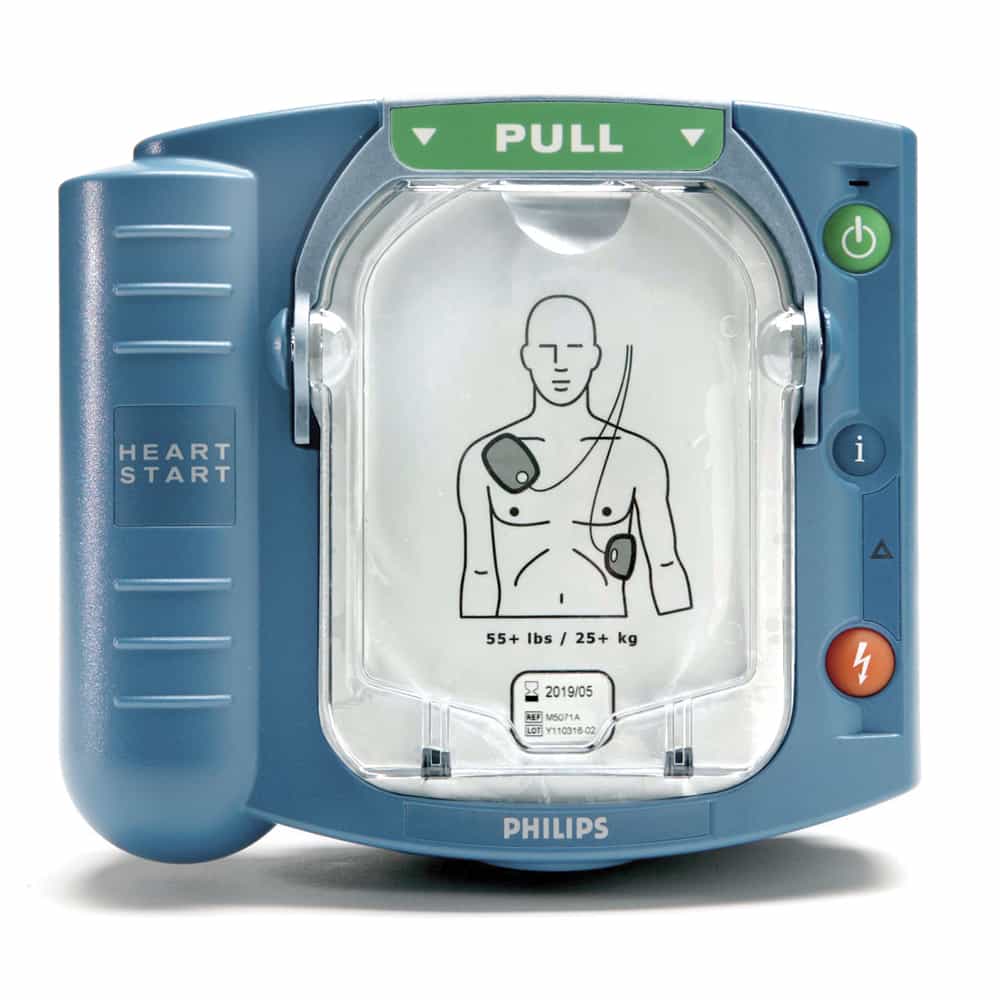
| Philips HeartStart OnSite | Ease of use for volunteers | Clear voice guidance, SMART Pads, 8-year warranty | $1,529.00 |
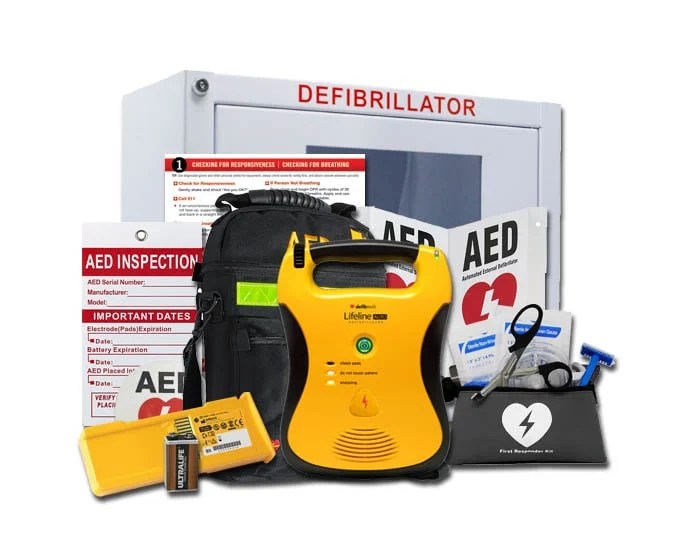
| Defibtech Lifeline AED | Durability and simplicity | One-button activation, bright yellow design, military-grade durability | $1,478.80 |
| Defibtech Lifeline VIEW | Visual learners, low-training settings | Video coaching display, CPR metronome, crushproof to 1,000 lbs | $2,024.95 |
| ZOLL AED Plus | CPR quality feedback | Real-time CPR coaching, audio and visual prompts, IP55 rated | $2,082.00 |
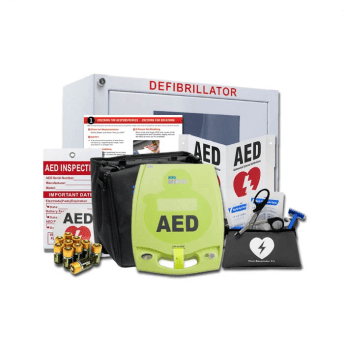
All of these models come with value packages from Response Ready that include a carry case, wall cabinet, AED signage, first responder kit, and free shipping. Value packages save hundreds of dollars compared to purchasing accessories separately.
How Should Churches Train Volunteers to Use an AED?
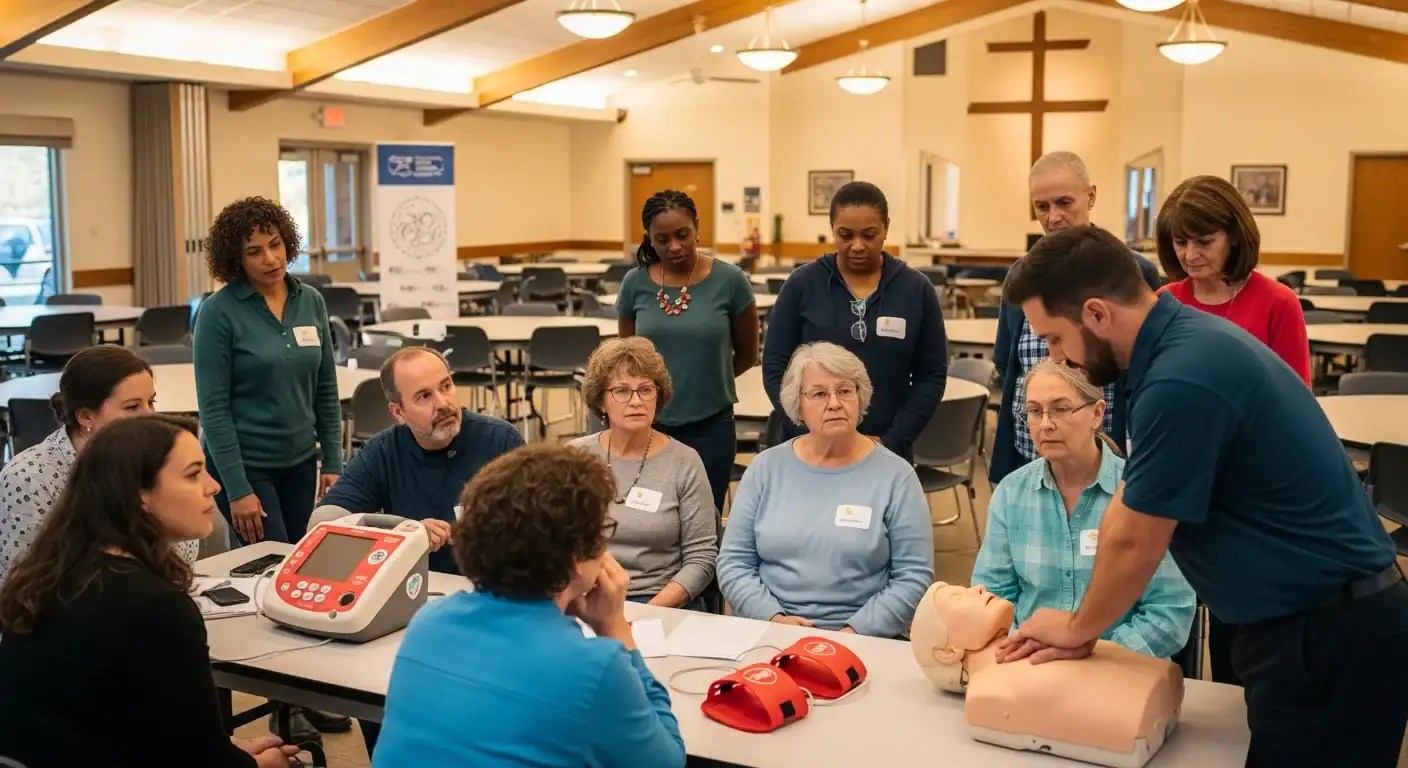
An AED is designed to be used by anyone, even without formal training. Modern AEDs provide step-by-step voice instructions that guide the user through the entire rescue process, from placing the electrode pads to delivering a shock. However, training builds confidence and reduces hesitation during an actual emergency. Response Ready recommends that churches establish a volunteer cardiac response team and invest in basic CPR/AED training for key members.
Building a Church Cardiac Response Team
A cardiac response team should include 6 to 10 volunteers who are willing to serve as designated first responders during services and events. Good candidates include ushers, greeters, security team members, nursery workers, and any congregation members with medical or first responder backgrounds. The team should have a simple protocol: one person calls 911, one retrieves the AED, and one begins CPR until the device arrives.
CPR and AED Training Options
Response Ready partners with CPR1 to provide certified CPR/AED/First Aid training through a nationwide instructor network. Training options include:
- On-site group training: An instructor comes to your church to train 6 to 20 people in a single session (typically 2 to 4 hours)
- Blended learning: Online coursework completed individually, followed by a brief in-person skills session
- AED orientation: A shorter session focused specifically on AED use and your church’s emergency action plan
Certifications typically last two years. Response Ready’s AED Total Solution program includes automated reminders for recertification so your team never falls out of compliance.
AED Trainer Devices for Ongoing Practice
Churches can purchase AED trainer devices and CPR training manikins to conduct regular practice drills. Trainer devices replicate the operation of a real AED without delivering an actual shock, allowing volunteers to practice pad placement, timing, and coordination. Running a 15-minute drill quarterly keeps skills sharp and ensures new team members are prepared.
How Much Does a Church AED Program Cost?
The total cost of a church AED program depends on the number of units needed, the model selected, and whether the church chooses to purchase or rent. Here is a realistic cost breakdown for a typical mid-sized church:
| Item | Purchase Option | Rental Option |
|---|---|---|
| AED device (value package with cabinet, signage, accessories) | $1,411 to $2,400 one-time | $45 to $75/month |
| Replacement pads (every 2 years) | $30 to $80 per set | Included with rental |
| Replacement battery (every 4 to 5 years) | $100 to $250 | Included with rental |
| CPR/AED training (group of 10) | $50 to $75 per person | $50 to $75 per person |
| AED Total Solution program management | $99/year | Included with rental |
For churches on a tight budget, the AED rental program starting at $45 per month is often the best path forward. The rental includes the AED device, free replacement of all consumables (pads and batteries), a loaner device if the AED is ever used in an emergency, automated compliance tracking, and medical director oversight through Response Ready’s AED Total Solution platform.
Contact Response Ready for a custom church AED program quote, or call 858-665-2025 to speak with an AED specialist.
How Can Churches Fund an AED Program?
Budget constraints are the most common barrier to AED adoption in churches, but several funding strategies can make a defibrillator program achievable for congregations of any size:
- Dedicated fundraising campaigns: Many churches have successfully funded AED purchases through special offerings, bake sales, or “Save a Life Sunday” campaigns. When members understand the life-saving purpose, giving is often generous and enthusiastic.
- Memorial donations: Families who have lost loved ones to cardiac arrest often welcome the opportunity to donate an AED in a loved one’s memory. A memorial plaque on the AED cabinet creates a lasting tribute.
- Community grants: Local foundations, community health organizations, and civic groups (Rotary, Lions Club, Kiwanis) frequently fund public safety equipment for nonprofit organizations, including churches.
- American Heart Association grants: The AHA periodically offers grants and partnership programs for public access defibrillation initiatives.
- State and local government programs: Some states and municipalities offer grants, tax incentives, or subsidized AED programs for houses of worship and community gathering places.
- Insurance premium reductions: Some insurance providers offer reduced premiums for churches that implement AED programs, which can offset the ongoing cost over time.
- Corporate sponsorships: Local businesses, hospitals, and healthcare organizations may sponsor AEDs for community institutions as part of their corporate social responsibility programs.
Response Ready’s rental program at $45 per month also eliminates the need for a large upfront capital expenditure, making it possible for even small congregations to start a program immediately.
What Legal Protections Exist for Churches Using AEDs?
One of the most common concerns church leaders express is the fear of legal liability if a volunteer uses an AED and something goes wrong. The good news is that every state in the United States has Good Samaritan laws that provide legal protection for individuals who use AEDs in good faith during an emergency. These protections are specifically designed to encourage bystander intervention by removing the fear of litigation.
Good Samaritan Law Coverage
Good Samaritan laws generally protect the following parties when an AED is used in an emergency:
- The person who uses the AED (whether trained or untrained)
- The organization that owns the AED (provided it is maintained according to manufacturer guidelines)
- The medical director providing oversight for the AED program
- The trainers who provided CPR/AED instruction
To maintain this legal protection, churches should follow three basic practices: keep the AED maintained per manufacturer specifications (regular inspections, pad and battery replacements on schedule), provide or arrange for volunteer training, and notify local EMS of the AED’s location if required by state law.
State-Specific Requirements
AED regulations vary by state. Some states require physician oversight, while others require registration of the AED with local emergency services. Response Ready maintains a comprehensive Legal Center with state-by-state compliance information to help churches understand their specific obligations. The AED Total Solution program also includes medical director services through Dr. Ann Jarris, MD, MBA, FACEP, ensuring churches have physician oversight where required by law.
How to Start a Church AED Program: Step by Step
Launching a defibrillator program for a church does not have to be complicated. Here is a practical, step-by-step process that any congregation can follow:
- Assess your needs: Evaluate your facility layout, congregation size, weekly foot traffic, and proximity to the nearest hospital or fire station. Use the placement guidelines above to determine how many AEDs you need.
- Get leadership buy-in: Present the case to your church board, elders, or trustees. Emphasize the duty of care, the statistical risk, and the relatively modest cost compared to the life-saving potential.
- Choose your AED model: Browse AED options for churches at Response Ready. Consider ease of use, budget, and whether pediatric capability is needed for children’s programs.
- Decide between purchase and rental: Purchasing is more economical long-term, while renting at $45/month includes all consumables, compliance management, and medical oversight.
- Install and position your AED: Mount the AED in a wall cabinet in a central, high-traffic location. Install clear signage. Ensure the AED is not locked behind doors that could be inaccessible during off-hours events.
- Recruit and train volunteers: Identify 6 to 10 volunteers and schedule a CPR/AED training session. Establish a written emergency action plan with assigned roles.
- Announce to the congregation: Let members know the AED is in place and who to alert in an emergency. A brief announcement and a walkthrough during a service builds awareness and confidence.
- Maintain and inspect regularly: Conduct monthly visual inspections. Replace pads and batteries on schedule. Response Ready’s AED Total Solution automates reminders and tracking.
Frequently Asked Questions About AEDs for Churches
Can an untrained person use an AED safely?
Yes. Modern AEDs are designed for use by anyone, regardless of medical training. The device provides clear voice instructions that guide the user through every step, including pad placement, standing clear, and delivering a shock. The AED analyzes the heart rhythm automatically and will only deliver a shock if it detects a shockable rhythm. It is physically impossible to shock someone who does not need it.
How long does an AED battery last?
Most AED batteries have a standby life of 4 to 5 years when the device is in ready mode and not actively in use. Electrode pads typically have a shelf life of 2 to 3 years. Response Ready’s AED Total Solution program tracks expiration dates and sends automated alerts so churches never have to worry about expired supplies.
Does a church need a prescription to buy an AED?
In most states, AEDs are available without a prescription. For states that do require a physician’s prescription, Response Ready provides prescription services through their Medical Director, Dr. Ann Jarris, eliminating any barrier to purchase.
Are churches legally required to have an AED?
Currently, no state specifically mandates that churches must have AEDs. However, the moral and ethical obligation to protect congregation members is strong, and many insurance providers look favorably on churches that implement AED programs. Some states do require AEDs in buildings that host large public gatherings, which could apply to church facilities depending on size and usage.
What happens if the AED is used during a service?
If the AED is deployed during an emergency, the church should call 911 immediately, allow the trained volunteer to operate the AED, and contact Response Ready afterward for post-event support. Response Ready provides a free loaner device while the used AED is serviced, event documentation assistance, and data download and preservation. The church’s AED will be returned to service-ready condition at no additional cost under the AED Total Solution program.
Can one AED serve an entire church campus?
For small, single-building churches, one AED is typically sufficient if it is centrally located. For larger campuses with multiple buildings, multiple AEDs are recommended to ensure the device can be retrieved and applied within three minutes. The American Heart Association recommends that an AED should be reachable within a 90-second walk from any point in a facility.
How much does it cost to maintain an AED each year?
Annual maintenance costs for a purchased AED typically run $50 to $150, covering inspection supplies and periodic pad and battery replacements spread over their shelf life. The AED Total Solution program at $99 per year handles all compliance tracking and reminders. For rental customers, all maintenance costs are included in the monthly fee.
Does Response Ready offer special pricing for churches?
Response Ready offers competitive pricing on all AED models, with value packages that include accessories worth hundreds of dollars. Churches can also take advantage of discount codes on specific models, such as HEARTSINE-SAMARITAN for savings on HeartSine models or PHILIPS-ONSITE for savings on the Philips HeartStart OnSite. Contact Response Ready at 858-665-2025 for custom quotes on multi-unit church orders.