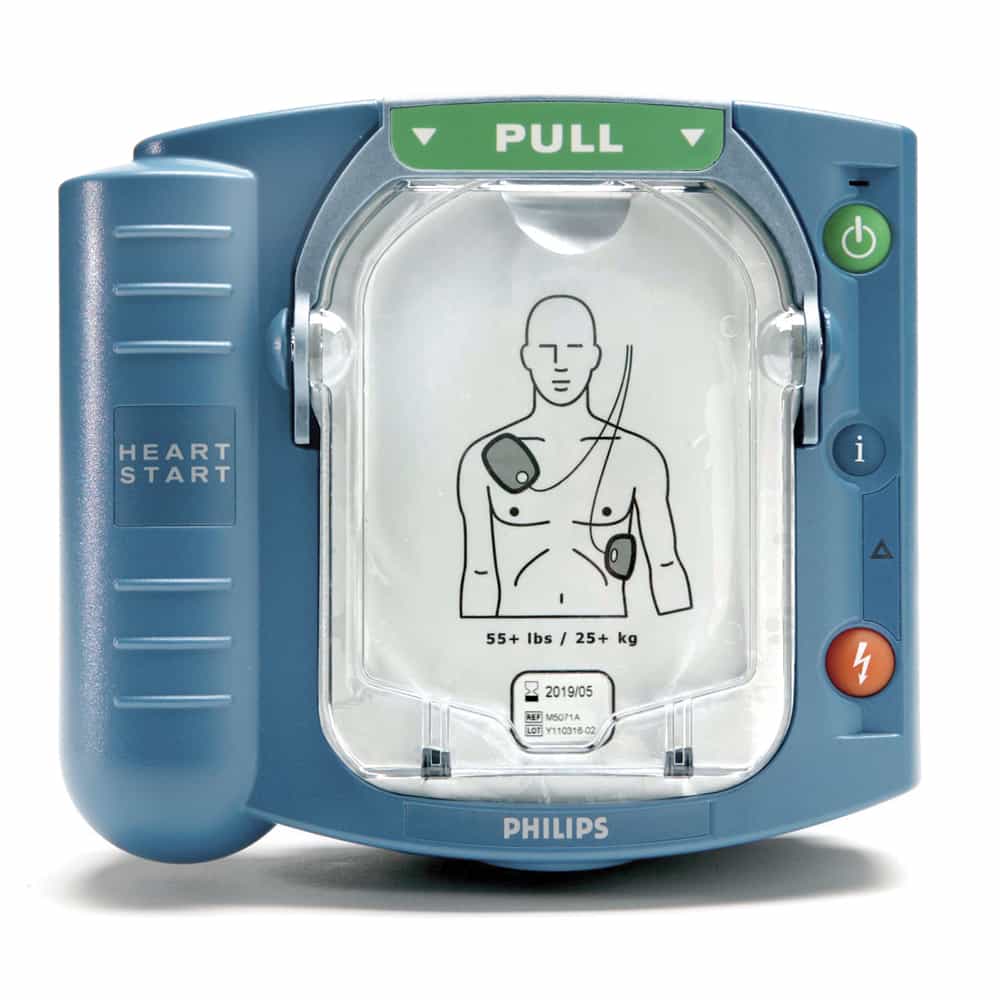
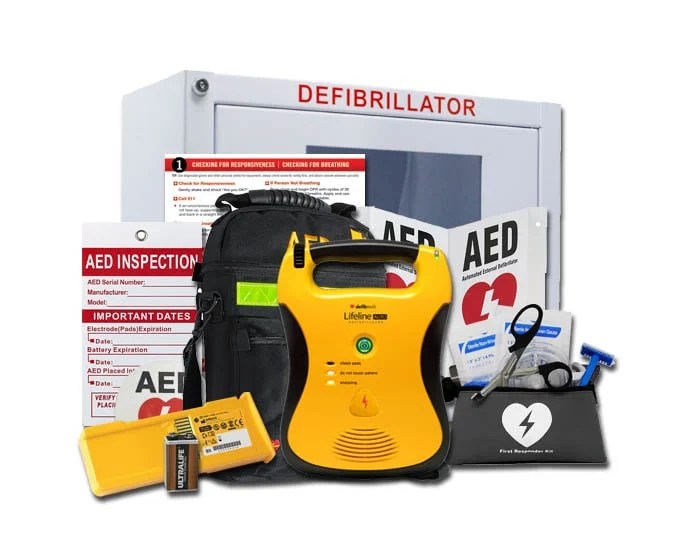
You’ve already made the most important choice: protecting your employees, students, or community with an Automated External Defibrillator (AED). Now for the next big question—what’s the smartest way to buy one? It’s tempting to go à la carte, picking and choosing individual devices and accessories to save a few dollars. But building your own emergency station introduces variables into a situation that demands absolute certainty. Before you start adding items to your cart one by one, consider the hidden risks of a DIY approach and the life-saving simplicity of a complete, ready-to-deploy solution.
This is a high stakes decision. Over 356,000 cardiac arrests happen outside of a hospital every year in the United States, and the survival rate is tragically low. Yet, according to research published in Frontiers in Public Health, immediate CPR and the use of an AED can increase the chance of survival to nearly 50%. You know you need the right equipment. The real question is whether it’s more cost effective to build your own AED setup or to purchase a complete bundle.
Let’s dive into the true costs, both financial and logistical, to help you make a confident, responsible choice.
What Does “À La Carte” Mean?
Before we weigh the pros and cons of buying individual components versus a complete kit, it helps to understand the concept of “à la carte.” You’ve probably seen this phrase on a restaurant menu, and its meaning in that context is a perfect analogy for the choice you’re facing. Thinking about it this way can clarify the trade-offs between total customization and guided convenience, helping you decide which path ensures you have everything you need for an emergency without any of the guesswork.
The French Origin and Meaning
The phrase “à la carte” comes to us from French and literally translates to “according to the menu.” In a dining setting, it means you order each dish individually. Instead of getting a pre-determined three-course meal for a single price, you select your appetizer, main course, and dessert separately, and each item has its own price tag. This approach gives you complete control to build your meal exactly as you wish. If you only want a steak and a side of asparagus, that’s all you order and pay for. It’s all about personal choice and paying for precisely what you select from the list of options.
À La Carte vs. Other Menu Styles
Ordering à la carte offers the ultimate flexibility. You can mix and match to suit your tastes, dietary needs, or budget. This is the equivalent of browsing a catalog and picking out an AED from one brand, a cabinet from another, and specific AED accessories one by one. You aren’t locked into a pre-set combination. While this freedom is appealing, it also places the responsibility squarely on your shoulders to ensure all the separate pieces work together to create a complete, functional rescue solution. This approach contrasts sharply with other dining styles where the choices are made for you.
Table d’hôte and Prix Fixe Menus
On the other end of the spectrum are “table d’hôte” or “prix fixe” menus. Both offer a full meal—typically an appetizer, a main course, and a dessert—for a single, fixed price. You might have a few options to choose from for each course, but the overall structure is set. This approach simplifies the decision-making process and often provides better value than ordering the same items à la carte. It’s the restaurant’s version of an all-in-one package, curated by experts to provide a balanced and complete experience. This is much like choosing from a selection of AED packages designed for specific environments like schools or offices.
The Buffet Approach
A buffet is another alternative where guests can choose from a wide variety of dishes for one set price. While it offers choice, the selection is pre-determined by the establishment. From the restaurant’s perspective, both buffets and set menus are more efficient to manage than à la carte service, which requires a kitchen to be prepared for any combination of orders. This operational efficiency often translates to better value for the customer. It’s a useful parallel to keep in mind when considering the cost and complexity of building your own emergency kit versus buying a complete one.
What Makes an AED Program Compliant?
An effective AED program is more than just a device in a box. To be truly ready for an emergency and meet compliance standards, you need a complete system where every part has a purpose. Think of it less like a single purchase and more like setting up a fire extinguisher station. It needs to be visible, accessible, and equipped with everything a rescuer needs to act without hesitation.
The essential components for a functional and compliant program:
The AED device:
The heart of your program. A modern device like the HeartSine Samaritan 350P is designed for use by anyone, regardless of training, with clear voice prompts and simple controls.Pads and battery:
These are the consumables that deliver the life saving shock. The HeartSine Pad-Pak cleverly combines the battery and electrode pads into a single cartridge with one expiration date, simplifying maintenance.A wall cabinet:
An AED stored in a desk drawer is an AED that won’t be found in time. A visible wall cabinet protects the device and serves as a clear beacon for rescuers.3D signage:
Regulations often require clear signage to direct people to the AED’s location. A 3D wall sign ensures it can be seen from any angle in a hallway or large room.A first responder kit:
A sudden cardiac arrest scene can be chaotic. A simple kit containing scissors to cut through clothing, a razor for clearing a hairy chest, and gloves for safety ensures that pads can be applied correctly and quickly. Learn more about how to ensure compliance with all necessary accessories.
The Hidden Costs of an “A La Carte” AED Program
At first glance, buying each component separately seems like a way to control costs. You shop around, look for deals, and assemble your own kit. But does it actually save you money? Let’s do the math.
If you were to purchase high quality, compatible accessories for a new AED individually, the costs can add up faster than you’d expect.
Item | Estimated Individual Cost | Why It Matters |
HeartSine Samaritan 350P AED | $1,400 | The core life-saving device. |
Standard AED Wall Cabinet | $180 | Essential for visibility and protection. |
First Responder Prep Kit | $30 | Contains critical tools for patient prep. |
3D AED Wall Sign | $25 | Ensures the AED can be located quickly. |
$5 | Helps you track and log readiness checks. | |
Multiple Shipping Fees | $40+ | A hidden cost from ordering from various suppliers. |
A La Carte Total | ~$1,680 | The price before you factor in your time. |
Beyond the sticker price, there are hidden costs. You’ll spend valuable time researching to make sure the cabinet fits your device, the signage meets local requirements, and that you haven’t missed any critical items. This DIY approach places the burden of compatibility and completeness entirely on you.

The Customer’s Dilemma: Freedom vs. Complexity
The freedom to pick and choose each component can feel empowering. You hunt for the best price on a cabinet, find a deal on a first responder kit, and select an AED from another vendor. But this freedom comes with a significant trade-off: complexity. Suddenly, you’re not just a buyer; you’re a project manager. You are responsible for ensuring the wall cabinet is compatible with your AED model, that the signage meets local compliance laws, and that you haven’t forgotten a critical accessory. This research takes valuable time and energy, and the hidden costs can quickly add up. The DIY approach places the entire burden of creating a functional, life-saving system squarely on your shoulders.
The Business Challenge: Managing Inventory and Operations
For a school, office, or community center, the challenge extends far beyond the initial purchase. An effective AED program is a complete system, and managing it piece by piece is an operational headache. Sourcing components from different suppliers means juggling multiple purchase orders, invoices, and shipping arrivals. More importantly, it complicates ongoing maintenance. You’ll have to track separate expiration dates for pads, batteries, and items in your prep kit, increasing the risk that a critical component is expired when an emergency strikes. A pre-configured bundle streamlines everything, ensuring every part is designed to work together and simplifying both setup and long-term readiness checks.
Why a Bundled Program is the Smarter Choice
This is where an AED package changes the equation of the initial purchase. A thoughtfully curated bundle isn’t just about discounting parts, it’s about delivering a complete, ready to deploy solution. It’s designed to eliminate the guesswork, hidden costs, and complexity of the a la carte method.
The primary advantages of a bundle are clear:
Guaranteed compatibility:
Every item in the package, from the cabinet to the signage, is selected to work perfectly with the included AED. There’s no risk of ordering a cabinet that’s too small or a sign that isn’t compliant.
Financial savings:
By packaging essential items together, we can offer a price that is significantly lower than the total cost of buying each item separately. You get more, for less.
Simplified logistics:
One purchase, one shipment, one point of contact. You save the time and hassle of tracking multiple orders and can get your program running faster. Our step by step setup guide makes installation simple.
Peace of mind:
This is perhaps the most significant benefit. With a bundle, you have expert assurance that you have everything you need. You can be confident your program is complete and compliant from day one.

How AED Packages Simplify Preparedness
Choosing an AED package is about more than just convenience; it’s about confidence. Instead of spending hours researching individual components, a bundled solution eliminates the guesswork. Every item, from the wall cabinet to the first responder kit, is guaranteed to be compatible with your device. This not only prevents costly mistakes, like ordering a cabinet that’s too small, but it also results in significant savings compared to buying each piece separately. Logistics become incredibly simple: one purchase, one shipment, and one point of contact. You get your program up and running faster, with the expert assurance that you have everything you need to be compliant and ready to save a life from day one.
Our Top Pick: The HeartSine Samaritan 350P Package
Based on over a decade of experience helping schools, small businesses, and community centers, we’ve designed a package that provides everything you need without anything you don’t. The HeartSine Samaritan 350P Value Package is the definitive solution for any cost-conscious organization that refuses to compromise on safety.
Included in the package are the following components:
HeartSine Samaritan 350P AED:
A lightweight, durable, and incredibly user friendly device ideal for public access settings. Its simple two button operation and clear voice prompts guide the rescuer through every step.
Standard wall cabinet:
A sturdy metal cabinet with a clear window to keep your AED secure, protected, and highly visible.
Complete responder kit:
Includes shears, a razor, gloves, and wipes, all in a convenient pouch that fits inside the AED’s carrying case.3D Wall sign & inspection tag:
All the necessary accessories to ensure your AED is easy to find and simple to maintain.
This isn’t merely a collection of products. It’s a comprehensive safety system, thoughtfully assembled to provide the best value and remove any barriers to getting prepared. It’s why HeartSine AEDs are considered ideal for public spaces.
Frequently asked questions
Before choosing a bundle, it helps to know which AED machine fits your environment. Our AED machine buying guide compares all six manufacturers by use case, price, and features. Making the right choice for your organization involves asking tough questions. Here are straightforward answers to some of the most common concerns we hear from first time buyers.
Ready to take action? Shop AED value packages at Response Ready.

Q: Is buying a bundle always the cheaper option?
A: Yes. When you compare the total cost of purchasing each essential item separately plus shipping fees, a value package like our HeartSine 350P bundle consistently offers a lower price. More importantly, it saves you the time and stress of research and guarantees you have a complete, compatible system.
Q: What about ongoing maintenance costs?
A: This is a crucial question. The HeartSine 350P is one of the most cost effective AEDs to own thanks to its unique Pad-Pak, which combines the battery and pads into one cartridge. You only have to track one expiration date every four years. To make it even easier, our Response Ready App that automates monthly readiness checks and sends reminders, so you always know your device is ready.
Q: Do my employees or I need special training to use this AED?
A: The HeartSine 350P is designed for use by the general public with no prior training. It provides simple, loud, and clear voice instructions to guide the user. However, training empowers people to act with greater confidence. We strongly recommend our accessible CPR and AED training courses to ensure your team feels fully prepared to respond in an emergency.
Q: How does having an AED affect our liability?
A: All 50 states have Good Samaritan laws to protect individuals who provide emergency aid in good faith. Having a well maintained and compliant AED program is a key part of demonstrating that you’ve taken responsible steps to protect people in your facility. Our packages and AED program management, Response Ready App, are solutions that are designed to help you meet these requirements and ensure your program is always ready.
Key Takeaways
- Building your own AED station introduces risk: Piecing together individual components can lead to compatibility issues, unexpected costs, and compliance gaps, turning a life-saving purchase into a complex project.
- Opt for a pre-configured package for guaranteed readiness: An expertly curated AED bundle ensures all components—from the cabinet to the signage—are designed to work together, saving you time, money, and stress.
- A complete system is more than just the device: For a response to be effective, your AED must be supported by essential accessories like a visible wall cabinet, clear signage, and a first-responder prep kit.
Related Articles
- AED bundles versus a la carte AED, the smart way to buy your first
- More than a box: a guide to AED value package essentials
- Beyond the price tag: understanding the true cost of AED ownership
- AED Package Archives — Response Ready
- Pad Pak or separate parts: which AED system is right for you