- Published
- July 13, 2026
ZOLL AED Plus vs Philips HeartStart OnSite: Which AED Is Right for You?


ZOLL AED Plus vs Philips HeartStart OnSite: Which AED Is Right for You?
Choosing between the ZOLL AED Plus and the Philips HeartStart OnSite is one of the most common decisions AED buyers face — and for good reason. Both are FDA-approved, proven in the field, and designed for people with no medical training. But while both save lives, they do it differently.
Need help deciding? Browse ZOLL AED Plus and Philips HeartStart OnSite AEDs at Response Ready, or call 858-665-2025 to speak with an AED specialist.
This comparison breaks down every difference that matters: CPR feedback quality, environmental durability, ease of use, battery life, replacement costs, warranty coverage, and the specific use cases where each AED shines. By the end, you’ll know exactly which device fits your facility.
What are the key differences between ZOLL and Philips AEDs?
| Feature | ZOLL AED Plus | Philips HeartStart OnSite (M5066A) |
|---|---|---|
| Starting Price | $2,082 | $1,529 |
| Weight | 6.7 lbs (3.1 kg) | 3.3 lbs (1.5 kg) |
| Warranty | 7 years | 8 years |
| Battery Standby | Up to 5 years | Up to 4 years |
| Pad Life | Up to 5 years | Up to 2 years |
| Dust/Water Rating | IP55 | IP21 |
| CPR Feedback | Real CPR Help (depth + rate with visual bar) | Life Guidance (voice-only depth coaching) |
| Self-Testing | Yes | Yes (85 daily tests) |
| Pediatric Mode | Pedi-Padz II (separate) | SMART Pads M5072A (separate) |
| Energy Output | Up to 200J | Up to 200J |
| Automatic Option | Yes (fully automatic available) | Semi-automatic only |
| Display | Text prompts on lid | No screen |
| Waveform | Rectilinear Biphasic | SMART Biphasic |
Which AED has better CPR feedback for untrained responders?
CPR quality is the single biggest factor in sudden cardiac arrest survival. Research consistently shows that compression depth and rate directly impact outcomes, yet most bystanders compress too lightly or too slowly without guidance.
The ZOLL AED Plus stands out for its Real CPR Help technology, which monitors chest compression depth and rate in real time. The device provides both audio cues (“push harder,” “good compressions”) and visual text prompts on the lid display. A depth bar indicator shows rescuers exactly how deep they are compressing, making it exceptionally effective for untrained bystanders who have never performed CPR.
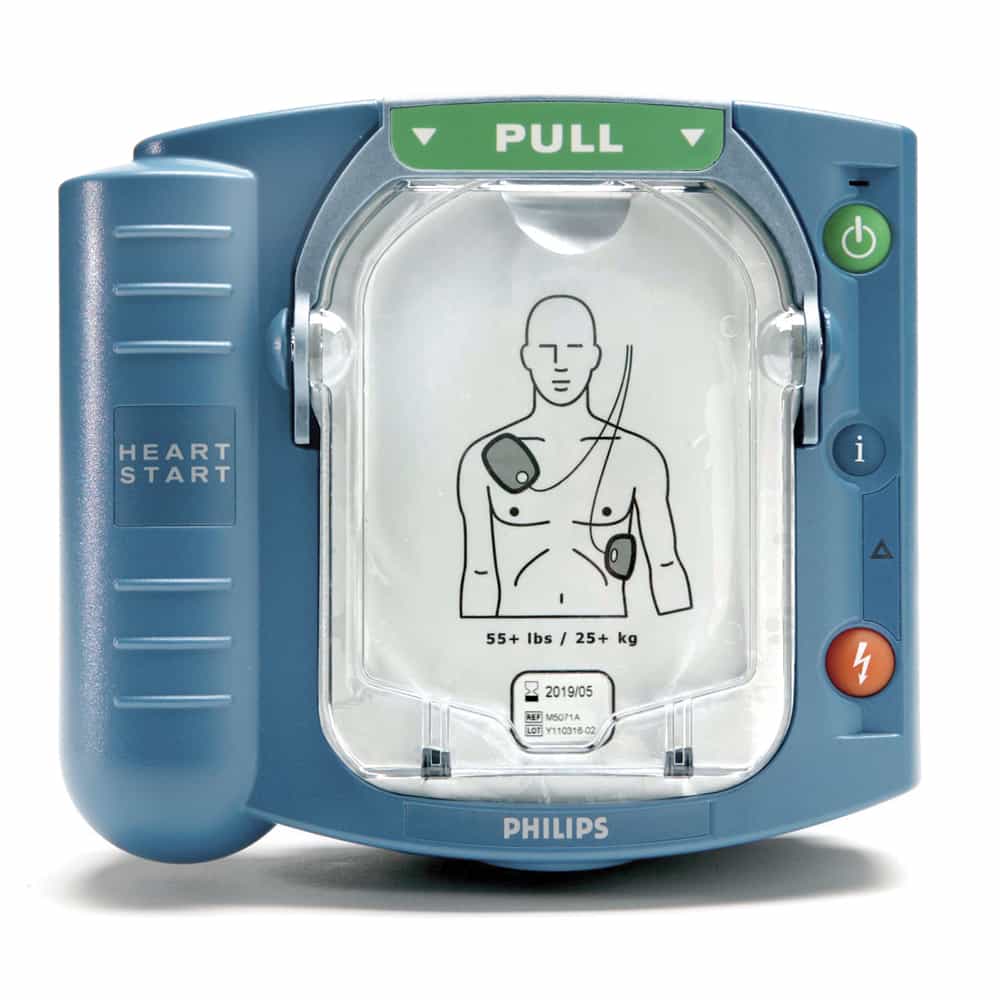
The Philips HeartStart OnSite uses Life Guidance technology, delivering step-by-step voice instructions through the entire rescue process. The voice prompts coach rescuers on compression depth and timing, though the feedback is less granular than what the ZOLL provides. There is no visual display.
Our recommendation: If real-time CPR coaching is a top priority, particularly for environments where untrained bystanders are the likely first responders, the ZOLL AED Plus delivers more detailed feedback.
How do ZOLL and Philips AEDs compare in durability and weather resistance?
Where you plan to place your AED matters significantly when choosing between these two devices.
The ZOLL AED Plus carries an IP55 dust and water resistance rating, meaning it is tested against dust ingress and water jets from any direction. It is built to handle extreme temperatures, high altitudes, and physical impact. This makes it a strong choice for construction sites, outdoor sports venues, fleet vehicles, and industrial facilities.
The Philips HeartStart OnSite has an IP21 rating, offering basic protection against vertically dripping water. It is not designed for dusty or wet environments. The OnSite performs best in controlled indoor settings such as offices, schools, churches, and retail stores.
Our recommendation: For outdoor, semi-outdoor, or harsh environments, choose the ZOLL AED Plus (IP55). For indoor-only placement, the Philips OnSite (IP21) is perfectly suitable.
Which AED is easier to use and more portable?
Both AEDs are designed for use by individuals with no medical training, but they differ in activation and handling.
The Philips HeartStart OnSite is widely considered the simplest AED to operate. Pull the green handle to power on, and the device immediately begins voice guidance. Pads and battery arrive pre-installed, so the device is ready to use straight out of the box. At just 3.3 lbs, it is one of the lightest AEDs available, making it easy to grab from a wall cabinet and carry to the patient.
The ZOLL AED Plus activates by opening the lid. Its one-piece CPR-D-padz design simplifies electrode placement, as the pad set includes a hand placement marker that guides rescuers to the correct compression location. The device walks users through each step with voice and text prompts. At 6.7 lbs, it is heavier than the Philips but still fully portable.
Our recommendation: If simplicity and weight are your top concerns, the Philips OnSite wins. It is lighter, activates instantly, and requires zero setup.
What are the long-term costs of ZOLL vs Philips AED ownership?
The purchase price is only one part of the equation. Replacement batteries and pads represent the primary ongoing expense of AED ownership.
ZOLL AED Plus
- Battery standby: Up to 5 years
- Pad life: Up to 5 years (CPR-D-padz)
- Replacement pads: ~$145
- Replacement battery: ~$155
Philips HeartStart OnSite
- Battery standby: Up to 4 years
- Pad life: Up to 2 years (SMART Pads)
- Replacement pads: ~$89
- Replacement battery: ~$199
Over a 7-year ownership period, the ZOLL AED Plus typically delivers lower total replacement costs despite its higher upfront price. The 5-year pad and battery lifespan means fewer replacements, while the Philips OnSite requires at least two to three sets of pads during the same period.
Our recommendation: Budget-conscious buyers should consider total cost of ownership, not just the sticker price. The ZOLL AED Plus has a higher upfront cost but lower long-term consumable expenses.
How does warranty coverage compare?
The Philips HeartStart OnSite comes with an 8-year manufacturer warranty, one of the longest in the AED industry. The ZOLL AED Plus offers a 7-year warranty. Both warranties cover manufacturing defects and device malfunctions under normal use conditions.
Response Ready also offers an AED Total Solution program starting at $99/year, which includes compliance oversight, maintenance tracking, pad and battery expiration reminders, and post-emergency support for both ZOLL and Philips devices.
Looking for ongoing compliance support? Explore Response Ready’s AED Total Solution program for maintenance tracking and reminders.
Who should choose the ZOLL AED Plus?
The ZOLL AED Plus is the stronger choice for organizations that need:
- Advanced CPR feedback. Real-time compression depth and rate monitoring with audio and visual prompts
- Outdoor durability. IP55 rating handles dust, water, extreme temperatures, and physical impact
- Lower long-term costs. 5-year battery and pad life reduces replacement frequency
- Fully automatic operation. Available without a shock button, ideal for high-stress environments
- Industrial or high-traffic placement. Construction sites, manufacturing floors, fleet vehicles, sports venues
Who should choose the Philips HeartStart OnSite?
The Philips HeartStart OnSite is the better fit for organizations that need:
- Lower upfront cost. Starting at $1,529, the OnSite is one of the most affordable FDA-approved AEDs
- Maximum simplicity. Pull the green handle and follow the voice. No setup, no screen to read
- Lightweight portability. At 3.3 lbs, it is one of the lightest AEDs on the market
- Indoor-only placement. Offices, schools, churches, dental offices, retail stores
- Longest warranty. 8-year manufacturer coverage
What features do both AEDs share?
Despite their differences, the ZOLL AED Plus and Philips HeartStart OnSite share the qualities that matter most:
- FDA-approved for use by non-medical personnel
- Voice-guided operation walks untrained rescuers through the entire process
- Pediatric-capable with separate child electrode pads
- Automatic self-testing to verify device readiness
- Energy output up to 200 joules using biphasic waveform technology
- Available from Response Ready with free shipping on orders over $99
The Verdict: Which AED should you buy?
There is no single “best” AED. Both the ZOLL AED Plus and Philips HeartStart OnSite are proven, FDA-approved devices that save lives.
Choose the ZOLL AED Plus if you prioritize CPR coaching quality, environmental durability, and lower long-term replacement costs. It is the more capable device overall, particularly for organizations in demanding environments.
Choose the Philips HeartStart OnSite if you want the simplest, lightest, and most affordable AED for indoor use, backed by the longest warranty in the industry.
The most important decision is not which AED to buy — it is having one available at all. Every minute without defibrillation during sudden cardiac arrest reduces survival by 7–10%.
Shop ZOLL and Philips AEDs at Response Ready
Response Ready carries both the ZOLL AED Plus and Philips HeartStart OnSite, along with every other FDA-approved AED brand. We offer free shipping on orders over $99, expert product guidance, and the AED Total Solution program for ongoing compliance and maintenance support.
Explore other AED comparisons to find the right fit: Choosing Between Philips and ZOLL AEDs for Workplace Safety and AED Brands Compared: All 6 FDA-Approved Defibrillators.
Ready to protect your facility? Browse ZOLL AED Plus and Philips HeartStart OnSite AEDs at Response Ready, or call 858-665-2025 for personalized recommendations.
Frequently Asked Questions
Is the ZOLL AED Plus better than the Philips HeartStart OnSite?
It depends on your priorities. The ZOLL AED Plus offers superior CPR feedback and outdoor durability (IP55), while the Philips HeartStart OnSite is lighter, more affordable, and backed by an 8-year warranty. Both are FDA-approved and clinically effective.
Can someone with no medical training use these AEDs?
Yes. Both devices are specifically designed for untrained bystanders. They provide clear, step-by-step voice instructions and will only deliver a shock when the heart rhythm requires it. You cannot accidentally shock someone who does not need it.
Which AED provides better CPR feedback?
The ZOLL AED Plus provides more detailed real-time CPR feedback, monitoring both compression depth and rate with audio and visual prompts. The Philips OnSite coaches on compression depth through voice prompts, but with less granularity.
How much does it cost to maintain each AED annually?
The ZOLL AED Plus has lower annual maintenance costs because both pads and battery last up to 5 years. The Philips OnSite requires pad replacement approximately every 2 years, increasing its long-term cost of ownership despite its lower purchase price.
Can I use these AEDs on children?
Yes. Both support pediatric use with separate child electrode pads sold separately. The ZOLL uses Pedi-Padz II for patients under 55 lbs, and the Philips uses Infant/Child SMART Pads (M5072A).
Which AED is better for outdoor environments?
The ZOLL AED Plus with its IP55 rating is significantly better suited for outdoor, semi-outdoor, or rugged environments. The Philips HeartStart OnSite carries an IP21 rating and is designed primarily for clean, dry, indoor locations.
Disclaimer for information purposes only:
The information provided on this website is intended for general educational and informational purposes only. It is not medical advice and should not be used as a substitute for professional diagnosis, treatment, or care. Always consult a qualified healthcare or medical professional regarding any health-related questions or concerns.
While we strive to ensure the information shared is accurate and up to date, no guarantees are made regarding completeness, accuracy, or applicability to any individual situation. Use of this content is at the reader’s sole discretion and risk.
This website is part of the Response Ready family of emergency preparedness and training resources, including CPR & first aid training and compliance services, AED sales and program support, AED program management software, and medical oversight solutions provided through our affiliated platforms:
• CPR1.com
• AEDLeader.com
• AEDTotalSolution.com
• MDSIMedical.com
By accessing or using this website, you agree to release, indemnify, and hold harmless the website owners, authors, contributors, and affiliated entities from any claims, losses, damages, or liabilities arising from the use or reliance on the information presented.