- Published
- March 25, 2026
Does your organization need an AED with ECG monitoring?


As an organization focused on the safety and wellbeing of your community, employees, or students, the decision to invest in an Automated External Defibrillator or AED is a critical one. You’re likely weighing various models, features, and capabilities, perhaps wondering if an AED with advanced Electrocardiogram or ECG monitoring is necessary for your specific environment. It’s a common question, and getting the right answer ensures you provide the most effective and user friendly life saving technology available.
At Response Ready, we understand that making this choice can feel complex. Our goal is to demystify the options and empower you to select an AED that truly fits your needs, budget, and the skill level of your potential responders. This guide will help you understand the true value of ECG monitoring in an AED and determine if it’s the right fit for your small business, school, or community center.
Understanding AEDs and ECG monitoring
An Automated External Defibrillator is a sophisticated, yet user friendly, medical device designed to deliver an electric shock to restore a normal heart rhythm during sudden cardiac arrest or SCA. Every 90 seconds, someone in the United States experiences sudden cardiac arrest, with approximately 350,000 cases occurring outside hospitals each year. When bystanders use an AED within the first three to five minutes of cardiac arrest, survival rates can exceed 70 percent. This underscores the profound importance of having an AED readily available.
The fundamental function of any FDA approved AED is to analyze a person’s heart rhythm and determine if a shockable rhythm is present. If it is, the device guides the user through delivering a life saving shock.
So, what exactly does ECG monitoring add to this process? An AED with ECG monitoring primarily offers a visual display of the patient’s heart rhythm on a screen. While the AED itself still analyzes the rhythm internally to decide if a shock is needed, the ECG display allows a trained medical professional to observe and interpret the real time electrical activity of the heart.
The key difference lies in interpretation. A standard AED provides clear voice and visual prompts, instructing the user exactly what to do. It analyzes, then tells you to shock or to continue CPR. An ECG enabled AED, on the other hand, also provides that visual trace, adding another layer of information for those qualified to understand it.
Who truly needs ECG monitoring on an AED
For specific environments and responder groups, an AED with ECG monitoring is incredibly valuable. These are typically settings where highly trained medical professionals are consistently present and can effectively utilize the additional data.
Medical professionals and advanced responders
Think of hospitals, clinics, emergency medical services or EMS teams, or large industrial sites that employ full time doctors, nurses, or paramedics. In these scenarios, the ability to view the ECG waveform offers several critical advantages:
-
Rhythm confirmation:
Trained personnel can visually confirm the rhythm the AED has detected, which aids in clinical decision making and helps prevent unnecessary shocks in complex situations.
-
Observing changes:
They can monitor how the heart rhythm changes over time, both before and after a shock, or during CPR.
-
Detailed EMS handoff:
When EMS arrives, having a real time ECG display can provide crucial information for patient history and continuity of care, allowing for a more informed transition. The information can be recorded and transferred for further analysis.
-
Advanced diagnostic capabilities:
Some ECG AEDs, like the Defibtech Lifeline ECG AED, offer advanced features tailored for medical professionals, allowing them to make more nuanced treatment decisions.
In these specialized settings, the ECG display is a tool for professional assessment and not necessarily for the lay responder following simple instructions.
Why simpler, CPR assistive AEDs are ideal for most organizations
Considering the vast majority of organizations looking to place an AED, small businesses, schools, community centers, gyms, places of worship, and even homes. These environments typically rely on lay responders or individuals with basic CPR and AED training, not medical professionals who can interpret complex ECG waveforms.
For these public access programs, simplicity is not just a benefit, it’s a critical safety feature.
Lay responders and general public access programs
When a sudden cardiac arrest occurs, it’s a high stress, chaotic situation. The person responding may be a teacher, a business owner, a community volunteer, or a parent. They need a device that is clear, concise, and incredibly easy to use, minimizing hesitation and maximizing immediate action.
This is where AEDs designed for lay responders, featuring robust CPR assistance, truly shine.
-
Reduces hesitation:
Simple, intuitive interfaces with clear voice prompts and visual instructions prevent responders from getting overwhelmed or confused. The AED literally walks them through each step, from pad placement to shock delivery.
-
Direct CPR guidance:
Many modern AEDs offer real time CPR feedback, guiding responders on the correct compression depth and rate. This is incredibly valuable, as effective CPR is just as vital as defibrillation for increasing survival rates.
-
Quick action:
For every minute that passes without defibrillation, survival rates drop by 7 to 10 percent. A device that is straightforward to operate allows for faster deployment and a quicker response, directly impacting the outcome.
-
Empowerment:
When responders feel confident and capable with the device, they are more likely to use it. An overly complex AED, especially one displaying information they cannot interpret, can introduce anxiety and delay.
For most organizations focused on public access defibrillation, the focus should be on ease of use, clear instruction, and integrated CPR support, rather than features that require advanced medical interpretation. These factors are far more critical for empowering everyday individuals to save a life.
Decision framework self qualify your organization’s needs
To help you determine the best AED for your specific situation, consider these key questions:
-
Staff training level:
Do you have medically trained personnel such as doctors, nurses, or paramedics consistently on site who are trained to interpret ECG rhythms and can use that information for clinical decision making? If your primary responders are individuals with basic CPR and AED certification, an ECG display is unlikely to enhance their ability to save a life and could even cause confusion.
-
Environment and EMS response time:
Is your organization in a high risk environment, like a manufacturing plant with specialized medical staff, or a remote location where EMS response might be prolonged? While an AED is critical in any environment, the need for an ECG display is usually tied to the presence of advanced medical personnel who can leverage that data.
-
Legal and best practice considerations:
While OSHA strongly encourages AED availability as part of workplace first aid programs, state regulations regarding AED placement and medical oversight vary. All AEDs in the US are Class III medical devices and require a physician’s prescription. Response Ready’s AED program management services can help ensure your device is compliant and ready for emergencies.
By honestly assessing these factors, you can move past the allure of advanced features and focus on what will genuinely make your AED program effective.
Introducing the ideal solution for most organizations the Cardiac Science Powerheart G5
For schools, small businesses, community centers, and families, the Cardiac Science Powerheart G5 AED stands out as an exceptional choice. It embodies the perfect balance of advanced technology for lay responders and intuitive design, making it a trusted device for public access defibrillation.
The Powerheart G5 offers:
-
Dual language capability:
Allows responders to switch between languages for clear instructions.
-
Real time CPR feedback:
Guides responders on the correct compression rate and depth, a feature far more beneficial to a lay rescuer than an ECG display.
-
RescueCoach voice prompts:
Clear, concise instructions that adapt to the rescue pace.
-
Rugged design:
Built to withstand various environments, ensuring reliability.
-
Automatic self tests:
Daily, weekly, and monthly self tests to ensure readiness, minimizing maintenance worries.
These features directly address the critical needs of lay responders by maximizing ease of use and providing direct, actionable guidance during a rescue. The focus here is on empowering anyone to respond effectively, confidently, and without the need for medical interpretation. This ensures that when an emergency strikes, your team is ready to act decisively.
The Powerheart G5 is an intuitive device designed to work with you, not against you, in a high stress situation. For most organizations, this is the smart, confident choice that provides life saving capabilities without unnecessary complexity.
Explore our full range of AED value packages
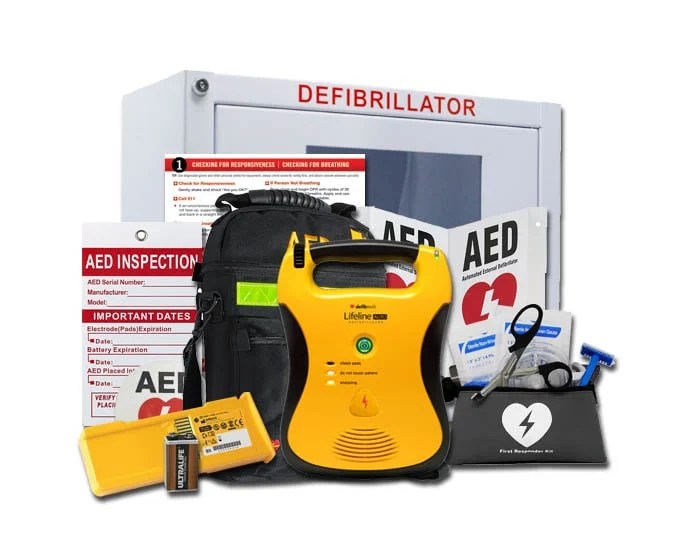
While the Cardiac Science Powerheart G5 is an excellent choice for many, Response Ready offers a carefully curated selection of FDA approved devices to fit diverse needs and budgets. We provide AED value packages that include everything you need to get started, from the AED unit itself to essential accessories like replacement pads and batteries, often bundled with cabinets and signage.
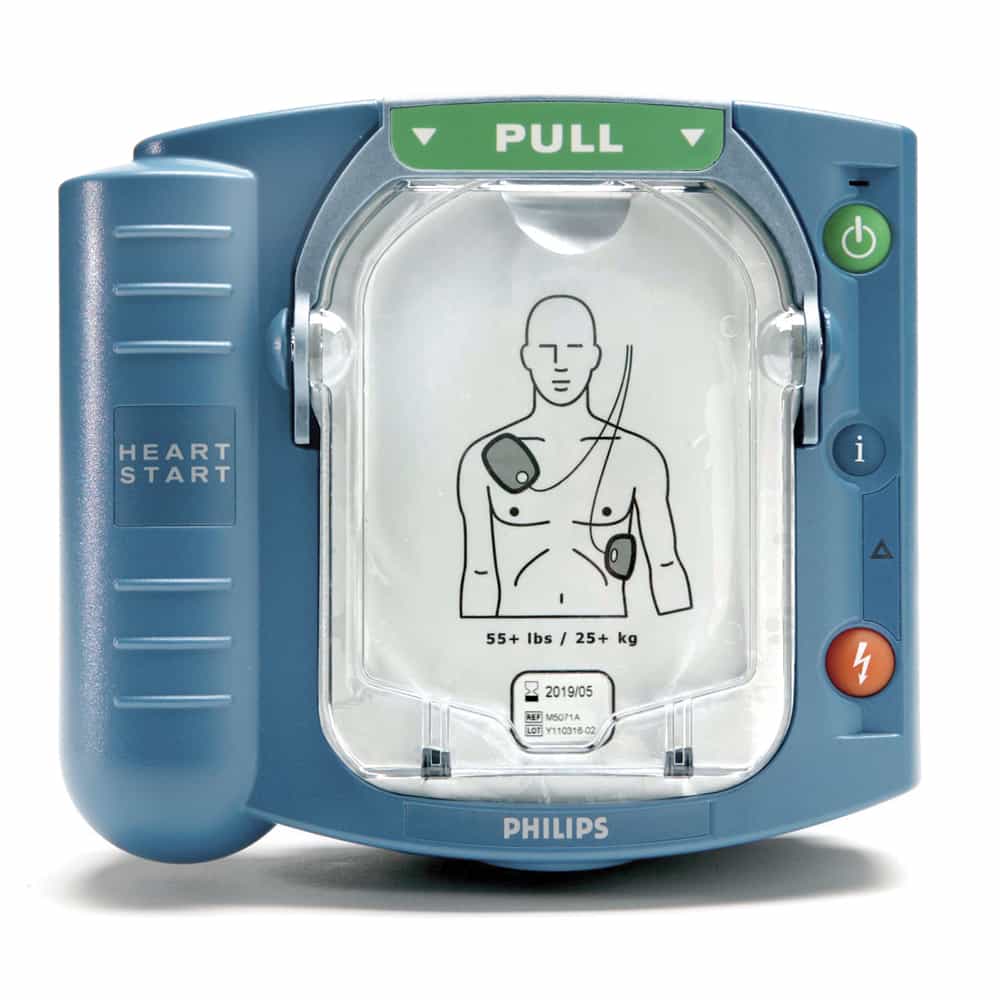
Whether you’re interested in compact, user-friendly models from Philips or HeartSine, or rugged units from Defibtech or ZOLL, you can find the ideal solution to fit your space, budget, and skill level. Our full range of AEDs are available with clear, upfront pricing and expert recommendations.
Maintaining your AED program
Acquiring an AED is the first step, maintaining it is equally crucial. Response Ready provides comprehensive support to ensure your device is always ready. Our AED program management services, including the convenient Response Ready App, automate monthly readiness checks and compliance reminders. Users consistently highlight the app’s convenience and effectiveness, noting how easy it makes managing AED programs across different locations.
We also offer a menu of accessible CPR and AED training courses, available in person. These programs ensure everyday consumers can confidently maintain and use their devices without navigating complex regulatory requirements.
Our commitment to your safety extends far beyond the sale. We’re here to be your trusted partner every step of the way. If you have any questions or need personalized guidance, our experts are available via live chat, email, or phone.
Frequently asked questions
Q: Do most organizations need an AED with ECG monitoring?
A: No. Most organizations, especially small businesses, schools, and community centers, do not need an AED with ECG monitoring. These devices are primarily beneficial for environments with highly trained medical professionals who can interpret the ECG waveform for advanced clinical decision making. For lay responders, a simpler AED with clear instructions and strong CPR feedback is more effective.
Q: Is an ECG AED harder for a layperson to use?
A: While the core function of delivering a shock remains guided by the AED’s voice prompts, an ECG display can introduce confusion or distraction for a layperson who cannot interpret the complex heart rhythms. Simpler AEDs are designed to be intuitive and direct, minimizing hesitation during a crisis.
Q: What is the main benefit of an AED like the Cardiac Science Powerheart G5 for public use?
A: The main benefit is its intuitive design combined with crucial real time CPR feedback. This empowers lay responders by guiding them through effective chest compressions and defibrillation steps without the need for advanced medical interpretation, making it a highly effective and user friendly solution for public access.
Q: Do I need a prescription to buy an AED?
A: Yes, all AEDs in the United States are Class III medical devices and require a physician’s prescription. Response Ready can assist you with this requirement, often including medical oversight as part of our comprehensive AED program management services.
Q: How often do AED pads and batteries need to be replaced?
A: AED pads typically have a shelf life of two to five years and batteries four to seven years, depending on the model. It’s crucial to regularly check the expiration dates and monitor your device’s readiness indicator. Response Ready offers automated reminders through our program management app to help ensure your consumables are always current. You can find replacement pads and batteries on our website.
Disclaimer for information purposes only:
The information provided on this website is intended for general educational and informational purposes only. It is not medical advice and should not be used as a substitute for professional diagnosis, treatment, or care. Always consult a qualified healthcare or medical professional regarding any health-related questions or concerns.
While we strive to ensure the information shared is accurate and up to date, no guarantees are made regarding completeness, accuracy, or applicability to any individual situation. Use of this content is at the reader’s sole discretion and risk.
This website is part of the Response Ready family of emergency preparedness and training resources, including CPR & first aid training and compliance services, AED sales and program support, AED program management software, and medical oversight solutions provided through our affiliated platforms:
• CPR1.com
• AEDLeader.com
• AEDTotalSolution.com
• MDSIMedical.com
By accessing or using this website, you agree to release, indemnify, and hold harmless the website owners, authors, contributors, and affiliated entities from any claims, losses, damages, or liabilities arising from the use or reliance on the information presented.