- Published
- April 28, 2026
The best AED for Schools and Outdoor Events: Defibtech Lifeline View


Why the Defibtech Lifeline View is the right AED for schools and outdoor events
When you’re responsible for safety in a dynamic environment like a school, community center, or outdoor event, you need more than just an AED. You need the absolute certainty that your device will perform flawlessly in the face of chaos, whether that’s a sudden downpour on the sports field, a dusty equipment closet, or an accidental drop in a crowded hallway. This is where the Defibtech Lifeline View AED proves it is not just another defibrillator but a purpose built tool for unpredictable settings.
Many AEDs claim to be durable, but the Lifeline View was engineered from the ground up to withstand the specific challenges of high traffic, real world use. If you’re evaluating options and wondering if this device is truly tough enough for your needs, this guide will walk you through the evidence that makes it the clear choice for protecting your community.
The high stakes in busy environments
Sudden Cardiac Arrest (SCA) can happen to anyone, anywhere, at any time. In the United States, between 7,000 and 23,000 young people under 18 experience SCA outside of a hospital each year, with a significant portion of these events happening during sports activities. The reality is that schools and public venues are places where the risk, however small, is always present.
When SCA occurs, every second is critical. The chance of survival decreases by 7 to 10 percent for every minute that passes without defibrillation. However, when an AED is used by a bystander, survival rates can jump from a mere 9 percent to an incredible 93 percent. This statistic highlights a crucial point: having an AED is important, but having one that is guaranteed to work in less than ideal conditions is what truly saves lives.
What makes the Lifeline View uniquely durable
The Defibtech Lifeline View AED stands apart because its ruggedness isn’t an afterthought. It’s built into its core design, backed by some of the highest durability ratings in the industry. Let’s break down what these features mean for your school or event.
Drop and shock resistance
The Lifeline View meets military standards for shock and vibration testing. This means it’s built to survive being dropped from a gurney, knocked off a desk during a chaotic emergency response, or jostled during transport across a bumpy field. For a school nurse running to an incident on the playground or a volunteer at an outdoor festival, this provides invaluable peace of mind.
Crush resistance
This device is designed to withstand up to 1,000 pounds of force. In a busy gym, crowded hallway, or packed storage area, equipment can get bumped, shifted, or compressed. The Lifeline View’s reinforced design ensures its internal components are protected from the kind of accidental impact that could disable a less robust device.
IP55 rating for water and dust protection
The Ingress Protection (IP) rating is a critical indicator of an AED’s environmental resilience. The Lifeline View’s IP55 rating offers a high level of defense against two common threats in public spaces.
The first digit ‘5’ signifies strong protection against dust. This is essential for AEDs stored in school gymnasiums with chalk dust, maintenance areas, or deployed at outdoor events on dirt fields where airborne particles could compromise sensitive electronics.
The second digit ‘5’ indicates protection against low pressure water jets from any direction. This goes far beyond simple splash resistance. It means the Lifeline View can handle exposure to rain, lawn sprinklers, or an accidental spill from a water bottle in the cafeteria without failing.
Real world scenarios where the Lifeline View excels
Technical specifications are important, but seeing how they apply to your specific environment is what builds confidence.
Imagine a championship soccer game on a school field when a sudden rainstorm begins. A spectator collapses from SCA. An emergency responder grabs the Defibtech Lifeline View AED and runs through the rain. Its IP55 rating ensures the water won’t compromise its function, allowing for immediate, life saving intervention.
Consider a busy school carnival in the gymnasium. The AED is stored in a wall cabinet that gets bumped hard by a rolling equipment cart. Later, a teacher needs to use it. Because of its superior crush and drop resistance, the device powers on and functions perfectly, ready to deliver a shock.
These aren’t extreme edge cases, they are the realities of managing safety in public spaces. The Lifeline View is engineered for these moments, ensuring it is always ready to perform.
More than just toughness a complete solution
While its durability is a major differentiator, the Lifeline View offers a full suite of features designed for bystander rescue in stressful situations.
Its bright, full color video screen provides clear, step by step instructions that supplement the voice prompts, making it exceptionally easy to use in noisy environments where audio might be hard to hear. This visual guidance for everything from pad placement to performing CPR is invaluable for an untrained responder.
Furthermore, managing your AED program is simple. The device performs daily self tests to ensure it’s ready, and you can easily track maintenance needs using tools like the Response Ready App. Because schools and community centers often have children present, the Lifeline View is also fully capable of pediatric rescue with the simple addition of child specific pads.
When you choose the Defibtech Lifeline View, you are not just buying a durable product, you are investing in a complete and reliable safety solution. For environments where you can’t afford to take chances, its proven ruggedness provides the assurance you need.
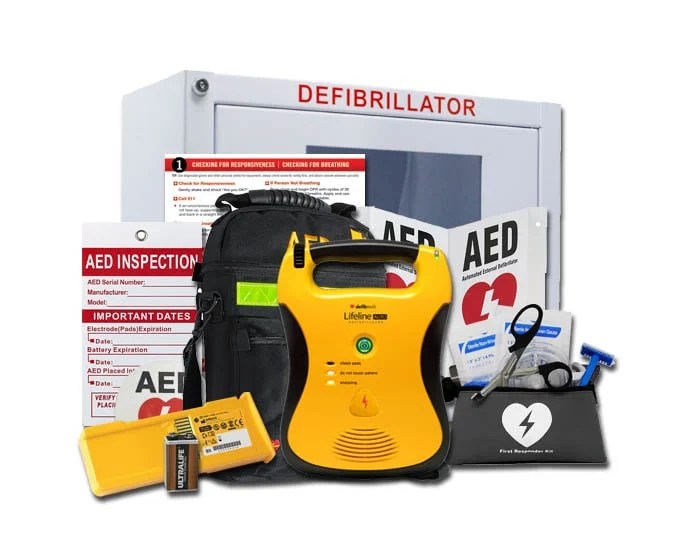
Ready to equip your facility with an AED built for the real world? You can find the best device for your needs in our AED superstore or explore our Defibtech Lifeline View AED value package for a comprehensive solution.
Frequently asked questions
Q: How does the Lifeline View’s IP55 rating compare to other AEDs?
A: The IP55 rating is one of the highest available for public access AEDs. While many devices offer protection against dust and dripping water (like IP21 or IP24), the Lifeline View’s rating signifies protection against direct, low pressure water jets from any angle, making it far more suitable for outdoor use and challenging indoor conditions.
Q: Is the video screen durable enough for rough handling?
A: Yes. The entire unit, including the screen, is built within a highly durable, rubberized housing designed to meet military standards for shock and drop testing. The rugged construction protects all internal components from the impacts common in active environments.
Q: Do we need special training to use the Lifeline View AED?
A: While we strongly recommend formal CPR and AED training for anyone who might be a responder, the Lifeline View is specifically designed for use by bystanders with no prior experience. Its clear voice prompts and full color video instructions guide the user through every step of the rescue process.
Q: What accessories are essential for deploying a Lifeline View in a school or at an outdoor event?
A: For maximum readiness, we recommend a sturdy carrying case for portability and protection, a set of pediatric pads for potential use on children, and a visible, alarmed wall cabinet to ensure the device is secure yet easily accessible.
Disclaimer for information purposes only:
The information provided on this website is intended for general educational and informational purposes only. It is not medical advice and should not be used as a substitute for professional diagnosis, treatment, or care. Always consult a qualified healthcare or medical professional regarding any health-related questions or concerns.
While we strive to ensure the information shared is accurate and up to date, no guarantees are made regarding completeness, accuracy, or applicability to any individual situation. Use of this content is at the reader’s sole discretion and risk.
This website is part of the Response Ready family of emergency preparedness and training resources, including CPR & first aid training and compliance services, AED sales and program support, AED program management software, and medical oversight solutions provided through our affiliated platforms:
• CPR1.com
• AEDLeader.com
• AEDTotalSolution.com
• MDSIMedical.com
By accessing or using this website, you agree to release, indemnify, and hold harmless the website owners, authors, contributors, and affiliated entities from any claims, losses, damages, or liabilities arising from the use or reliance on the information presented.